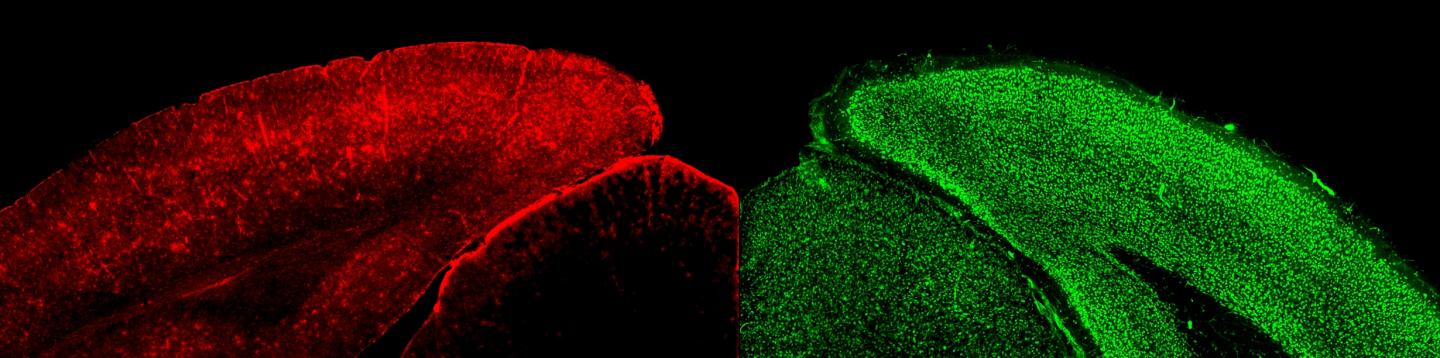
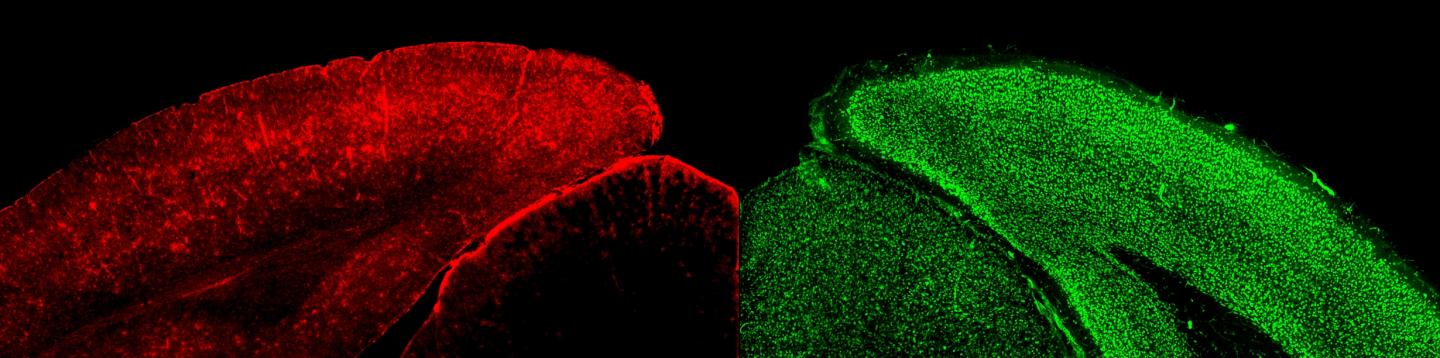
Credit: Rodrigo Garcia/Picower Institute for Learning and Memory
Neurons are the star of the show in brain science, but they don't work alone to process information. In new research funded by a $1.9 million grant from the National Institutes of Health, a team at MIT's Picower Institute for Learning and Memory aims to discover the likely crucial role of the supporting cast member with a stellar-sounding name: the astrocyte. The work could ultimately provide insight into many brain disorders.
Astrocytes are at least as abundant in the brain as neurons but because they don't "spike" with electrical impulses like neurons do, they've essentially been "invisible" in studies of how brain circuits process information, said Mriganka Sur, Newton Professor of Neuroscience in the Department of Brain and Cognitive Sciences and director of the Simons Center for the Social Brain at MIT. Astrocytes have instead been appreciated mostly for shuttling various molecules and ions around to keep the brain's biochemistry balanced and functioning.
While they don't spike, astrocytes do signal their activity with increases of calcium. A decade ago in Science , Sur and colleagues used that insight to discover that astrocyte activity in the visual cortex, the part of the brain that processes vision, matched in lock-step with the activity of neurons in response to visual stimuli. That suggested that astrocytes make a vital contribution to vision processing. In the new study , Sur's lab will investigate exactly what astrocytes are doing, for instance to regulate the formation of neural connections called synapses, how the calcium activity arises, and what difference that activity makes. They'll look not only during the course of normal vision, but also during the critical period early in life when vision is first developing.
Using sophisticated and precise imaging tools, Sur's team will monitor astrocyte and neuron activity in the visual cortex as mice see different stimuli. They'll also use genetic and pharmaceutical tools to manipulate astrocyte activity. A key mechanism that's likely involved, Sur said, is the way astrocytes deploy a molecule called GLT1 to regulate the level and time course of the neurotransmitter glutamate. Glutamate is vital because it mediates communication between neurons across synapses. By systematically manipulating the GLT1 activity of astrocytes in the visual cortex and measuring the effects, Sur said, the team will be able to determine how astrocytes contribute to the performance and formation of neural circuits.
"Just as neurons have their spiking code, we think there is an astrocyte calcium code that reflects and works in partnership with neurons," Sur said. "That's totally underappreciated but very important."
The results will matter for more than just vision, Sur said. The visual cortex is a perfect model system in which to work, he said, but astrocytes are also believed to be important, if poorly understood, in disorders as wide-ranging as Alzheimer's disease and developmental disorders such as schizophrenia and autism,.
"Astrocytes are emerging as a major player because disorders of brain development have genetic origins," Sur said. "Genes expressed in astrocytes are emerging as very important risk factors for autism and schizophrenia."
The new grant from the National Eye Institute (grant number R01EY028219 ) lasts for four years.
###
Media Contact
David Orenstein
[email protected]
617-324-2079
@PicowerMIT
http://picower.mit.edu
Original Source
http://picower.mit.edu/new-grant-mit-neuroscientists-will-give-invisible-cells-new-look