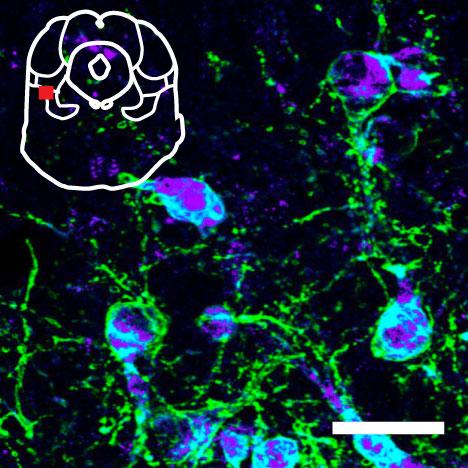
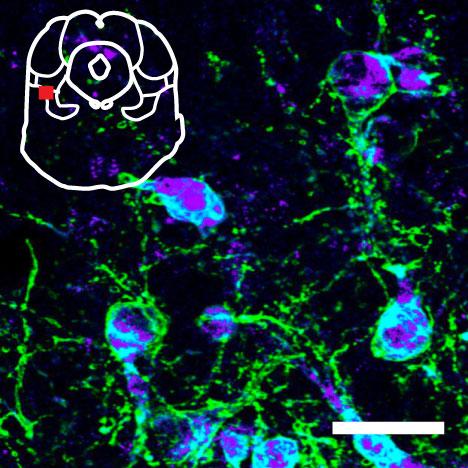
IMAGE: These are neurons in the brainstem involved in walking are lit up using optogenetics. [Roseberry et al., Cell]
Credit: Tom Roseberry, Gladstone Institutes
Two secrets of one of the brain's most enigmatic regions have finally been revealed. In a pair of new studies, scientists from the Gladstone Institutes have discovered a specific neural circuit that controls walking, and they found that input to this circuit is disrupted in Parkinson's disease.
Walking becomes a major challenge for people afflicted by Parkinson's disease. Parkinson's is caused by a depletion of dopamine–an important neurochemical–in the basal ganglia (BG), a brain region involved in fundamental behaviors like movement, learning, reward, and motivation. In Parkinson's, an imbalance arises between two pathways in the BG: the direct or "go" pathway and the indirect or "stop" pathway. Ordinarily, these pathways work together seamlessly to control locomotion, but in Parkinson's the stop pathway overpowers the go pathway, making it difficult to initiate movement. How the imbalance between these two pathways developed remained a mystery–until now.
Correcting an Imbalance in the Brain
Published in Neuron, scientists led by Gladstone associate investigator Anatol Kreitzer, PhD, discovered that dopamine depletion causes a miscommunication between the BG and another region called the thalamus, an area thought to relay sensory information to the brain. This miscommunication results in a loss of input to the go pathway from the thalamus, which consequently disrupts movement. Blocking the connection between the two regions reversed the imbalance between the stop and go pathways and restored normal behavior in a mouse model of Parkinson's.
"This study provides strong evidence for a mechanism by which the stop pathway overcomes the go pathway in Parkinson's disease," says first author Philip Parker, PhD, a former graduate student in Dr. Kreitzer's lab at the Gladstone Institutes and the University of California, San Francisco (UCSF). "Our findings implicate the thalamus in the development of the disease, an area of the brain that has received relatively little attention in Parkinson's research."
"Several studies have targeted the thalamus with deep brain stimulation to treat Parkinson's, but the region's role in the disease was not well established," adds Dr. Kreitzer, who is also an associate professor of physiology and neurology at UCSF. "Our findings finally provide a clear picture of how the thalamus can imbalance neural circuits and suppress movement in this condition."
Discovering How the Brain Controls Walking
In the second study, published in Cell, the scientists discovered that the go and stop pathways from the BG control locomotion by regulating a group of nerve cells in the brainstem that connects the brain to the spinal cord. The researchers revealed that the go pathway selectively activates a type of neuron in the brainstem that releases the neurochemical glutamate, and these neurons are responsible for triggering locomotion.
The scientists used optogenetics–an innovative research tool that uses light to activate or inhibit select cells in the brain–to stimulate either the go or the stop pathway in mice that were running on a tiny treadmill, while recording neural activity in the brainstem. They discovered that the go pathway selectively activated glutamate neurons, causing the mice to move, whereas the stop pathway inhibited these neurons and made the mice stop.
"This is the first time we have been able to demonstrate how the go and stop pathways regulate locomotion," says Tom Roseberry, a graduate student in the lab of Dr. Kreitzer. "We show a very precise connection from the basal ganglia to the brainstem that controls movement."
Remarkably, the researchers discovered that the brainstem neurons can overpower the signals from the BG–that is, if glutamate neurons were turned on, the animal moved even if the stop pathway is activated.
"In order to understand why walking is particularly disrupted in Parkinson's disease, we need to map out the circuitry that controls locomotion," says Dr. Kreitzer. "Our study shows that a specific set of neurons in the brainstem are both necessary and sufficient to initiate locomotion. This finding could open the door for new treatment targets to help Parkinson's patients walk more easily."
###
Other Gladstone scientists on the study include Moses Lee, who was a co-first author on the Cell paper, and Arnaud Lalive. Linda Wilbrecht from UC Berkeley and Antonello Bonci from Johns Hopkins University also took part in the research. Funding was provided by the National Institute of Neurological Disorders and Stroke, National Institute on Drug Abuse, National Institute of General Medical Sciences, National Center for Research Resources, Swiss National Science Foundations, and the State of California.
About the Gladstone Institutes
To ensure our work does the greatest good, the Gladstone Institutes focuses on conditions with profound medical, economic, and social impact–unsolved diseases of the brain, the heart, and the immune system. Affiliated with the University of California, San Francisco, Gladstone is an independent, nonprofit life science research organization that uses visionary science and technology to overcome disease.
Media Contact
Dana Smith
[email protected]
415-734-2532
http://www.gladstone.ucsf.edu