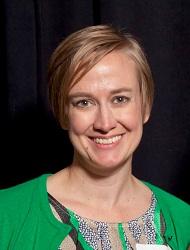
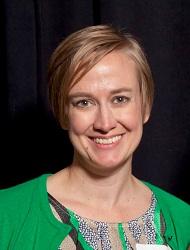
IMAGE: Nancy Cheak-Zamora said caregivers should start talking to their children with autism early about their plans for the future.
Credit: MU News Bureau
COLUMBIA, Mo. – As the number of children diagnosed with autism spectrum disorders continues to rise, medical professionals have emphasized early diagnosis, intervention and treatment. However, less attention has been given to children with autism once they reach their teen years and adulthood. Now, one University of Missouri researcher is working to find ways to support teens with autism and their caregivers so the teens can transition into adulthood successfully and independently.
"We need to focus our efforts on addressing the needs of young adults with autism in a much bigger and broader way," said Nancy Cheak-Zamora, an assistant professor in the MU School of Health Professions and a researcher at the MU Thompson Center for Autism and Neurodevelopmental Disorders. "As health care providers, we cannot only help them take care of their health care needs; we also need to assure they're connected to resources necessary to live independently and succeed in employment and education."
Cheak-Zamora and her colleagues conducted two focus groups with youth with autism and two focus groups with the teens' caregivers to explore the teens' experiences transitioning into adulthood and their plans for the future. Specifically, the researchers wanted to know the teens' and caregivers' needs, beyond health care. The researchers found both teens with autism and their caregivers felt fearful and anxious about the teens becoming adults; caregivers also reported lacking social, educational and vocational resources to help their children prepare for their futures. The caregivers said they were struggling to fill those gaps in resources themselves.
"Some parents get apartments for their young adults and then maintain two households," Cheak-Zamora said. "The mom, in most cases, is taking care of her house and her young adult's home. It's wonderful that the adult with autism is getting independence, but it can be unbelievably burdensome for the family and the parents."
Caregivers should start talking to their children with autism early about their plans for their future, Cheak-Zamora said.
"A lot of the young adults in our study told us about their goals for their future, but few had ever communicated these goals to their caregivers," Cheak-Zamora said. "Our young adults with autism really want to be able to socialize and succeed in higher education, but sometimes they don't know how to go about doing that. Caregivers need to start saying to their children at the age of 12 or 13, 'What do you want to do? We've got 5 years, so let's make a plan.' They can even do that in the doctor's office and with a school counselor."
Cheak-Zamora said finding ways to facilitate independence for the young adults with autism is important, and it doesn't have to be expensive. However, it does take some creativity and help from others, she said.
"Care coordination should be in the health care setting, and this is a part of the medical home model — making sure that the family isn't just meeting with the doctor for 15 minutes — that somebody else is following up with them to again think about what resources and unmet needs they have and how to connect them with resources. It would also be an opportunity for the family to feel supported."
###
The Journal of Applied Research in Intellectual Disabilities published the study, "'Transitions are Scary for our Kids, and They're Scary for us': Family Member and Youth Perspectives on the Challenges of Transitioning to Adulthood with Autism." Co-authors from the University of Missouri include Michelle Teti, an assistant professor in the Department of Health Sciences in the School of Health Professions and Jennifer First, from the School of Social Work in the College of Human Environmental Sciences. Cheak-Zamora recently received Young Professional Award from the American Public Health Association for her significant contributions to the field of maternal and child health. Cheak-Zamora currently is working on a project, "Improving Healthcare Transition Planning and Health-Related Independence for Youth with ASD and Their Families," funded by the U.S. Department of Defense.
Media Contact
Sheena Rice
[email protected]
573-882-8353
@mizzounews
http://www.missouri.edu