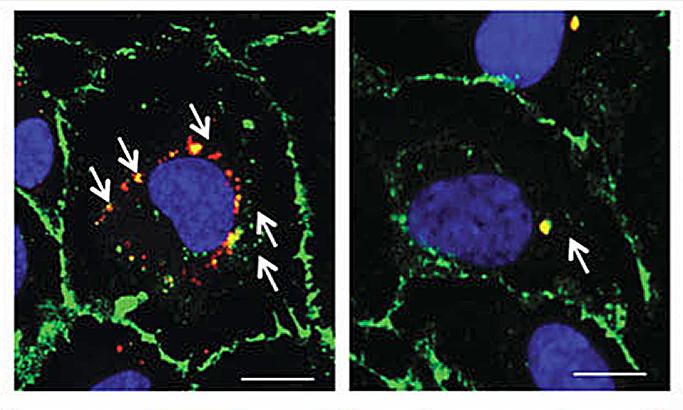
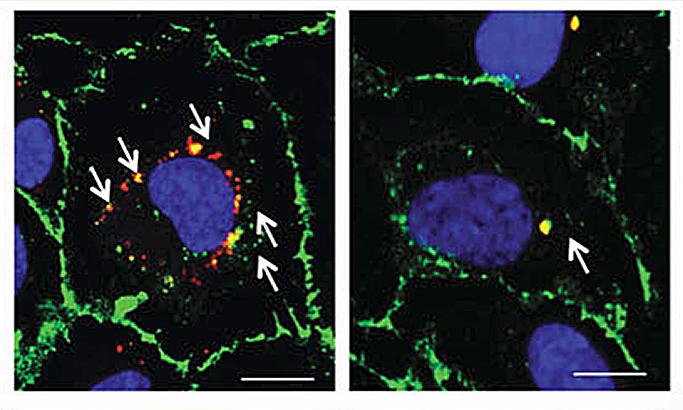
IMAGE: Arrows indicate that more CD59 is drawn into the cell in people with sleep apnea who are not taking statins (left); whereas more CD59 remains on the cell surface in…
Credit: Lab of Sanja Jelic/Columbia University Medical Center
NEW YORK, NY (Jan. 6, 2016) — A new study conducted at Columbia University Medical Center (CUMC) has revealed some of the underlying mechanisms that may increase the risk of heart disease in people with sleep apnea. The study also found that statins — the cholesterol-lowering medications commonly prescribed to combat heart disease — may help reverse this process.
The study was published in the Jan. 6, 2016 online edition of Science Translational Medicine.
More than 18 million adults have obstructive sleep apnea, in which relaxation of muscles in the throat during sleep causes frequent interruptions in breathing. The condition disrupts sleep and causes fluctuations in oxygen levels, which can lead to excessive daytime sleepiness and difficulty concentrating. In addition, sleep apnea triples the risk for developing heart disease, including hypertension, and ischemic stroke.
"It has been well documented that sleep apnea is a powerful and independent risk factor for heart disease, but the underlying reason for this has remained unclear," said Sanja Jelic, MD, associate professor of medicine at CUMC. "The aim of our study was to understand the mechanisms by which sleep apnea may lead to heart disease in an effort to reduce the risk."
The study included 128 people who underwent sleep studies at CUMC's Sleep Disorders Center, including 76 people who were diagnosed with obstructive sleep apnea and 52 people who did not meet the criteria for this condition. The researchers analyzed cells that line blood vessel walls (obtained from the participants' arm veins) to look for differences that may explain the increased risk for heart disease in people with sleep apnea.
The investigators found that people with sleep apnea had higher levels of a protein called CD59, which inhibits the buildup of inflammatory proteins on cell surfaces. Unexpectedly, however, CD59 was found mainly within the cells of those with sleep apnea, instead of on the cell surface. As a result, the cells of the sleep apnea group had larger deposits of inflammatory proteins.
"This unexpected finding suggests that repeatedly interrupting oxygen flow during sleep draws CD59 away from the cell surface, where it is better positioned to do its job in protecting cells from inflammation," said Dr. Jelic.
The researchers also noticed that CD59 was preserved on the cell surface in a small subset of subjects with sleep apnea who were being treated with statins, similar to those who did not have sleep apnea. Further testing revealed that cholesterol draws CD59 away from the cell surface in a process known as endocytosis.
"We were surprised to discover that these commonly prescribed drugs appeared to reverse the process that leads to vascular injury, and ultimately heart disease, in people with sleep apnea," said Dr. Jelic. "This striking result provides support for the concept that statins may be considered as a primary prevention strategy for reducing heart disease risk in people with sleep apnea, pending further clinical trials."
###
The paper is titled, 'Increased Internalization of Complement Inhibitor CD59 May Contribute to Endothelial Inflammation in Obstructive Sleep Apnea.'
The study was supported by a grant from the NIH/National Heart, Lung, and Blood Institute (R01HL106041). The researchers declare no financial or other conflicts of interest.
Columbia University Medical Center provides international leadership in basic, preclinical, and clinical research; medical and health sciences education; and patient care. The medical center trains future leaders and includes the dedicated work of many physicians, scientists, public health professionals, dentists, and nurses at the College of Physicians and Surgeons, the Mailman School of Public Health, the College of Dental Medicine, the School of Nursing, the biomedical departments of the Graduate School of Arts and Sciences, and allied research centers and institutions. Columbia University Medical Center is home to the largest medical research enterprise in New York City and State and one of the largest faculty medical practices in the Northeast. For more information, visit cumc.columbia.edu or columbiadoctors.org.
Media Contact
Karin Eskenazi
[email protected]
212-342-0508
@ColumbiaMed
http://www.cumc.columbia.edu