Credit: Katy Robertson
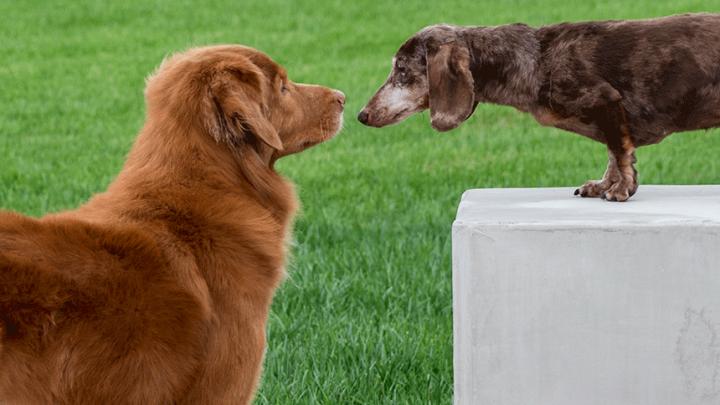
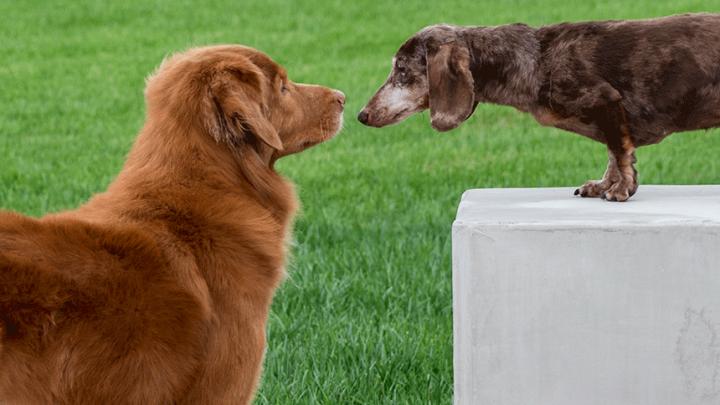
Since the early 1900s, veterinarians have observed intervertebral disc disease — a common cause of back pain, rear limb paralysis and inability to walk — more frequently in dogs with short legs (dachshund, French bulldog, and Pekingese to name a few.) But they couldn't pinpoint why — until now.
This week, University of California, Davis, researchers reveal the discovery of a genetic mutation across breeds that is responsible for chondrodystrophy (the skeletal disorder leading to shorter legs and abnormal intervertebral discs) in a study published in the Proceedings of the National Academy of Sciences.
"Dogs with intervertebral disc disease (IVDD) are 50 times more likely to have this mutation; that's an incredibly strong correlation with disc disease," said Danika Brannasch, a veterinary geneticist and the paper's senior author. "Being able to identify the cause of this painful condition is the first step to alleviating pain and suffering for dogs at greatest risk."
A dog lover and breeder of Nova Scotia duck tolling retrievers, Bannasch has long been fascinated by the makes and shapes of canines. As a geneticist, she is driven to understand what creates those physical characteristics. Her colleague, UC Davis veterinary neurologist Pete Dickinson, has witnessed all too often the correlation of unique shapes and debilitating disease in the neurology clinic.
"IVDD is the most common neurological condition we deal with in the clinic," Dickinson said. "It's the herniation of those abnormal discs that can lead to paralysis in the worst cases."
Treatment can be quite costly and prohibitive for some.
"The disease cost our clients approximately $1.7 million last year on cases that were severe enough to lead to surgery," Dickinson said. "In addition to the pain and discomfort it causes our patients, it takes an enormous financial and emotional toll on owners."
GENETIC SEARCH BEGAN WITH SHORT-LEGGED BREEDS
Bannasch started her genetic search with the toller breed, some of whom also have shorter legs. Her laboratory found a genomewide region of significance on chromosome 12 that appeared linked to abnormal long bone growth. When the group looked for other breeds that shared the DNA sequence in this region, they found that it was in the chondrodystrophic breeds such as beagles, dachshunds and spaniels.
Thanks to an extensive biorepository amassed at the UC Davis veterinary hospital over the past 15 years, Bannasch and her team were able to look at the DNA from cases with IVDD from a variety of dog breeds, which showed the same region was implicated. The hunt for the actual mutation took lots of hard work from DVM/Ph.D. student Emily Brown, who completed her doctoral thesis using this project. At first, the results weren't revealing. It took meticulous combing through the genetic sequence by eye to detect the presence of an FGR4 retrogene insertion. Once Bannasch realized what they had uncovered, she went screaming down the hall with excitement.
"It was kind of like looking for a needle in a haystack," she said. "But I knew it was there somewhere."
The FGF4 retrogene is an important molecule involved in development. When its receptor FGF3R is mutated, it can also lead to dwarfism in humans.
DISCOVERY COULD HELP REDUCE RISK OF DISC DISEASE
"There's a lot of literature that points to chondrodystrophy in dogs as an exciting animal model for degenerative disc disease in people," said Bannasch, who also holds the Maxine Adler Endowed Chair in Genetics. "Now that we know more about why it's occurring, it might make it a better animal model."
Being able to identify dogs with this genetic susceptibility could provide a valuable tool for owners, breeders and veterinarians for mitigating the risk of intervertebral disc herniation and resulting spinal cord disease.
"I am a geneticist but I am also a veterinarian and having the ability to eliminate a disease as painful and debilitating as IVDD is the most satisfying result of my scientific career," Bannasch said. "This is what research is all about — reducing pain and suffering in animals."
"What we need to know now is the prevalence of this retrogene in all of these breeds," Dickinson said. "Without that, it's difficult to establish how to start breeding the condition out. We need as much information as possible to make a plan and help improve the well-being for dogs who suffer from this condition."
###
Additional UC Davis authors on the paper include Emily Brown (a DVM student who recently completed her Ph.D. in the Veterinary Scientist Training Program), Tamer Mansour, Beverly Sturges, Miriam Aguilar, Amy Young (UC Davis Genome Center), Courtney Korff, Jenna Lind, Cassandra Ettinger (Department of Animal Science), Samuel Varon (2017 DVM graduate), Rachel Pollard, and C. Titus Brown. Terje Raudsepp of Texas A&M University also contributed to the paper.
This study was funded by generous donors to the Center for Companion Animal Health at UC Davis, funds from the Maxine Adler Endowed Chair, the National Institutes of Health and a UC Davis Signature Research Genomics grant.
Media Contact
Trina Wood
[email protected]
530-752-5257
@ucdavisnews
http://www.ucdavis.edu