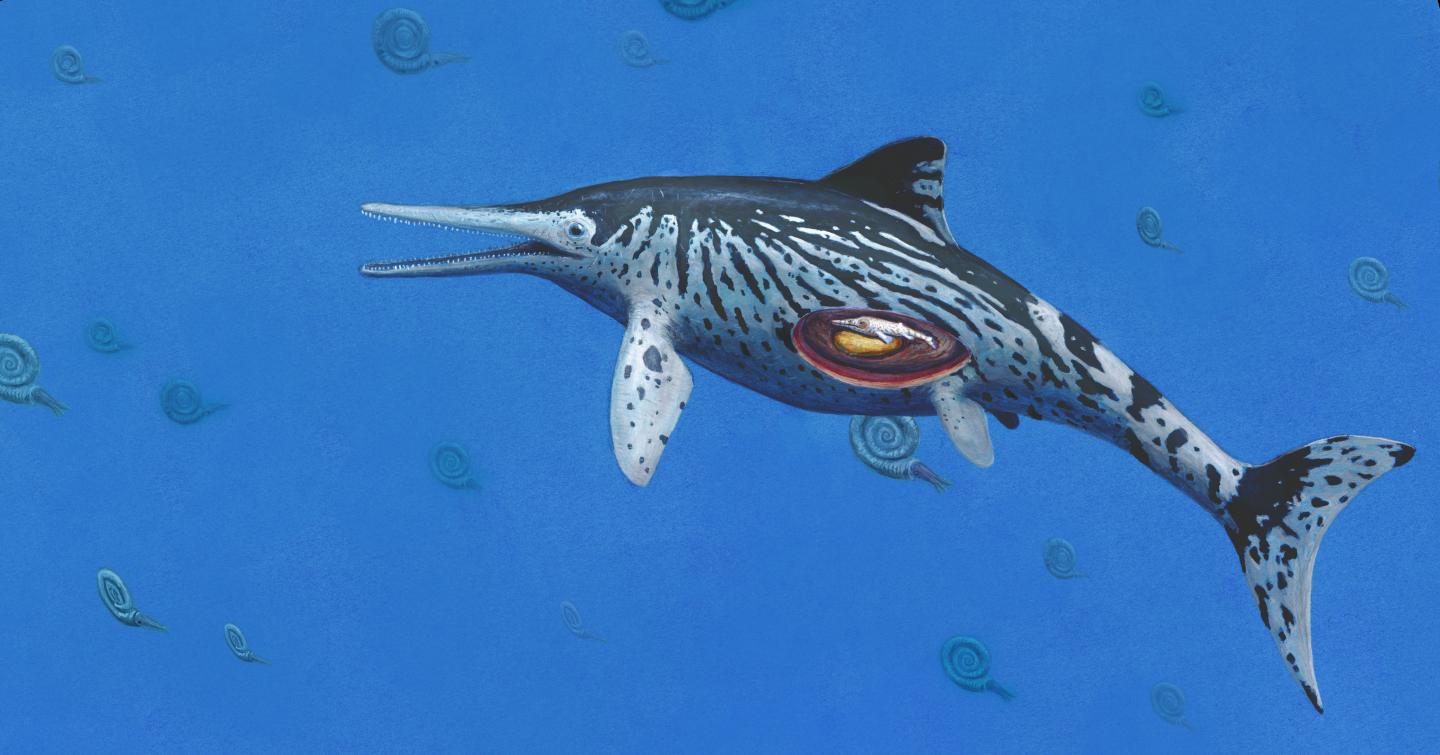
Credit: copyright of Joschua Knüppe.
Scientists from the UK and Germany have discovered the largest Ichthyosaurus on record and found it was pregnant at the time of death.
The new specimen is estimated to be between 3 and 3.5 m long and is an adult female. Ichthyosaurs were a highly successful group of sea-going reptiles that became extinct about 90 million years ago. Often misidentified as swimming dinosaurs, these reptiles appeared before the first dinosaurs had evolved. The largest species of ichthyosaur grew to over 20 m in length.
The new specimen was originally discovered on the Somerset coast, during the mid-1990s, and is from the Early Jurassic, roughly 200 million years old. However, the specimen remained unstudied until it wound up in the collections of the Lower Saxony State Museum in Hannover, Germany.
Palaeontologist Sven Sachs of the Bielefeld Natural History Museum (Germany) first saw the specimen in August 2016, whilst on a routine visit. He informed University of Manchester palaeontologist and ichthyosaur expert, Dean Lomax, and together, the pair examined the new specimen in early 2017. They identified it as an example of an Ichthyosaurus somersetensis, a new species that Dean and another colleague, Prof. Judy Massare, had previously identified.
Dean said "It amazes me that specimens such as this [the biggest] can still be 'rediscovered' in museum collections. You don't necessarily have to go out in the field to make a new discovery. This specimen provides new insights into the size range of the species, but also records only the third example of an Ichthyosaurus known with an embryo. That's special"
The embryo is incomplete and preserves only a portion of the back bone, a forefin, ribs and a few other bones. The preserved string of vertebrae is less than 7 cm long. The bones of the embryo are not fully ossified, meaning that the embryo was still developing.
Another intriguing discovery the duo made was that the tail of this new specimen did not belong with the rest of the skeleton. A tail from another ichthyosaur had been added to the skeleton to make it appear more complete and visually appealing for display.
Sven added "It is often important to examine fossils with a very critical eye. Sometimes, as in this instance, specimens aren't exactly what they appear to be. However, it was not 'put together' to represent a fake, but simply for a better display specimen. But, if 'fake' portions remain undetected then scientists can fall foul to this, which results in false information presented in the published record.
"Specimens like this provide palaeontologists with important information about when these animals lived. Many examples of Ichthyosaurus are from historical collections and most do not have good geographical or geological records, but this specimen has it all. It may help to date other ichthyosaur fossils that currently have no information."
Ichthyosaurus is one of the most common fossil reptiles in the UK, with thousands of specimens known, ranging from isolated bones to complete skeletons. Some of the very first examples were collected from along the Dorset coast by Victorian palaeontologist, Mary Anning, who first brought them to the attention of the scientific world.
The new study has been published today in the scientific journal, Acta Palaeontologica Polonica.
###
Notes to editors
Dean Lomax is a multiple award-winning palaeontologist, science communicator and author. He has travelled around the world and worked on many fascinating projects from excavating dinosaurs in the American West to discovering new fossil hunting locations and describing new species of extinct marine reptiles in the UK.
An Honorary Scientist at The University of Manchester, Dean is passionate about communicating palaeontology and actively engages with traditional and social media. He has written two books, numerous scientific papers and many popular articles and regularly appears on television, most recently as series advisor and recurring on-screen expert presenter for ITV's Dinosaur Britain. Dean is also the patron of the UK Amateur Fossil Hunters organisation. More here: http://www.deanrlomax.co.uk.
Please reference the article as "Lomax, D. R. and Sachs, S. 2017. On the largest Ichthyosaurus: A new specimen of Ichthyosaurus somersetensis containing an embryo. Acta Palaeontologica Polonica, XXXXXXXXXXXXXXXXXX.
For media interviews with Dean Lomax, please email [email protected] or 0161 275 8257
About The University of Manchester
The University of Manchester, a member of the prestigious Russell Group, is the UK's largest single-site university with 38,600 students and is consistently ranked among the world's elite for graduate employability.
The University is also one of the country's major research institutions, rated fifth in the UK in terms of 'research power' (REF 2014). World class research is carried out across a diverse range of fields including cancer, advanced materials, addressing global inequalities, energy and industrial biotechnology.
No fewer than 25 Nobel laureates have either worked or studied here.
It is the only UK university to have social responsibility among its core strategic objectives, with staff and students alike dedicated to making a positive difference in communities around the world.
Manchester is ranked 35th in the world in the Academic Ranking of World Universities 2016 and 5th in the UK. The University had an annual income of almost £1 billion in 2015/16.
Visit http://www.manchester.ac.uk for further information.
Facts and figures: http://www.manchester.ac.uk/discover/facts-figures/
Research Beacons: http://www.manchester.ac.uk/research/beacons/
News and media contacts: http://www.manchester.ac.uk/discover/news/
Media Contact
Jordan Kenny
[email protected]
01-612-758-257
@UoMNews
http://www.manchester.ac.uk