Credit: Mission X: Train Like an Astronaut
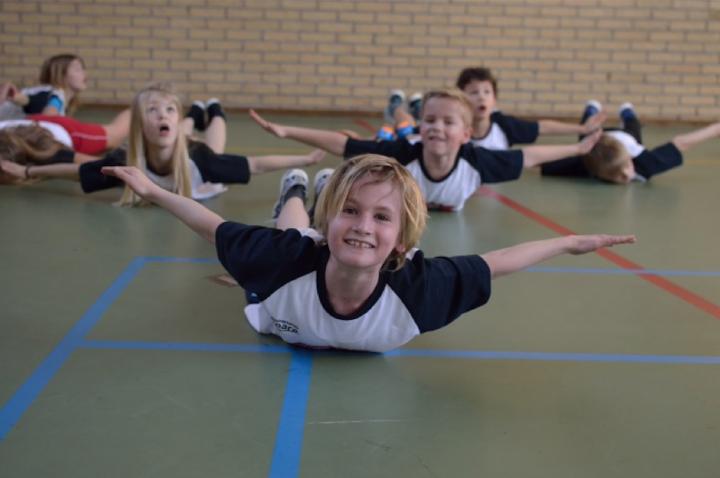
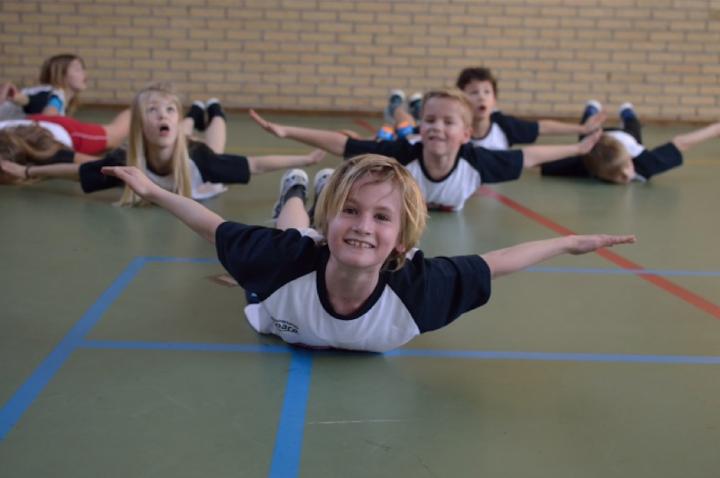
Mission X: Train like an Astronaut, since its inception in 2011, has morphed into an international collaboration of physical fitness challenges. The program is an immersive resource that fosters mind, body and spirit in students all around the globe. It's an education unlike any other that has encouraged tens of thousands of young people to take their pulse for the first time and blast off with straightforward exercises that make fitness fun. Equipped with the training and critical thinking necessary for any real astronaut, these future explorers are now more than ready to embark upon Mission X, taking the torch of spaceflight to even deeper reaches of space.
Through the Mission X: Train Like an Astronaut fitness challenge, space invades the classroom, physically manifesting as elaborate decorations of stars and fields of meteors. As planets and aliens made of paint and plaster hang above, Mission X is brought to life by the teachers who use the project's resources to encourage mental and physical growth.
"The teachers are the real champions," said NASA Human Research Program project contributor Scott Townsend. "It takes one person in a school system to make something happen, and then it takes the support of the person above them."
Mission X began as a local investment in NASA Johnson Space Center's community in its pilot year. The next year, the project reached 12 countries and roughly 4,200 student participants. That number has now skyrocketed to more than 104,000 students in 38 countries and Taiwan in the 2017 challenge. Participants use NASA and the astronaut experience as a roadmap for their own health and fitness achievements.
Mission X, however, is about more than simply physical and nutritional growth. Children are provided with interactive science experiments that demonstrate how comparison and rationale play into drawing conclusions. Teamwork is emphasized, showing what can be accomplished when working together. Students are not only exposed to the present landscape of spaceflight, but also challenged to stand before their classmates and present about the history of NASA, fostering public speaking skills and the presentation of ideas before a group at a very young age.
Mission X also enlists real astronauts on space missions as "ambassadors" to interact with the students. Nearly 50 Mission X ambassadors, such as Kate Rubins from Expedition 48/49, have engaged with students through videos while aboard the International Space Station. They answer questions, participate in Mission X activities and encouraging healthy lifestyles by sharing their own personal journeys.
Nubia Carvajal believes the program's success is partly due to its "international flair."
"Mission X encourages teamwork without borders," Carvajal said. "Mission points are converted into steps, and that is how we get Astro Charlie (the program mascot) moving. It is not about one step or one country, it is about everyone moving."
Both Carvajal and Townsend spent years as public school educators. Carvajal regularly meets with international partners such as ESA (the European Space Agency) to discuss the future of Mission X. Each country has a lead who participates in decisions about the upcoming direction of the project.
With teachers at the helm and more students worldwide to reach, there is indeed a bright future ahead–for NASA and this interactive education portal. The universe is vast; the opportunities for growth are almost as endless. But before you can fly, you must first simply . . . move.
Consider joining the worldwide team at Mission X: Train Like an Astronaut.
###
NASA's Human Research Program (HRP) is dedicated to discovering the best methods and technologies to support safe, productive human space travel. HRP enables space exploration by reducing the risks to human health and performance using ground research facilities, the International Space Station and analog environments. This leads to the development and delivery of a program focused on: human health, performance and habitability standards; countermeasures and risk-mitigation solutions; and advanced habitability and medical-support technologies. HRP supports innovative, scientific human research by funding more than 300 research grants to respected universities, hospitals and NASA centers to over 200 researchers in more than 30 states.
Media Contact
Monica Edwards
[email protected]
281-483-9612
@NASA_Johnson
http://www.nasa.gov/centers/johnson/home
Original Source
https://www.nasa.gov/feature/nasa-encourages-kids-to-train-like-an-astronaut