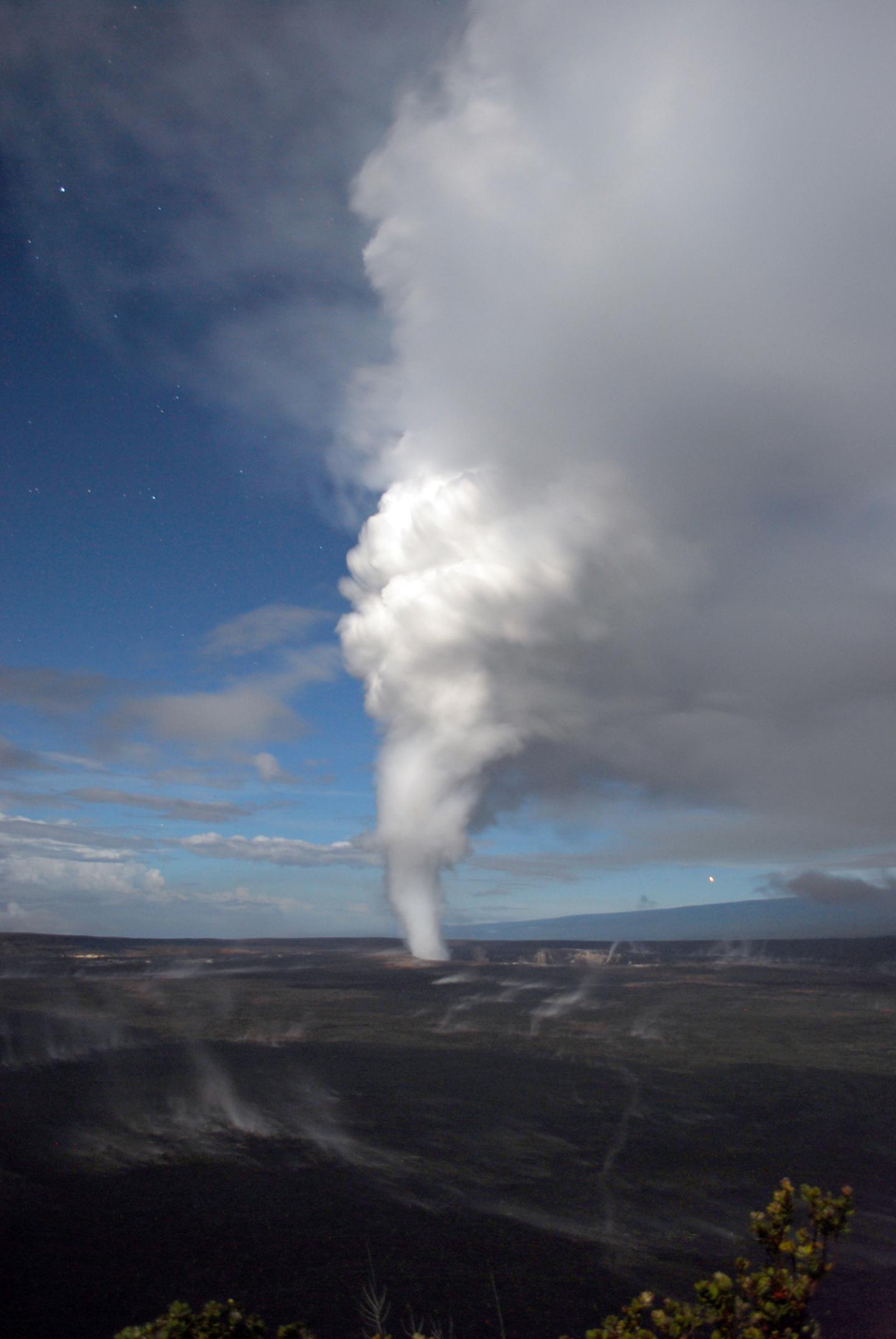
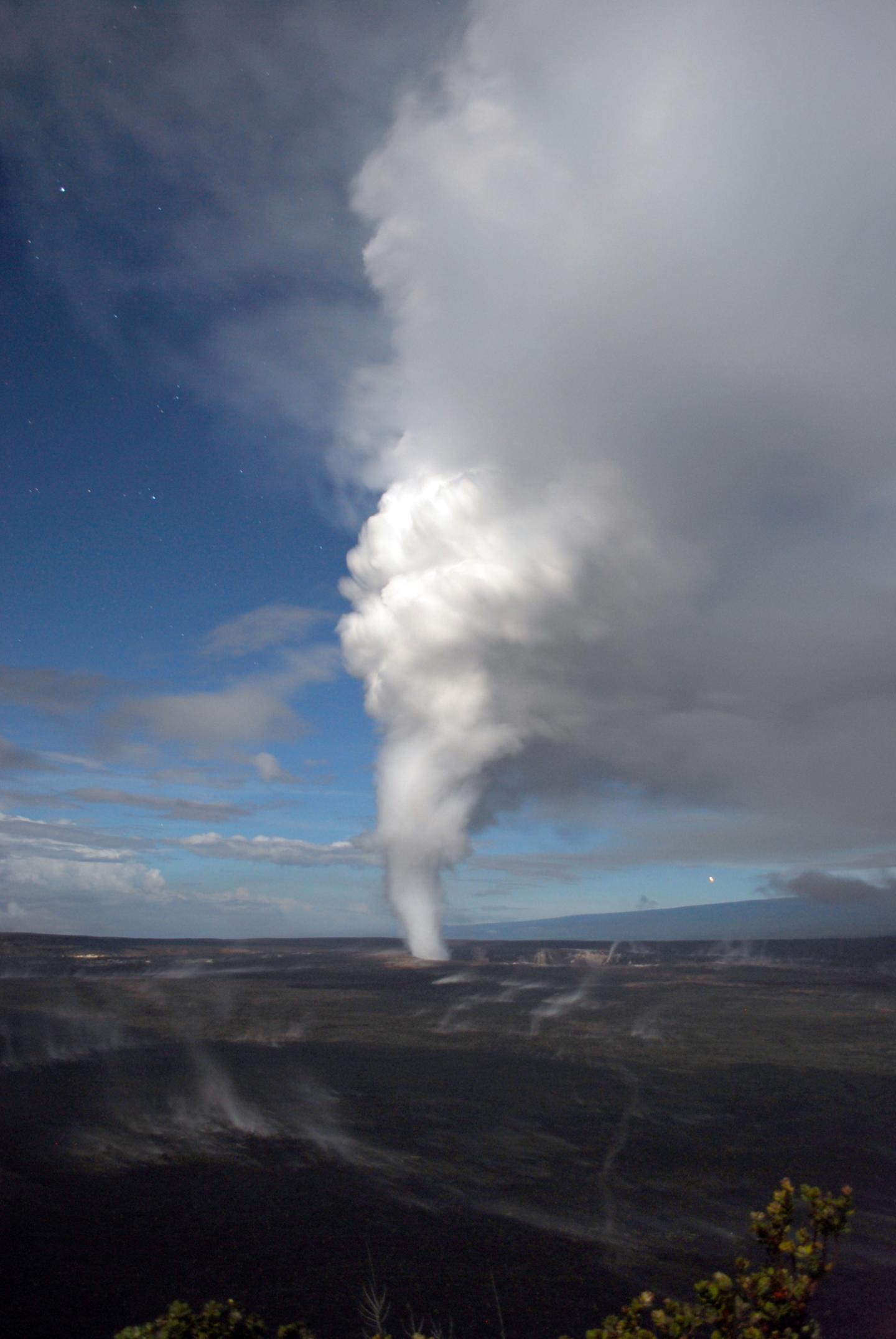
A paper published this month in the Bulletin of the American Meteorological Society details the development and utility of a computer model for the dispersion of volcanic smog or "vog," which forms when volcanic sulfur dioxide gas interacts with water and coverts it to acid sulfate aerosol particles in the atmosphere.
Vog poses a serious threat to the health of Hawai'i's people as well as being harmful to the state's ecosystems and agriculture. Even at low concentrations, which can be found far from the volcano, vog can provoke asthma attacks in those with prior respiratory conditions. It also damages vegetation and crops downwind from the volcano.
Scientists from the UH Mānoa School of Ocean and Earth Science and Technology (SOEST), under the leadership of Dr. Steve Businger, and in collaboration with researchers at the Hawaiian Volcano Observatory, developed a computer model for predicting the dispersion of vog. The vog model uses measurements of the amount of sulfur dioxide (SO2) emitted by Kilauea, along with predictions of the prevailing winds, to forecast the movement of vog around the state.
The team of scientists developed an ultraviolet spectrometer array to provide near real-time volcanic gas emission rate measurements; developed and deployed SO2 and meteorological sensors to record the extent of Kīlauea's gas plume (for model verification); and developed web-based tools to share observations and model forecasts, providing useful information for safety officials and the public, and raising awareness of the potential hazards of volcanic emissions to respiratory health, agriculture and general aviation.
"Comparisons between the model output and vog observations show what users of the vog model forecasts have already guessed – that online model data and maps depicting the future location and dispersion of the vog plume over time are sufficiently accurate to provide very useful guidance, especially to those among us who suffer allergies or respiratory conditions that make us sensitive to vog," said Businger.
Kilauea volcano, the most active volcano on earth, is situated on Hawai'i Island. The current eruption has been ongoing since 1983, while a new summit eruption began in 2008. The most significant effect of this new eruption has been a dramatic increase in the amount of volcanic gas that is emitted into Hawai'i's atmosphere. While the effects of lava eruption are limited to the southeastern sector of the Big Island, the volcanic gas emitted by Kilauea is in no way constrained; it is free to spread across the entire state.
Said Businger, "Higher gas fluxes from Kilauea appear to be the new norm. For the State of Hawai'i to understand the effects of vog and then come up with strategies to efficiently mitigate its effects, accurate forecasts of how vog moves around the state are vital."
The American Recovery Act award that originally funded the development of the vog model program has long since expired. Funding for a PhD candidate, Andre Pattantyus, to help keep the online vog products available has been provided by SOEST and the Joint Institute for Marine and Atmospheric Research (JIMAR) at UH SOEST. Because Andre Pattantyus, the lead vog modeler, is set to graduate this winter, the vog program is at a crossroads. Businger is working with stakeholders that include federal, state, commercial and private interests to jointly fund an ongoing vog and dispersion modeling capability for the residents of Hawai'i.
Public support of the vog modeling program is critical for the program to continue providing vog plume predictions in future.
###