• HOME
  • NEWS
  • EXPLORE
    • CAREER
      • Companies
      • Jobs
    • EVENTS
    • iGEM
      • News
      • Team
    • PHOTOS
    • VIDEO
    • WIKI
  • BLOG
  • COMMUNITY
    • FACEBOOK
    • INSTAGRAM
    • TWITTER
Sunday, May 17, 2026
BIOENGINEER.ORG
No Result
View All Result
  • Login
  • HOME
  • NEWS
  • EXPLORE
    • CAREER
      • Companies
      • Jobs
        • Lecturer
        • PhD Studentship
        • Postdoc
        • Research Assistant
    • EVENTS
    • iGEM
      • News
      • Team
    • PHOTOS
    • VIDEO
    • WIKI
  • BLOG
  • COMMUNITY
    • FACEBOOK
    • INSTAGRAM
    • TWITTER
  • HOME
  • NEWS
  • EXPLORE
    • CAREER
      • Companies
      • Jobs
        • Lecturer
        • PhD Studentship
        • Postdoc
        • Research Assistant
    • EVENTS
    • iGEM
      • News
      • Team
    • PHOTOS
    • VIDEO
    • WIKI
  • BLOG
  • COMMUNITY
    • FACEBOOK
    • INSTAGRAM
    • TWITTER
No Result
View All Result
Bioengineer.org
No Result
View All Result
Home NEWS Science News Biology

Brain scientists at TU Dresden examine brain networks during short-term task learning

Bioengineer by Bioengineer
February 11, 2018
in Biology
Reading Time: 2 mins read
0
Share on FacebookShare on TwitterShare on LinkedinShare on RedditShare on Telegram
IMAGE

Credit: Holger Mohr et al.

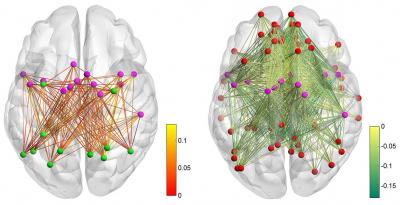
This works especially efficient when we are guided by explicit instructions. A team of researchers at TU Dresden has now examined the underlying neural processes in a current imaging study. The results of the study are published today in the prestigious scientific journal Nature Communications under the title „Integration and segregation of large-scale brain networks during short-term task automatization".

Within the collaborative research center 940 'volition and cognitive control' sponsored by the DFG (German Science Foundation), the brain scientists Holger Mohr, Uta Wolfensteller, and Hannes Ruge from the Department of Psychology at Technische Universität Dresden (Germany) in collaboration with colleagues from the USA and Switzerland examined the neural processes responsible for the automatization of instruction-based tasks. Their research approach embraced the currently popular assumption that mental functions like memory or language do emerge from specific patterns of communication within and between subnetworks of the brain. Going beyond this basic assumption, it was examined whether a rapid reorganization of these communication patterns is possible – specifically during the rapid instruction-based automatization of novel tasks. Previous studies in this context mainly focused on long-term changes.

The results of this current study suggest that rapid instruction-based task automatization is facilitated by rapidly increasing communication between subnetworks associated with the transformation of visual information into motor responses. At the same time, this is accompanied by a release of network resources initially serving the controlled and attention-demanding implementation of the instructed task – while the so-called default mode network is increasingly decoupled from task-related networks. Together, these findings suggest that rapid instruction-based task automatization is indeed reflected by a rapid system-level reorganization of network communications distributed across the entire brain.

###

Please find the complete paper at: http://www.nature.com/articles/ncomms13217

https://tu-dresden.de/mn/psychologie/allgpsy/die-professur/mitarbeiter/utawolfensteller/agneuro

Media Contact

Holger Mohr
[email protected]
49-351-463-42432
@tudresden_de

http://tu-dresden.de/en

Share14Tweet7Share2ShareShareShare1

Related Posts

Uncovering C. elegans Immunity via Genetic Screens — Biology

Uncovering C. elegans Immunity via Genetic Screens

May 16, 2026
Single mother must adapt swiftly — the survival of her colony depends on it — Biology

Single mother must adapt swiftly — the survival of her colony depends on it

May 15, 2026

Why Are Nearly Everyone Right-Handed? It Might Be Linked to How We Learned to Walk

May 15, 2026

Excessive Neuronal Activity Initiates Severe Autoimmune Brain Disorder

May 15, 2026
Please login to join discussion

POPULAR NEWS

  • Research Indicates Potential Connection Between Prenatal Medication Exposure and Elevated Autism Risk

    844 shares
    Share 338 Tweet 211
  • New Study Reveals Plants Can Detect the Sound of Rain

    730 shares
    Share 291 Tweet 182
  • Salmonella Haem Blocks Macrophages, Boosts Infection

    62 shares
    Share 25 Tweet 16
  • Breastmilk Balances E. coli and Beneficial Bacteria in Infant Gut Microbiomes

    58 shares
    Share 23 Tweet 15

About

We bring you the latest biotechnology news from best research centers and universities around the world. Check our website.

Follow us

Recent News

Noncanonical Sulfur Metabolism, Immunity Altered in Down Syndrome

Physical Resilience Linked to Aging Views in Chinese Elders

Tau T205 Phosphorylation Controls Memory and Engrams

Subscribe to Blog via Email

Enter your email address to subscribe to this blog and receive notifications of new posts by email.

Join 82 other subscribers
  • Contact Us

Bioengineer.org © Copyright 2023 All Rights Reserved.

Welcome Back!

Login to your account below

Forgotten Password?

Retrieve your password

Please enter your username or email address to reset your password.

Log In
No Result
View All Result
  • Homepages
    • Home Page 1
    • Home Page 2
  • News
  • National
  • Business
  • Health
  • Lifestyle
  • Science

Bioengineer.org © Copyright 2023 All Rights Reserved.