• HOME
  • NEWS
  • EXPLORE
    • CAREER
      • Companies
      • Jobs
    • EVENTS
    • iGEM
      • News
      • Team
    • PHOTOS
    • VIDEO
    • WIKI
  • BLOG
  • COMMUNITY
    • FACEBOOK
    • INSTAGRAM
    • TWITTER
Saturday, February 7, 2026
BIOENGINEER.ORG
No Result
View All Result
  • Login
  • HOME
  • NEWS
  • EXPLORE
    • CAREER
      • Companies
      • Jobs
        • Lecturer
        • PhD Studentship
        • Postdoc
        • Research Assistant
    • EVENTS
    • iGEM
      • News
      • Team
    • PHOTOS
    • VIDEO
    • WIKI
  • BLOG
  • COMMUNITY
    • FACEBOOK
    • INSTAGRAM
    • TWITTER
  • HOME
  • NEWS
  • EXPLORE
    • CAREER
      • Companies
      • Jobs
        • Lecturer
        • PhD Studentship
        • Postdoc
        • Research Assistant
    • EVENTS
    • iGEM
      • News
      • Team
    • PHOTOS
    • VIDEO
    • WIKI
  • BLOG
  • COMMUNITY
    • FACEBOOK
    • INSTAGRAM
    • TWITTER
No Result
View All Result
Bioengineer.org
No Result
View All Result
Home NEWS Science News Biology

Study reveals the atmospheric footprint of global warming hiatus

Bioengineer by Bioengineer
February 11, 2018
in Biology
Reading Time: 2 mins read
0
Share on FacebookShare on TwitterShare on LinkedinShare on RedditShare on Telegram
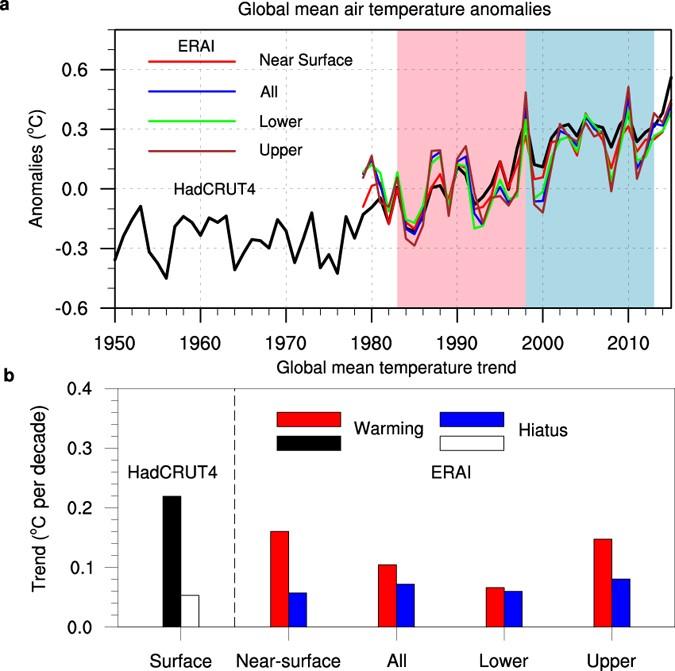
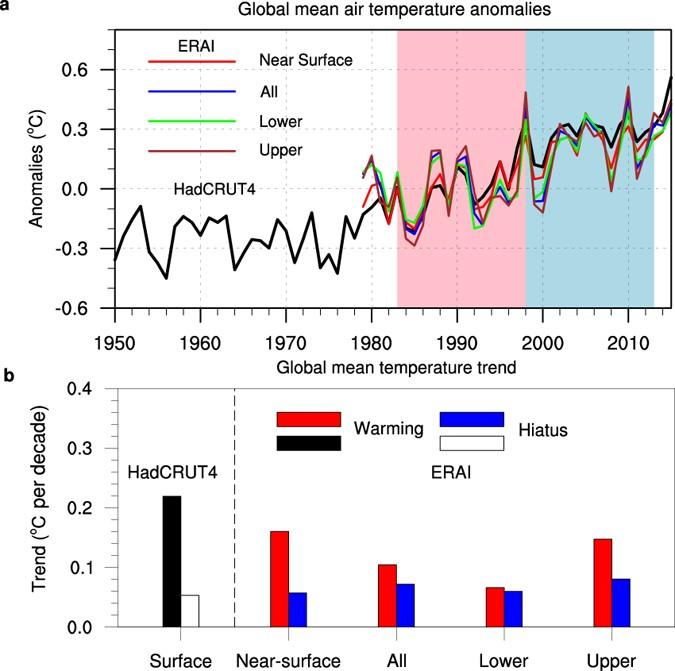
IMAGE

Credit: Liu and Zhou

The increasing rate of the global mean surface temperature was reduced from 1998 to 2013, known as the global warming hiatus or pause. Great efforts have been devoted to the understanding of the cause. The proposed mechanisms include the internal variability of the coupled ocean-atmosphere system, the ocean heat uptake and redistribution, among many others. However, the atmospheric footprint of the recent warming hiatus has been less concerned. Both the dynamical and physical processes remain unclear.

In a recent paper published in Scientific Report, LIU Bo and ZHOU Tianjun from the Institute of Atmospheric Physics, Chinese Academy of Sciences have investigated the atmospheric anomalous features during the global warming hiatus period (1998-2013). They show evidences that the global mean tropospheric temperature also experienced a hiatus or pause.

To understand the physical processes that dominate the warming hiatus, they decomposed the total temperature trends into components due to processes related to surface albedo, water vapor, cloud, surface turbulent fluxes and atmospheric dynamics.

The results demonstrated that the hiatus of near surface temperature warming trend is dominated by the decreasing surface latent heat flux compared with the preceding warming period, while the hiatus of upper tropospheric temperature is dominated by the cloud-related processes. Further analysis indicated that atmospheric dynamics are coupled with surface turbulent heat fluxes over lower troposphere and coupled with cloud processes over upper troposphere.

As to why the surface latent heat flux, atmospheric dynamics and cloud-related processes showed such large differences between 1983-1998 and 1998-2013, LIU, first author of the paper, explained, "They are dominated by the Hadley Circulation and Walker Circulation changes associated with the phase transition of Interdecadal Pacific Oscillation (IPO)."

According to LIU, the IPO is a robust, recurring pattern of sea surface temperature anomalies at decadal time scale. During a positive phase of IPO, the west Pacific and the mid-latitude North Pacific becomes cooler and the tropical eastern ocean warms, while during a negative phase, the opposite pattern occurs. The IPO has shifted from the positive phase to negative phase since 1998/1999, and this transition has led to the weakening of both Hadley Circulation and Walker Circulation, which served as a hub linking the three processes mentioned above.

"Though the heat capacity of the atmosphere is nearly negligible compared with the ocean", said ZHOU, corresponding author of the paper, "understanding the atmospheric footprint is essential to gain a full picture of how internal climate variability such as IPO affects the global climate from the surface to the troposphere. The new findings also provide useful observational metrics for gauging climate model experiments that are designed to understand the mechanism of global warming hiatus".

###

Media Contact

Zheng Lin
[email protected]mail.iap.ac.cn
108-299-5053
@aasjournal

http://english.iap.cas.cn/

Share12Tweet7Share2ShareShareShare1

Related Posts

Florida Cane Toad: Complex Spread and Selective Evolution

Florida Cane Toad: Complex Spread and Selective Evolution

February 7, 2026
New Study Uncovers Mechanism Behind Burn Pit Particulate Matter–Induced Lung Inflammation

New Study Uncovers Mechanism Behind Burn Pit Particulate Matter–Induced Lung Inflammation

February 6, 2026

DeepBlastoid: Advancing Automated and Efficient Evaluation of Human Blastoids with Deep Learning

February 6, 2026

Navigating the Gut: The Role of Formic Acid in the Microbiome

February 6, 2026
Please login to join discussion

POPULAR NEWS

  • Robotic Ureteral Reconstruction: A Novel Approach

    Robotic Ureteral Reconstruction: A Novel Approach

    82 shares
    Share 33 Tweet 21
  • Digital Privacy: Health Data Control in Incarceration

    63 shares
    Share 25 Tweet 16
  • Study Reveals Lipid Accumulation in ME/CFS Cells

    57 shares
    Share 23 Tweet 14
  • Breakthrough in RNA Research Accelerates Medical Innovations Timeline

    53 shares
    Share 21 Tweet 13

About

We bring you the latest biotechnology news from best research centers and universities around the world. Check our website.

Follow us

Recent News

Personalized Guide to Understanding and Reducing Chemicals

Inflammasome Protein ASC Drives Pancreatic Cancer Metabolism

Phage-Antibiotic Combo Beats Resistant Peritoneal Infection

Subscribe to Blog via Email

Enter your email address to subscribe to this blog and receive notifications of new posts by email.

Join 73 other subscribers
  • Contact Us

Bioengineer.org © Copyright 2023 All Rights Reserved.

Welcome Back!

Login to your account below

Forgotten Password?

Retrieve your password

Please enter your username or email address to reset your password.

Log In
No Result
View All Result
  • Homepages
    • Home Page 1
    • Home Page 2
  • News
  • National
  • Business
  • Health
  • Lifestyle
  • Science

Bioengineer.org © Copyright 2023 All Rights Reserved.