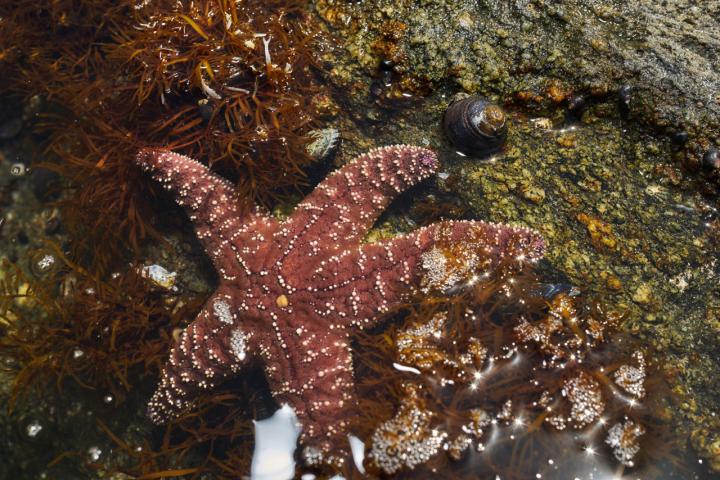
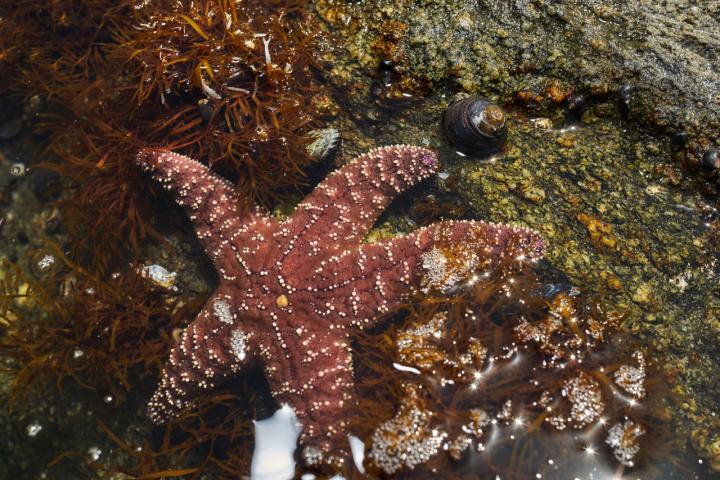
Credit: Gabriel Ng, UC Davis
Ocean acidification makes it harder for sea snails to escape from their sea star predators, according to a study from the University of California, Davis.
The findings, published in the journal Proceedings of The Royal Society B, suggest that by disturbing predator-prey interactions, ocean acidification could spur cascading consequences for food web systems in shoreline ecosystems.
For instance, black turban snails graze on algae. If more snails are eaten by predators, algae densities could increase.
"Ocean acidification can affect individual marine organisms along the Pacific coast, by changing the chemistry of the seawater," said lead author Brittany Jellison, a Ph.D. student studying marine ecology at the UC Davis Bodega Marine Laboratory.
"But it can also alter how species interact, such as by impairing the ability of prey to avoid predators," she said.
Sea star and snail interactions under ocean acidification
Jellison and colleagues from the UC Davis Bodega Marine Laboratory collected ochre sea stars and black turban snails — two common species along the Pacific coastline — from tide pools on the Bodega Marine Reserve. In lab tanks, they explored interactions between the sea stars and snails under 16 different levels of seawater pH, or acidity, ranging from present levels to those expected for rocky intertidal pools by the year 2100.
The scientists found that lower pH levels, which indicate higher acidity, did not slow the snails' movements or reduce their ability to sense the predatory sea stars. However, the more acidic waters did impair the snails' escape response.
Tipping point
Usually, when a black turban snail senses an ochre sea star, it quickly crawls up and out of the tide pool to avoid it, as sea stars rarely leave the water to eat. But when pH levels fell to 7.1 or below, the snails failed to fully implement their escape response. Neither did the snails recover their escape response when the water's acidity fluctuated between normal and more acidic levels.
The pH levels that spur these behavioral changes already occur in tide pools and are expected to become more frequent in coming decades.
More research is needed to understand why the snails show a degraded escape response, or if they may adapt to more acidic ocean conditions in the future.
More CO2, more ocean acidification
One-third of carbon dioxide emitted by humans enters the oceans, making seawater more acidic, the study noted.
Rocky tide pools may operate as an indicator for future ocean conditions. They experience pH levels that are predicted for the open ocean later. Models project a 0.3-0.4 drop in the global average of ocean pH by 2100.
"Dozens of West Coast species display escape responses to sea stars," said senior author Brian Gaylord, a professor of evolution and ecology at the UC Davis Bodega Marine Laboratory and Jellison's faculty adviser. "We don't yet know the extent to which ocean acidification could alter these additional predator-prey interactions, but there is clear potential for broader disruption of links within shoreline food webs."
###
The study's co-authors, all affiliated with the UC Davis Bodega Marine Laboratory, include graduate student Aaron Ninokawa, Professor Tessa Hill of the Department of Earth and Planetary Sciences and Coastal Marine Science Institute, and professors Eric Sanford and Brian Gaylord of the Department of Evolution and Ecology.
The study was funded by grants from the National Science Foundation, California Sea Grant and UC Davis Bodega Marine Laboratory.
Media Contact
Andy Fell
[email protected]
530-752-4533
@ucdavisnews
http://www.ucdavis.edu