Civil engineers and materials scientists have developed a physics-data hybrid digital twin framework that predicts early-age cracking risks in restrained concrete structures by coupling sparse sensor observations with surrogate-accelerated inverse analysis. Concrete represents the most widely consumed manufactured material in the modern construction sector, with global annual consumption reaching approximately thirty billion tons across transportation networks, energy facilities, and water control infrastructure. During the initial hours and days following casting, concrete undergoes complex chemical hydration reactions that simultaneously release substantial heat and drive significant volumetric shrinkage strains. When volumetric deformations are mechanically restrained by adjacent structural components or internal reinforcements, internal tensile stresses develop and accumulate rapidly within the hardening cementitious matrix. If these developing tensile stresses exceed the evolving tensile strength of the young concrete, microcracking and macrocracking inevitably occur, reducing effective structural load-bearing capacity and opening aggressive transport conduits for moisture, chlorides, and other harmful chemical species that accelerate long-term steel rebar corrosion and structural degradation.
Traditional structural health monitoring and numerical modeling strategies have historically faced steep operational hurdles when applied to early-age concrete cracking assessment under real-world conditions. Standard embedded physical sensors, such as vibrating-wire gauges or electrical resistance foils, provide direct readings that are strictly local to discrete points within a structural member, failing to capture global spatial gradients across entire structural elements. Conversely, numerical approaches relying on three-dimensional finite element analysis can computationally resolve full-field thermal, volumetric, and mechanical stress distributions by integrating thermo-chemo-mechanical governing equations. However, calibrating these multi-physics finite element models against physical specimens traditionally depends on manual trial-and-error parameter adjustments, where each simulation cycle can consume tens of computational hours, rendering iterative inverse updating far too sluggish for real-time risk mitigation and site decision-making.
To overcome these computational and observational bottlenecks, the research team constructed an integrated digital twin architecture establishing a continuous bidirectional feedback loop between physical restrained concrete specimens and an adaptive digital representation. The digital framework comprises four operational components: the physical structural entity, a physics-based digital simulation entity, an optimization-driven parameter inversion module, and a hydration-dependent cracking risk evaluation engine. Rather than treating machine learning algorithms merely as offline forward predictors or relying on one-off initial calibrations, the framework actively ingests sparse temperature and strain measurements recorded at discrete early-age intervals. It then performs inverse updating on latent boundary-dependent functions representing equivalent internal hydration heat generation and volumetric shrinkage. By updating these fundamental time-dependent physical inputs dynamically as monitoring data accumulate, the digital twin continuously synchronizes its internal representation with the physical specimen, extrapolating future thermo-mechanical trajectories and stress evolution across the critical initial seven-day curing period spanning one hundred sixty-eight hours.
The foundational computational database was generated using the commercial software suite Midas FEA NX to model modified restrained-ring concrete specimens designed in accordance with standard AASHTO T 334 specifications. The physical experimental geometry comprised a concentric concrete ring with an outer diameter of six hundred millimeters, an inner diameter of three hundred forty millimeters, and an axial height of seventy-five millimeters, surrounding an inner structural steel restraint ring. To provide physically realistic thermal boundary conditions, convective heat transfer coefficients were staged within the model, assigning nine point eight kilojoules per square meter hour degree Celsius during the initial twenty-four-hour wet burlap curing period and thirty kilojoules per square meter hour degree Celsius following formwork removal. Rather than enforcing an idealized rigid bond, the contact interface between the inner perimeter of the concrete ring and the outer face of the steel restraint ring was explicitly simulated to permit normal separation and tangential slip. A structured two-dimensional mesh featuring one hundred ten circumferential divisions and eleven radial divisions was vertically extruded across fifteen solid element layers, yielding an exact three-dimensional discretization.
To assemble a diverse candidate library for surrogate training and parameter inversion, the researchers executed four hundred independent finite element simulations driven by maximum-minimum Latin hypercube sampling over realistic concrete material ranges. The generated dataset spanned maximum adiabatic temperature rises between twenty-eight and seventy-six degrees Celsius and ultimate shrinkage values ranging from negative one hundred eighty-six to negative seven hundred eighty microstrain, discretized at one-hour temporal increments across one hundred sixty-nine consecutive time steps. Using this comprehensive synthetic database, the team systematically trained, hyperparameter-tuned, and benchmarked eight distinct machine learning regression models representing classical statistical algorithms, probabilistic interpolation methods, and decision-tree ensemble architectures. The candidate surrogate models included multilayer perceptrons, support vector regression, Kriging models, Gaussian process regression, random forests, extreme gradient boosting, LightGBM, and CatBoost. Performance across the test dataset was rigorously evaluated using the coefficient of determination, mean absolute error, root mean squared error, median absolute deviation, and mean absolute percentage error across both temperature and strain prediction channels.
Among the eight evaluated surrogate algorithms, extreme gradient boosting emerged as the most accurate, balanced, and robust model for multivariate thermo-mechanical forecasting. Extreme gradient boosting achieved coefficients of determination exceeding zero point ninety-eight for both thermal and mechanical strain distributions across the test set, recording a root mean squared error of zero point fifteen degrees Celsius for temperature and ten point thirty-five microstrain for restrained strain. Its sequential gradient-boosted decision-tree architecture proved uniquely capable of capturing the coupled, asymmetric physical dynamics of early hydration thermal peaks followed by protracted volumetric shrinkage decay. Crucially, the validated extreme gradient boosting surrogate executed a complete forward response evaluation in approximately three seconds, slashing computational runtimes by roughly ninety-nine point eight percent compared to the thirty minutes required for a single traditional three-dimensional finite element analysis.
Leveraging this ultrafast surrogate engine, the researchers evaluated three distinct mathematical optimization algorithms to solve the inverse problem of identifying equivalent heat-source and shrinkage histories from physical sensor measurements: a policy-gradient reinforcement learning routine known as REINFORCE, particle swarm optimization, and simulated annealing. The inverse objective function balanced the time-weighted coefficients of determination for concrete temperature and restrained strain, applying an empirical two-to-one weighting ratio favoring the initial forty-eight hours after casting to emphasize rapid early-age reaction kinetics. In parallel, a third-order Savitzky-Golay polynomial filter and monotonic decreasing constraints were implemented across post-forty-eight-hour response histories to suppress unphysical high-frequency numerical oscillations. Systematic comparisons across experimental test cases revealed that particle swarm optimization delivered the highest reconstruction precision, attaining coefficients of determination up to zero point nine hundred ninety-three for temperature histories and zero point nine hundred ninety-nine for mechanical strain histories, outperforming simulated annealing while demonstrating exceptional stability across regular multi-parameter search landscapes.
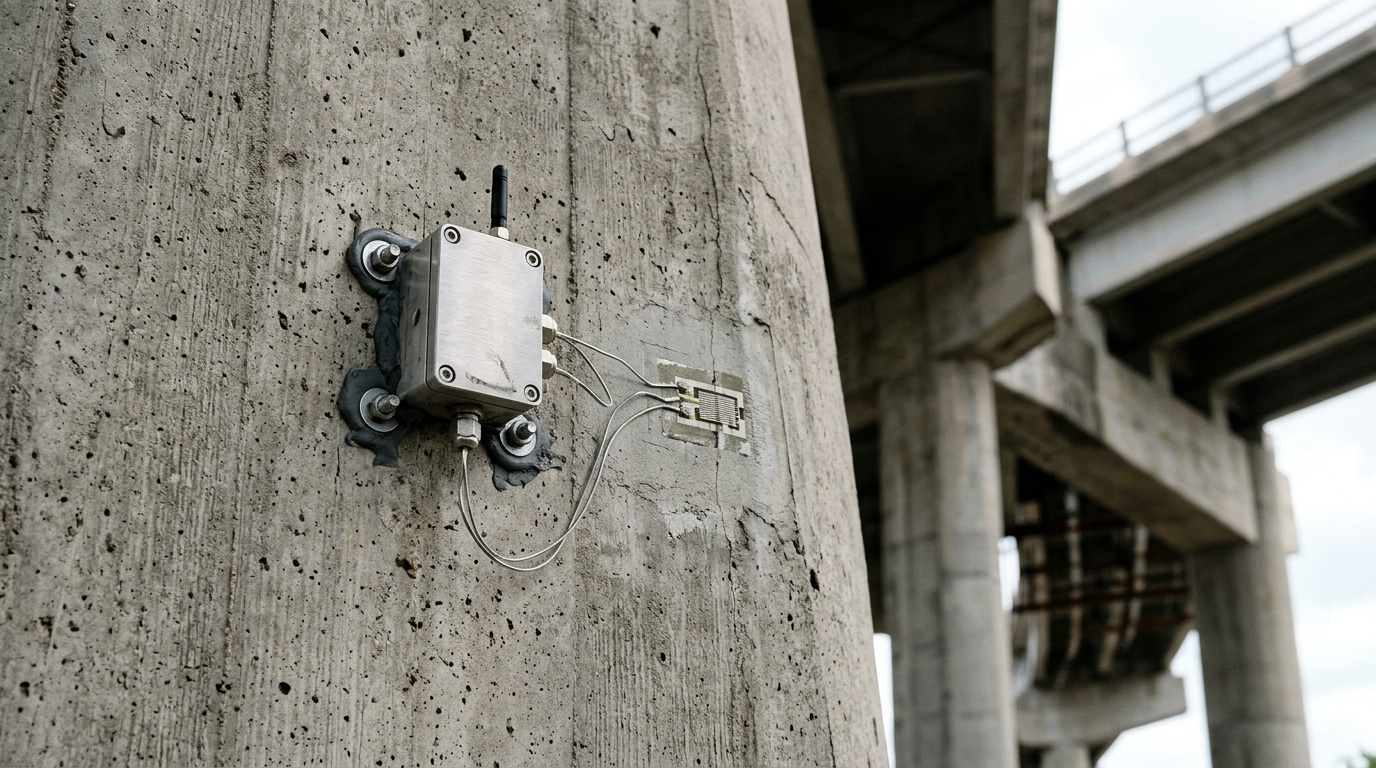
The complete digital twin methodology was experimentally validated using four distinct concrete mixture formulations subjected to varied environmental conditions, including a conventional repair mortar, two proprietary non-fiber ultra-high-performance concrete mixtures, and an ultra-high-performance concrete reinforced with industrial steel fibers. Physical ring specimens were instrumented with two symmetrically embedded vibrating-wire strain and temperature sensors alongside four electrical resistance strain gauges mounted directly along the inner steel ring surface. Experimental testing confirmed that inverted heat-source curves exhibited lower effective amplitudes than idealized adiabatic calorimetry tests due to actual environmental boundary heat dissipation, while inverted shrinkage functions reflected coupled autogenous, drying, thermal, and creep deformation mechanisms. Sequential updating trials conducted across cumulative monitoring windows of six, twelve, twenty-four, forty-eight, seventy-two, and one hundred sixty-eight hours demonstrated that thermal predictions converged rapidly within twenty-four hours, whereas accurate strain prediction required longer observation windows because of complex viscoelastic stress relaxation and gradual moisture diffusion within the cement paste.
Structural cracking vulnerability was continuously quantified through a stress-to-strength failure criterion defined as the ratio of maximum finite element-calculated tensile stress to the evolving hydration-dependent concrete tensile strength. In experimental validation cases designated Case One, Case Two, and Case Three, no macroscopic cracking occurred throughout the seven-day observation period. Conversely, the fiberless ultra-high-performance concrete mixture labeled Case Four suffered physical cracking at approximately fifty hours after casting, marked by an abrupt drop in internal sensor strain. Operating strictly on pre-cracking sensor data, the digital twin framework generated a clear warning signal: the twenty-four-hour updating window pushed the projected risk index beyond zero point seven, while the forty-eight-hour update drove the index toward unity directly preceding physical fracture.
Despite these successful laboratory demonstrations, the investigators emphasize several engineering hurdles that must be resolved prior to full-scale deployment in major civil construction projects. Furthermore, the finite element formulation assumed constant specific heat capacity and thermal conductivity values to constrain parameter dimensionality, which may introduce minor thermal gradient errors across mass concrete pours. Because structural drying shrinkage and creep continue over months or years, future iterations must extend training libraries and temporal horizons well beyond the initial seven-day window.
Subject of Research: Digital twin modeling for early-age concrete cracking risk assessment
Article Title: Digital twin for assessing early-age cracking risks of restrained concrete using sparse measurements and physics-data hybrid models
Article References: Shu, Y., Huang, J., Guo, P., Teng, L., Li, J., Bao, Y., Meng, W., & Liu, J. (2026). Digital twin for assessing early-age cracking risks of restrained concrete using sparse measurements and physics-data hybrid models. Case Studies in Construction Materials, 25, Article e06740. https://doi.org/10.1016/j.cscm.2026.e06740
Image Credits: AI Generated
DOI: 10.1016/j.cscm.2026.e06740
Keywords: digital twin, concrete cracking, restrained concrete, finite element analysis, physics-data hybrid models, machine learning surrogates, XGBoost, particle swarm optimization, cement hydration, autogenous shrinkage, drying shrinkage, stress-to-strength ratio, vibrating-wire sensors, strain gauges, ultra-high-performance concrete, AASHTO T 334, Midas FEA NX, thermal stress, computational mechanics
News Source: Denise Maddox. (November 29, 2026). Digital Twin Accurately Forecasts Concrete Cracking Risk Using Sparse Sensor Data. Scienmag.