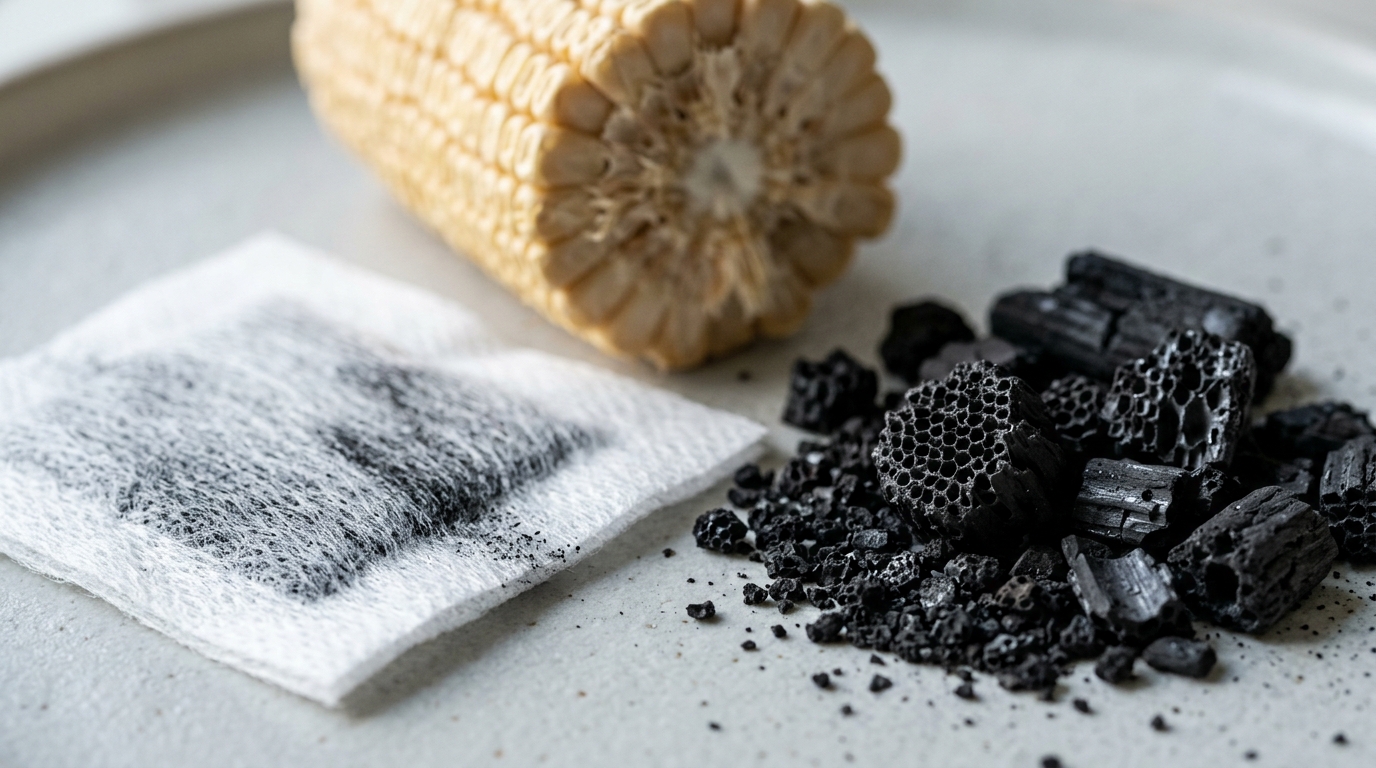
Activated carbon synthesized from agricultural corncob residue via pre-carbonization and potassium carbonate activation suppresses common wound pathogens while sustaining high cytocompatibility in cultured cells, according to a laboratory study in Chemical Physics Impact. The investigation demonstrated that the porous carbon framework reduced recoverable populations of Staphylococcus aureus by approximately 88 percent and Escherichia coli by roughly 80 percent during in vitro contact assays. Concurrently, the material supported L929 mouse fibroblast viability above 90 percent across all tested concentrations up to 50 micrograms per milliliter, with half-maximal inhibitory concentration thresholds exceeding that range. By transforming lignocellulosic agricultural waste into an engineered material, the authors evaluated physicochemical traits alongside cellular and antibacterial responses to assess its prospective utility in advanced wound care systems.
The skin serves as the primary protective barrier of the body, organized into an outer melanin-producing epidermis, a collagen- and elastin-rich dermis providing structural strength and vascular support, and an underlying adipose hypodermis that cushions internal organs. When injured, rapid restoration of tissue integrity is frequently hindered by bacterial colonization, particularly from Gram-positive Staphylococcus aureus and Gram-negative Escherichia coli. As bacteria attach to the wound surface and multiply, they can establish persistent infections characterized by prolonged inflammation, oxidative stress, and damage to host fibroblasts and keratinocytes, delaying re-epithelialization. This pathological cascade worsens when microorganisms form biofilms, whose protective matrix restricts standard antimicrobial therapies, elevates protease activity, degrades the extracellular matrix, and halts progression toward the proliferative healing phase.
To prevent infection-driven healing failure, biomaterials engineered for wound management must combine effective antimicrobial performance with biocompatibility toward regenerating tissues. Carbon-based architectures have drawn attention because their tunable porosity, broad surface chemistry, mechanical robustness, and large specific surface area permit favorable interactions with wound exudate, cells, and therapeutic agents. Agricultural residues represent an abundant, renewable, and inexpensive biomass source, offering a practical route to convert farm waste into functional biomaterials. Corncob possesses an inherent framework of cellulose, hemicellulose, and lignin that naturally favors hierarchical pore networks spanning macroporous, mesoporous, and microporous dimensions upon activation. Despite these advantageous traits, translating corncob-derived activated carbon into biomedical platforms has lagged behind its established use in environmental adsorption and electrochemical energy storage applications.
The experimental synthesis began with raw corncobs obtained from a regional market, which were sliced into segments and washed with double-distilled water to eliminate impurities. The cleaned pieces were dried in a hot air oven at 100 degrees Celsius for 12 hours before undergoing thermal pre-carbonization inside a chemical vapor deposition system under an inert argon atmosphere at 450 degrees Celsius for 4 hours. This initial heating decomposed the primary lignocellulosic constituents, stripping away volatile components to establish a stable carbonaceous precursor. The pre-carbonized material was subsequently divided to evaluate two distinct chemical activating agents, potassium carbonate and potassium hydroxide, maintaining an identical corncob-to-chemical mass ratio of three to one in 250-milliliter aqueous solutions for 24 hours to ensure thorough impregnation throughout the matrix.
Following chemical soaking, the impregnated corncob precursors were oven-dried at 120 degrees Celsius for 12 hours and ground into fine powders using a mortar and pestle. Carbonization was carried out in a muffle furnace at 750 degrees Celsius for 3 hours with a controlled heating rate of 5 degrees Celsius per minute to drive extensive pore development. The heated products were repeatedly washed with distilled water until reaching a neutral pH to extract residual chemical reagents, before being dried at 60 degrees Celsius to yield final activated carbon powders. To evaluate processing variables, the authors prepared three formulations: potassium carbonate activation without pre-carbonization, potassium carbonate activation with pre-carbonization, and potassium hydroxide activation with pre-carbonization, establishing comparative baselines for structural and morphological analyses.
Comprehensive structural characterization confirmed the amorphous nature and defective lattice configurations of the synthesized materials. X-ray diffraction analysis using copper K-alpha radiation revealed broad diffraction humps centered around 24 degrees for potassium carbonate-treated samples and 23 degrees for potassium hydroxide-treated carbon, reflecting the absence of long-range crystalline order. The formulation prepared without pre-carbonization displayed an unwanted sharp crystalline peak at a two-theta value of 29.4 degrees from residual potassium compounds that promoted localized graphitization; this artifact was successfully eliminated by incorporating the 450-degree pre-carbonization step.
Scanning electron microscopy and energy-dispersive X-ray spectroscopy highlighted striking morphological and compositional differences between activation routes. The potassium hydroxide-activated sample exhibited irregular shapes and particle agglomeration, whereas the pre-carbonized potassium carbonate material developed a finely textured, highly porous network well-suited for biological fluids and cell anchorage. This morphology arose because potassium carbonate decomposes above 700 degrees Celsius into potassium oxide and carbon dioxide, which are reduced by carbon to metallic potassium and carbon monoxide; the resulting potassium intercalation and gasification etched the framework before being washed away. Energy-dispersive elemental analysis revealed that pre-carbonized potassium carbonate carbon contained 88.60 weight percent carbon and 11.40 weight percent oxygen, whereas the potassium hydroxide material retained 74.95 weight percent carbon and 25.05 weight percent oxygen.
Quantitative textural assessments via nitrogen adsorption-desorption isotherms at 77.35 Kelvin underscored the physical advantages of potassium carbonate activation following twelve hours of vacuum degassing at 200 degrees Celsius. Brunauer-Emmett-Teller measurements showed that potassium carbonate-activated carbon achieved a specific surface area of 303.84 square meters per gram and a total pore volume of 0.214 cubic centimeters per gram, outperforming the potassium hydroxide sample which recorded 266.78 square meters per gram and 0.173 cubic centimeters per gram. Both materials displayed overlapping adsorption and desorption curves without pronounced hysteresis loops, indicating a dominant micro-to-mesoporous architecture where Barrett-Joyner-Halenda analysis revealed that approximately 76 percent of total pore volume occupied the 2 to 10 nanometer diameter window, yielding an average pore diameter of 2.82 nanometers.
Thermal degradation profiling, particle sizing, and infrared spectroscopy provided additional confirmation of material integrity and surface chemistry. Thermogravimetric and differential thermal analyses on 1.71-milligram samples revealed three successive stages of weight loss: a 2 to 4 percent mass reduction below 150 degrees Celsius from adsorbed water, a 7.246 percent loss between 150 and 300 degrees Celsius from decomposing surface functional groups and residual lignocellulose, and complete oxidative transition occurring around 530 degrees Celsius. Dynamic light scattering across five replicate runs established a mean hydrodynamic particle size of 268.31 nanometers, with an average polydispersity index of 0.199. Furthermore, Fourier transform infrared spectroscopy identified a broad hydroxyl band at 3444 inverse centimeters, aliphatic vibrations at 2925 inverse centimeters, graphitic carbon-carbon bonds at 1628 inverse centimeters, and carbon-oxygen stretching at 1385 inverse centimeters on the carbonate-treated carbon.
In vitro cytocompatibility testing performed on L929 mouse fibroblasts demonstrated that the potassium carbonate-activated carbon remained non-toxic across a wide dosage spectrum. Fibroblasts seeded in 96-well plates at an initial density of 10,000 cells per well in Dulbecco’s Modified Eagle Medium supplemented with 10 percent fetal bovine serum and antibiotic-antimycotic were exposed to carbon concentrations of 3.1, 6.2, 12.5, 25, and 50 micrograms per milliliter for 24 hours. The standard MTT colorimetric assay, measuring the reduction of tetrazolium salt to purple-blue formazan crystals by metabolically active cells at 570 nanometers, revealed that cell viability stayed consistently above 90 percent for all five concentrations. Even at 50 micrograms per milliliter, cell viability experienced only a negligible decrease, and the corresponding half-maximal inhibitory concentration exceeded 50 micrograms per milliliter.
Quantitative antimicrobial evaluations conducted through contact assays and drop-plate colony-forming unit determinations confirmed meaningful suppression of representative bacterial pathogens following 24 hours of exposure at 1 milligram per milliliter. For Gram-negative Escherichia coli, initial bacterial burdens of 10.377 plus or minus 0.069 log10 colony-forming units per milliliter were reduced to 9.656 plus or minus 0.107, representing a statistically significant log reduction of 0.72, or approximately 80 percent fewer viable cells. Against Gram-positive Staphylococcus aureus, viable bacterial counts dropped from 10.439 plus or minus 0.043 to 9.513 plus or minus 0.183 log10 units, achieving a log reduction of 0.926, which corresponds to an 88 percent decline in recoverable colonies. The heightened susceptibility of Staphylococcus aureus was attributed to its lack of the protective outer membrane found in Gram-negative organisms, allowing porous carbon edges and oxygen-bearing functional groups to disrupt the bacterial envelope.
Despite these encouraging in vitro outcomes, the authors explicitly defined key scientific boundaries, cautioning that laboratory antibacterial action and cytocompatibility cannot be interpreted as direct evidence of wound healing or tissue regeneration. The study did not include scratch migration assays, in vivo wound closure experiments, or fluid absorption and swelling tests, leaving the complex dynamics of physiological repair unmeasured.
Subject of Research: Biomass-derived activated carbon for antibacterial wound care applications
Article Title: Biomass-derived activated carbon via dual alkaline activation: Antibacterial activity and cytocompatibility for potential wound care applications
Article References: S, R., & Raj, N. N. (2026). Biomass-derived activated carbon via dual alkaline activation: Antibacterial activity and cytocompatibility for potential wound care applications. Chemical Physics Impact, 13, Article 101225. https://doi.org/10.1016/j.chphi.2026.101225
Image Credits: AI Generated
DOI: 10.1016/j.chphi.2026.101225
Keywords: activated carbon, corncob biomass, alkaline activation, potassium carbonate, potassium hydroxide, antibacterial activity, Staphylococcus aureus, Escherichia coli, cytocompatibility, L929 fibroblasts, MTT assay, pre-carbonization, mesoporous carbon, BET surface area, Raman spectroscopy, X-ray diffraction, wound dressing biomaterials
News Source: Bethany Barker. (November 28, 2026). Activated Carbon From Corncobs Suppresses Wound Bacteria While Maintaining Cell Viability. Scienmag.