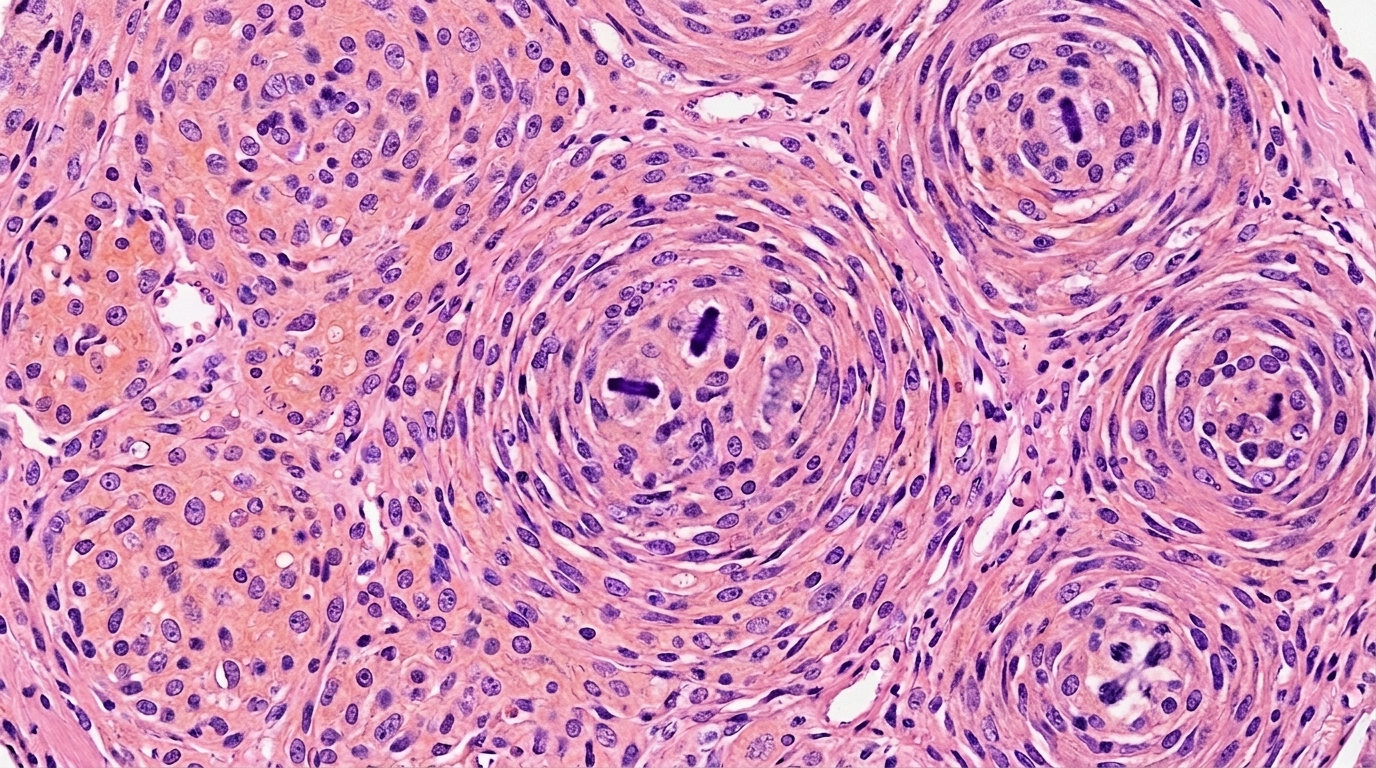
An investigation analyzing meningioma transcriptomes has revealed that elevated cell-cycle gene expression correlates with significantly shorter progression-free survival, while distinct extracellular matrix programs show partial resemblance to adult and fetal meningeal references. The findings clarify the core biological pathways operating across meningiomas and demonstrate how developmental and structural transcriptional features shift as tumors become more aggressive.
To revisit the diverse transcriptional landscapes of these tumors, researchers integrated public single-cell RNA sequencing datasets with bulk RNA sequencing derived from both institutional and public patient cohorts. The analytical approach incorporated reference transcriptional profiles from four adult dural specimens and eight fetal meningeal tissue samples, allowing investigators to track how tumor expression architectures compare directly against non-neoplastic developmental and mature intracranial coverings.
Through detailed analysis of single-cell sequencing data encompassing twenty tumors, the research team identified four recurrent transcriptional metaprograms that define meningioma cellular states. Two of these recurrent metaprograms were primarily associated with extracellular matrix organization. A third metaprogram governed cellular stress responses, while the fourth recurrent metaprogram was characterized by prominent cell-cycle activity.
Cross-comparison with healthy anatomical reference profiles indicated that the two tumor extracellular matrix programs were not entirely aberrant. Instead, the first extracellular matrix program displayed partial resemblance to the normal transcriptional signature of mature adult dura, whereas the second extracellular matrix program partially resembled the specialized interface program found between the fetal dura and arachnoid membranes.
Meningiomas presenting with higher histological grades and greater copy-number variation burden exhibited marked attenuation of both the adult dura-resembling and fetal meningeal-resembling transcriptional programs. Concurrently, these clinically aggressive tumors demonstrated reciprocal activation and elevated scores across the proliferative cell-cycle program.
Multivariate survival analyses confirmed the independent prognostic relevance of the cell-cycle program score. Even after formal statistical adjustment for World Health Organization histological grade, surgical extent of resection, and post-operative adjuvant radiotherapy, higher cell-cycle program scores remained significantly associated with shorter progression-free survival, yielding an adjusted hazard ratio of 2.87 with a 95 percent confidence interval spanning 1.82 to 4.53.
The authors concluded that attenuation of normal meningeal-resembling programs and reciprocal activation of cell-cycle programs characterize tumors with higher histological grade and greater copy-number variation burden.
Subject of Research: Transcriptional metaprograms and prognostic biomarkers in meningioma
Article Title: Revisiting the core transcriptional programs of meningioma
Article References: Sato, D., Miyawaki, S., Sakai, Y., Nomura, M., Ohara, K., Hirano, Y., Umekawa, M., Teranishi, Y., Hongo, H., Ogawa, S., Tsuchiya, T., Hirata, S., Ono, H., Ushiku, T., & Saito, N. (2026). Revisiting the core transcriptional programs of meningioma. Journal of Neuro-Oncology, 180(3), Article 77. https://doi.org/10.1007/s11060-026-05893-w
Image Credits: AI Generated
DOI: 10.1007/s11060-026-05893-w
Keywords: meningioma, transcriptional metaprograms, single-cell RNA sequencing, bulk RNA sequencing, cell-cycle activity, extracellular matrix, progression-free survival, hazard ratio, WHO histological grade, copy-number variation, adult dura, fetal meninges, dura-arachnoid interface, neuro-oncology, adjuvant radiotherapy, extent of resection
News Source: Nathaniel Bowman. (November 28, 2026). Meningioma Cell Cycle Programs Link to Shorter Progression Free Survival. Scienmag.