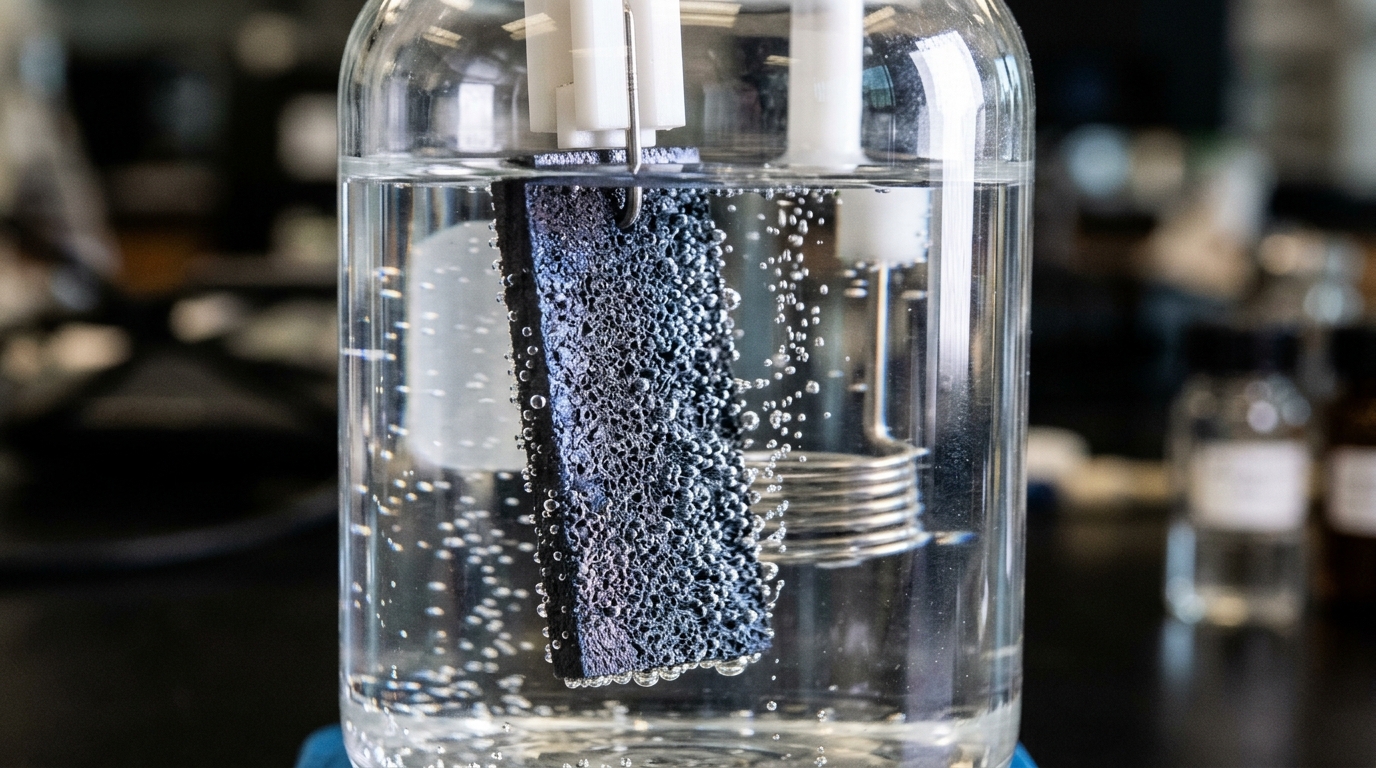
Researchers have developed multifunctional composite electrode materials composed of graphene-quantum-dot-modified UiO-66/ZrS2 designed for electrochemical energy storage and electrocatalytic hydrogen evolution. In the reported investigation, the researchers carried out systematic analyses of the crystal structure, surface morphology, interfacial features, and electrochemical characteristics across individual UiO-66, pristine ZrS2, the binary UiO-66/ZrS2 heterostructure, and the modified GQDs@UiO-66/ZrS2 composite.
The introduction of graphene quantum dots into the UiO-66/ZrS2 heterostructure produced measurable physical and electrochemical enhancements at the composite interface. According to the reported findings, the graphene quantum dot modification improved electronic connectivity across the heterostructure interface, enlarged the total surface area accessible to the electrolyte solution, facilitated ion-transport pathways, and significantly enhanced the overall utilization of available redox-active sites.
Evaluation of the GQDs@UiO-66/ZrS2 composite in a three-electrode testing configuration revealed high charge-storage capacities across complementary electrochemical procedures. Cyclic voltammetry measurements conducted at a sweep rate of 3 mV/s delivered a specific capacity of 1563 C/g, whereas galvanostatic charge–discharge measurements performed at a current density of 2.0 A/g yielded a specific capacity of 2365 C/g for the electrode material.
To examine device-level functionality, the authors subsequently fabricated an asymmetric supercapattery device utilizing the synthesized GQDs@UiO-66/ZrS2 composite material as the positive electrode and commercial activated carbon as the negative electrode. When evaluated under galvanostatic charge–discharge conditions at an applied current density of 2.0 A/g, this assembled asymmetric cell delivered a specific capacity of 366 C/g.
Operational testing of the complete asymmetric supercapattery cell demonstrated robust energy and power metrics, achieving a maximum energy density of 81 Wh/kg and a maximum power density of 2560 W/kg. Extended cycling stability assessments revealed that the assembled device preserved 88.2% of its original specific capacity following 10,000 continuous charge–discharge cycles, while sustaining a coulombic efficiency of 96.8%.
In addition to its electrochemical energy storage performance, the GQDs@UiO-66/ZrS2 composite exhibited catalytic activity toward the electrocatalytic hydrogen evolution reaction. The composite recorded an overpotential of 131.73 mV and a corresponding Tafel slope of 56.87 mV/dec, parameters characteristic of a Volmer–Heyrovsky reaction mechanism, highlighting the material as a multifunctional candidate for integrated energy-storage and hydrogen-generation technologies.
Subject of Research: Graphene-quantum-dot-modified UiO-66/ZrS2 composite electrodes for electrochemical energy storage and hydrogen evolution
Article Title: A next-generation GQDs-Doped UiO-66/ZrS2 composite electrode for energy storage and hydrogen evolution applications
Article References: Abbas, T., Mumtaz, S., El Maati, L. A., Alotaibi, M. T., Tawfik, S. G., & Sottarov, A. (2026). A next-generation GQDs-Doped UiO-66/ZrS2 composite electrode for energy storage and hydrogen evolution applications. Ionics. https://doi.org/10.1007/s11581-026-07661-2
Image Credits: AI Generated
DOI: 10.1007/s11581-026-07661-2
Keywords: GQDs@UiO-66/ZrS2, graphene quantum dots, UiO-66, ZrS2, composite electrode, supercapattery, energy storage, hydrogen evolution reaction, electrocatalysis, activated carbon, specific capacity, energy density, power density, cyclic stability, coulombic efficiency, Tafel slope, overpotential, Volmer–Heyrovsky pathway
News Source: Gavin Prescott. (November 28, 2026). Graphene Quantum Dot Modified Composite Electrode Demonstrates Energy Storage and Hydrogen Evolution. Scienmag.