• HOME
  • NEWS
  • EXPLORE
    • CAREER
      • Companies
      • Jobs
    • EVENTS
    • iGEM
      • News
      • Team
    • PHOTOS
    • VIDEO
    • WIKI
  • BLOG
  • COMMUNITY
    • FACEBOOK
    • INSTAGRAM
    • TWITTER
Friday, November 27, 2026
BIOENGINEER.ORG
No Result
View All Result
  • Login
  • HOME
  • NEWS
  • EXPLORE
    • CAREER
      • Companies
      • Jobs
        • Lecturer
        • PhD Studentship
        • Postdoc
        • Research Assistant
    • EVENTS
    • iGEM
      • News
      • Team
    • PHOTOS
    • VIDEO
    • WIKI
  • BLOG
  • COMMUNITY
    • FACEBOOK
    • INSTAGRAM
    • TWITTER
No Result
View All Result
Bioengineer.org
No Result
View All Result
Home NEWS Science News Technology

Presynaptic Active-Zone Scaffold Proteins Self-Assemble Into Ordered Hexagonal Nanolattices

by
November 27, 2026
in Technology
Reading Time: 2 mins read
0
Presynaptic Active-Zone Scaffold Proteins Self-Assemble Into Ordered Hexagonal Nanolattices

Presynaptic Active-Zone Scaffold Proteins Self-Assemble Into Ordered Hexagonal Nanolattices

Share on FacebookShare on TwitterShare on LinkedinShare on RedditShare on Telegram

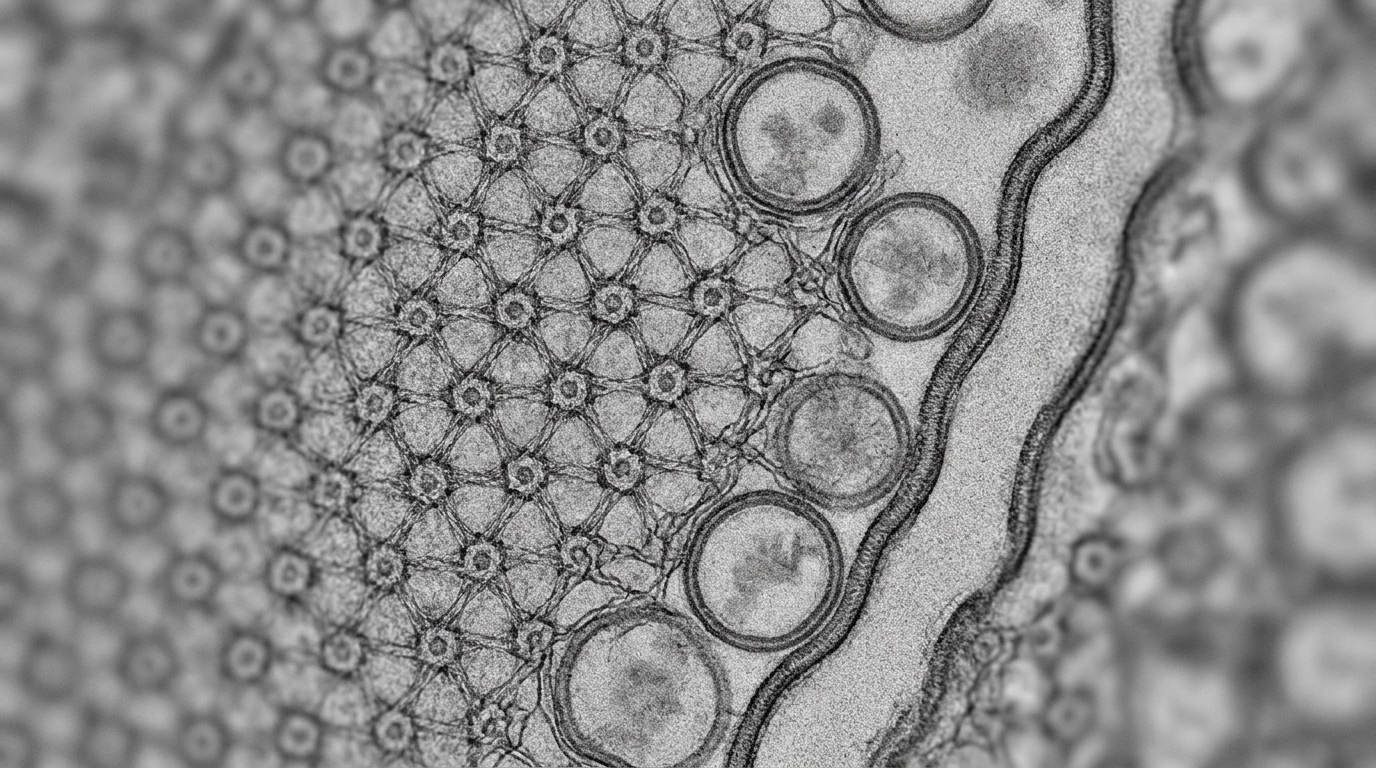
Presynaptic active-zone scaffold proteins ELKS and RIM assemble into periodic nanoscale lattices when reconstituted in non-neuronal cells, establishing that these components form a minimal functional module for synaptic architecture. In reconstituted cellular assemblies, ELKS proteins organize into discrete nanodots with diameters of approximately 60 nanometres, arranged within a regular spatial pattern characterized by a typical lattice spacing of around 130 nanometres. Active zones in presynaptic nerve terminals naturally serve as architectural models for nanotechnology because their native scaffold assemblies spatially organize the complex biological machinery required for neurotransmitter release.

To determine the governing principles behind this spatial organization, researchers analyzed reconstituted protein assemblies alongside native neuronal synapses using super-resolution nanoscopy and quantitative spatial analysis. The investigation integrated these imaging measurements directly with block-copolymer theory to evaluate assembly behaviour. Through this combined approach, the study identified ELKS and RIM as a minimal scaffold module that is fully sufficient to generate ordered hexagonal lattices. The self-assembly process is driven by orthogonal self-association between individual scaffold proteins coupled directly with specific binding interactions between ELKS and RIM.

Accordingly, classical block-copolymer physics provides an explanatory framework capable of describing the nanostructure organization formed by ELKS2 and RIM1.

The researchers further demonstrated that the geometry of the reconstituted nanolattices is systematically tunable through changes in molecular composition. Adjusting the relative stoichiometry of the core scaffold proteins directly alters both the lattice spacing and the overall morphology of the arrays. Furthermore, the structural modularity of the ELKS2–RIM1 system accommodates the recruitment of additional client proteins. The targeted incorporation of regulatory synaptic clients, specifically including RIMBP2 and Liprin-α3, systematically modifies both the spacing between nanodots and the structural morphology of the assembled lattice.

By defining how orthogonal self-association, specific inter-protein binding, and scaffold stoichiometry control lattice parameters, the research elucidates key molecular principles underlying presynaptic active-zone architecture. Designing biological nanomaterials with programmable geometry and function has remained a central challenge across nanotechnology.

Subject of Research: Self-assembly of presynaptic active-zone scaffold proteins into nanoscale lattices

Article Title: Supramolecular protein block copolymers encode presynaptic active-zone nanolattices

Article References: Sakamoto, H., & Shimobayashi, S. F. (2026). Supramolecular protein block copolymers encode presynaptic active-zone nanolattices. Nature Nanotechnology. https://doi.org/10.1038/s41565-026-02340-9

Image Credits: AI Generated

DOI: 10.1038/s41565-026-02340-9

Keywords: presynaptic active zones, scaffold proteins, ELKS, RIM, ELKS2, RIM1, nanolattices, block-copolymer theory, microphase separation, super-resolution nanoscopy, RIMBP2, Liprin-α3, supramolecular assembly, protein condensates, hexagonal lattices, nanotechnology, neurotransmitter release, spatial organization

News Source: Denise Maddox. (November 27, 2026). Presynaptic Active-Zone Scaffold Proteins Self-Assemble Into Ordered Hexagonal Nanolattices. Scienmag.


Tags: block-copolymer theoryELKSELKS2hexagonal latticesLiprin-α3microphase separationnanolatticesnanotechnologyneurotransmitter releasepresynaptic active zonesprotein condensatesRIMRIM1RIMBP2scaffold proteinsSpatial Organizationsuper-resolution nanoscopysupramolecular assembly
Share12Tweet7Share2ShareShareShare1

Related Posts

Terrain Elevation Differences Statistically Explain Systematic Wind Biases Across European Models

Terrain Elevation Differences Statistically Explain Systematic Wind Biases Across European Models

November 27, 2026
Spatiotemporal Graph Network Reduces Traffic Prediction Error Across Three Benchmarks

Spatiotemporal Graph Network Reduces Traffic Prediction Error Across Three Benchmarks

November 27, 2026

Swiss Study Links Organizational Screening Scores to Generative AI Adoption Stages

November 27, 2026

Molecular Locking Strategy Yields 26.73% Efficiency in Perovskite Solar Cells

November 27, 2026

POPULAR NEWS

  • Polidocanol Foam Ratios Show Similar Saphenous Vein Occlusion in Cohort Study

    Polidocanol Foam Ratios Show Similar Saphenous Vein Occlusion in Cohort Study

    29 shares
    Share 12 Tweet 7
  • Extracellular Biophysical Forces Drive Gene Regulation by Directly Deforming the Nucleus

    29 shares
    Share 12 Tweet 7
  • Viatorr Stents Improve Shunt Patency Over Bare Stents in TIPS Review

    29 shares
    Share 12 Tweet 7
  • Fisetin Reduces Bone Density Loss in Accelerated Aging Progeria Mouse Model

    29 shares
    Share 12 Tweet 7

About

We bring you the latest biotechnology news from best research centers and universities around the world. Check our website.

Follow us

Recent News

New Multilevel Exercise Empowerment Scale Demonstrates High Reliability in Adults

Most Surveyed Jowhar Farmers Report Drought Losses and Severe Maize Impacts

Plant Mutualistic Networks Maintained Stable Modular Structures Over Millions of Years

Subscribe to Blog via Email

Enter your email address to subscribe to this blog and receive notifications of new posts by email.

Join 89 other subscribers
  • Contact Us

Bioengineer.org © Copyright 2023 All Rights Reserved.

Welcome Back!

Login to your account below

Forgotten Password?

Retrieve your password

Please enter your username or email address to reset your password.

Log In
No Result
View All Result
  • Homepages
    • Home Page 1
    • Home Page 2
  • News
  • National
  • Business
  • Health
  • Lifestyle
  • Science

Bioengineer.org © Copyright 2023 All Rights Reserved.