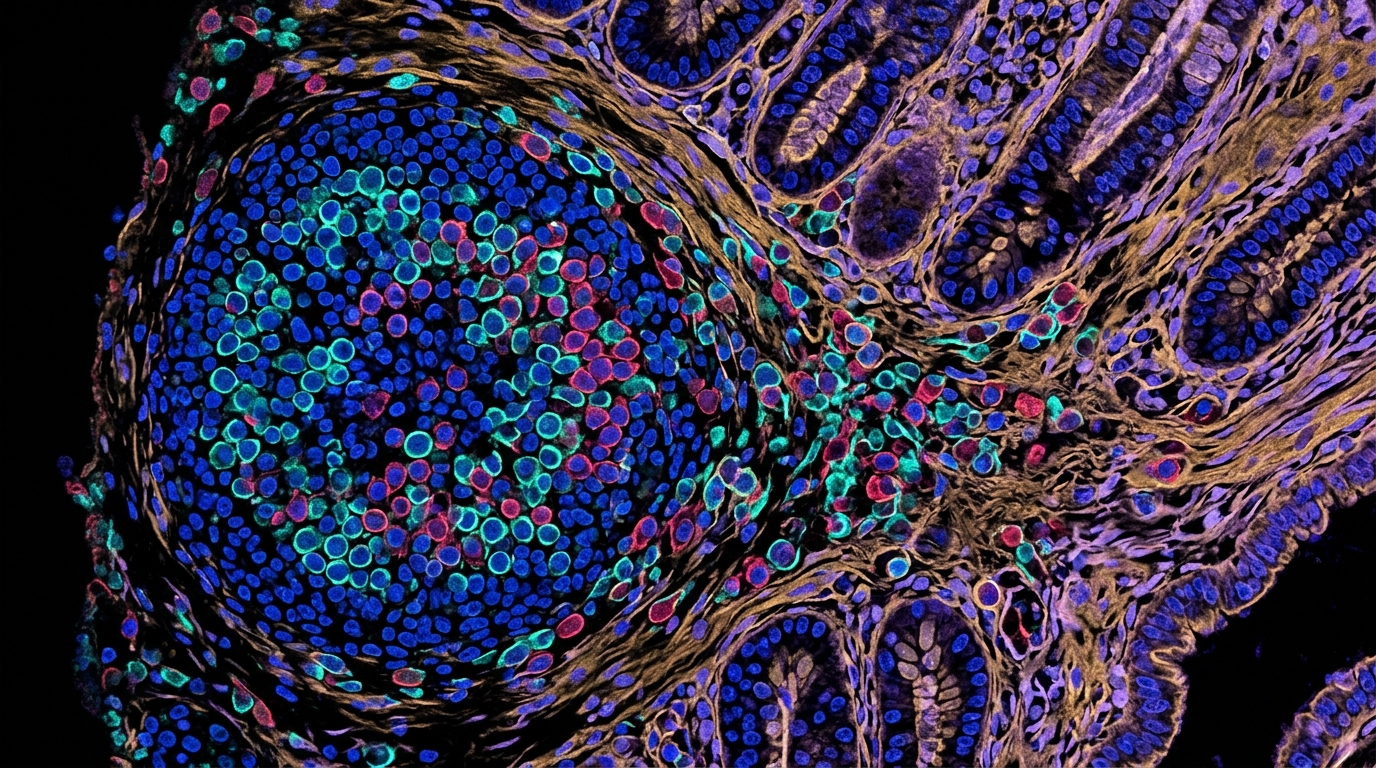
Patients undergoing surgery for peritoneal metastases from colorectal cancer experience significantly longer time to peritoneal relapse when their tumors display tertiary lymphoid structures and elevated expression of an activated immune gene module, according to a clinical investigation. Researchers observed that individuals exhibiting high expression of this specific gene signature achieved a median time to peritoneal relapse of 50 months compared with 16 months among patients with lower expression levels.
The peritoneum represents a specialized immunological niche capable of influencing tumor progression and overall clinical prognosis. Patients diagnosed with peritoneal metastases originating from colorectal cancer face a poor prognosis, yet scientific understanding regarding the specific local immunological factors that influence patient outcomes has remained limited. To clarify these biological relationships, the investigative team analyzed local immune parameters alongside clinical records to track time to peritoneal relapse across a cohort of 87 surgical patients.
To evaluate local immunity within peritoneal metastatic tissues, investigators utilized immunofluorescence staining, flow cytometry, and a dedicated gene expression panel. By applying enrichment analysis together with co-expression network modeling to the profiling data, the researchers identified a coordinated gene module linked directly to postsurgical relapse outcomes. The statistical analysis confirmed that elevated expression of this identified module significantly correlated with extended time to peritoneal relapse, yielding a p-value of 0.014.
Biological characterization of the prognostic gene module revealed markers corresponding to activated, Th1-polarised T cells characterized by active T cell receptor signaling. The module also encompassed complement factors as well as MHC class 1-related protein, designated as MR1. The identification of MR1 within this network suggested a functional contribution of mucosal associated invariant T cells, commonly known as MAIT cells, in mediating anti-tumor immunity within metastatic peritoneal tissues.
Subsequent flow cytometry analyses confirmed the physical presence of MAIT cell infiltration across all examined peritoneal metastases. These infiltrating MAIT cells mounted a measurable Th1 type cytokine response upon evaluation. In parallel, immunofluorescence examinations detected tertiary lymphoid structures in 23 percent of the patient cohort. The presence of these lymphoid structures was similarly associated with prolonged time to peritoneal relapse, showing a median outcome exceeding 60 months compared to 17.7 months in patients lacking the structures, with a p-value of 0.028.
In contrast to the clear predictive value of tertiary lymphoid structures and the specific gene module, general T cell density and macrophage density showed no significant correlation with patient clinical endpoints. When investigators evaluated a combined score incorporating both tertiary lymphoid structure presence and high gene module expression in a multivariate Cox regression analysis, the correlation with time to peritoneal relapse remained statistically significant at a p-value of 0.016. Together, these findings indicate that MAIT cells and tertiary lymphoid structure formation may contribute to effective anti-tumor responses and represent promising targets for future immunotherapeutic strategies in colorectal peritoneal metastases.
Subject of Research: Immune predictors of relapse in colorectal peritoneal metastases
Article Title: Tertiary lymphoid structure formation, MR1 and an activated T cell signature predict relapse after surgery for peritoneal metastases from colorectal cancer
Article References: Sand, J., Langegård, E., Rangelova, T., Ljungman, D., Quiding Järbrink, M., & Bexe Lindskog, E. (2026). Tertiary lymphoid structure formation, MR1 and an activated T cell signature predict relapse after surgery for peritoneal metastases from colorectal cancer. Cancer Immunology, Immunotherapy. https://doi.org/10.1007/s00262-026-04636-0
Image Credits: AI Generated
DOI: 10.1007/s00262-026-04636-0
Keywords: Colorectal cancer, Peritoneal metastases, Tertiary lymphoid structures, Time to peritoneal relapse, MAIT cells, MR1, Th1 polarization, T cell receptor signaling, Flow cytometry, Immunofluorescence, Gene expression panel, Co-expression network modeling, Complement factors, Macrophage density, T cell density, Multivariate Cox analysis, Tumor microenvironment, Immunotherapy targets
News Source: Nathaniel Bowman. (November 27, 2026). Immune Structures and Activated T Cell Genes Predict Colorectal Metastasis Relapse. Scienmag.