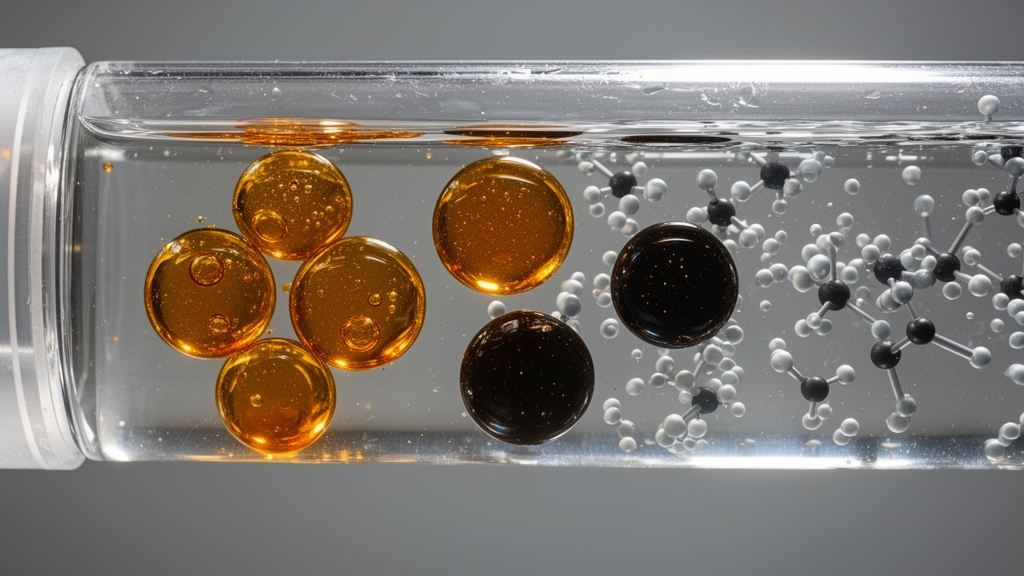
Experimental pressurization of water-in-oil emulsions using carbon dioxide and nitrogen gases has revealed starkly contrasting stability behaviors between Brazilian post-salt and pre-salt crude oils, according to laboratory investigations published in the Brazilian Journal of Chemical Engineering. Researchers evaluated how moderate gas pressurization at 1.0 megapascal over twenty-four hours altered droplet size distribution, interfacial tension, and total acid number across distinct saline formulations. Emulsions formed with dense, highly viscous post-salt crude exhibited notably robust stability with minimal morphological variation following pressurization. In sharp contrast, emulsions prepared with lighter pre-salt petroleum displayed substantial droplet interface disruption, coalescence, and pronounced shifts in interfacial dynamics when subjected to the same gaseous environments.
Water-in-oil emulsions represent a pervasive operational challenge throughout the petroleum production lifecycle, particularly during fluid extraction, transport, and refinery processing stages. When formation water coexists with produced crude, high mechanical shear during extraction readily disperses saline water droplets throughout the continuous oil matrix. These stabilized emulsions substantially hinder oil-water separation, escalate operational expenses, demand chemical demulsifiers, and drive equipment corrosion, scaling, and viscosity increases. While carbon dioxide and nitrogen are routinely injected into subsurface reservoirs during enhanced oil recovery operations, their subsequent thermodynamic and chemical interactions with emulsified fluids under moderate surface facility pressures remain critical to downstream phase separation efficiency.
To investigate these comparative interactions, the research team gathered post-salt crude designated as Oil A and pre-salt petroleum designated as Oil B, subjecting both to comprehensive physicochemical characterization under standardized ASTM procedures. Post-salt Oil A exhibited a high density of 0.970 grams per cubic centimeter, an API gravity of 13.7 degrees, an elevated dynamic viscosity of 6,766 millipascal-seconds at 40 degrees Celsius, and a total acid number of 1.209 milligrams of potassium hydroxide per gram. In contrast, pre-salt Oil B presented a lighter density of 0.870 grams per cubic centimeter, an API gravity of 27.3 degrees, a significantly lower viscosity of 18.489 millipascal-seconds at 40 degrees Celsius, and a minimal total acid number of 0.176 milligrams of potassium hydroxide per gram.
SARA compositional fractionation underscored the molecular divergence between the two crude specimens, with pre-salt Oil B comprising 53 weight percent saturates and 20 weight percent polar compounds, compared to post-salt Oil A which incorporated 7 weight percent asphaltenes alongside significantly higher polar concentrations. These inherent compositions directly dictated emulsion formation. The researchers prepared water-in-oil emulsions by dispersing a 10 percent volume-to-mass aqueous phase into heated crude samples at 5,000 revolutions per minute using a mechanical rotor-stator homogenizer. The aqueous phases replicated downhole chemistry, utilizing deionized water, synthetic formation water containing 55,000 milligrams per liter of sodium chloride, and saturated single-salt solutions of sodium chloride, sodium carbonate, calcium chloride, and magnesium chloride.
Pressurization trials were performed within a five-liter stainless-steel pressure vessel equipped with dedicated pressure monitoring manometers and gas inlet-outlet valves. Prepared emulsion batches of approximately 100 milliliters were introduced to the sealed vessel, purged with either 99.98 percent purity carbon dioxide or 99.99 percent purity nitrogen, and maintained under 1.0 megapascal of pressure for 24 hours at a regulated room temperature of 25 degrees Celsius. Following depressurization, the emulsions were immediately characterized without chemical dilution or mechanical disturbance using polarized light optical microscopy, pendant drop interfacial tensiometry, and direct potentiometric titration according to ASTM standard D664-17.
Optical microscopy revealed that post-salt Oil A emulsions generally maintained their structural integrity and droplet morphology after exposure to both gases, except when formulated with alkaline sodium carbonate. In that specific formulation, carbon dioxide exposure caused noticeable droplet deformation and interfacial film darkening. The researchers attributed this darkening and localized interfacial wrinkling to acid-base chemical reactions occurring between dissolved acidic carbon dioxide gas and basic carbonate ions within the aqueous droplets. Conversely, nitrogen exposure exerted negligible morphological influence on post-salt emulsions, preserving spherical dispersed water droplets across the examined saline systems.
Pre-salt Oil B emulsions demonstrated far greater morphological vulnerability to gaseous pressurization, particularly in the presence of carbon dioxide. In emulsions prepared with deionized water, optical microscopy following carbon dioxide depressurization showed widespread rupture of the interfacial protective films surrounding dispersed aqueous droplets. Depressurization allowed dissolved carbon dioxide to form microbubbles that migrated upward through the droplet interfaces, mechanically tearing the protective surfactant layer and inducing droplet coalescence. This coalescence dramatically shifted the average droplet diameter of the deionized water emulsion from a baseline range of 3.6 to 7.5 micrometers up to 13.7 micrometers, accompanied by severe interfacial agglomeration.
Droplet size distribution measurements further quantified this divergence, showing that baseline post-salt Oil A emulsions exhibited narrow mean droplet diameters between 1.67 and 2.75 micrometers, which remained tightly bounded between 1.60 and 2.70 micrometers after carbon dioxide exposure and between 1.79 and 3.26 micrometers after nitrogen contact. For pre-salt Oil B, while carbon dioxide caused pronounced droplet coarsening, nitrogen pressurization produced an opposing effect, reducing average droplet sizes to between 3.2 and 4.7 micrometers, specifically in systems prepared with sodium chloride, calcium chloride, and magnesium chloride. The researchers suggested that nitrogen preferentially dissolves into lighter hydrocarbon fractions, modifying continuous oil phase dynamics and limiting droplet expansion.
Interfacial tension measurements corroborated the optical and droplet size findings, with pre-salt Oil B generally exhibiting higher baseline interfacial tension than post-salt Oil A due to lower polar compound and asphaltene contents. For post-salt Oil A, carbon dioxide pressurization drastically escalated interfacial tension against deionized water from 3.38 to 13.3 millinewtons per meter due to carbonic acid formation and asphaltene destabilization, while reducing tension against formation water from 8.20 to 1.63 millinewtons per meter. In pre-salt Oil B, nitrogen contact induced a more substantial interfacial tension reduction across saline phases than carbon dioxide, consistent with the observed decrease in droplet dimensions and suggesting enhanced kinetic stability under moderate nitrogen pressures.
Direct potentiometric titration of whole emulsions revealed complex chemical interactions governing total acid number shifts. In post-salt Oil A, carbon dioxide pressurization sharply increased the apparent total acid number in sodium carbonate emulsions from 0.747 to 5.320 milligrams of potassium hydroxide per gram, and in calcium chloride systems from 0.609 to an extraordinary 23.515 milligrams of potassium hydroxide per gram. The latter spike was attributed to high inorganic acidity generated by intense proton release during carbon dioxide dissolution alongside concentrated chloride ions. In pre-salt Oil B, nitrogen pressurization produced an unexpected, previously unreported reduction in total acid number in emulsions prepared with calcium chloride and magnesium chloride, highlighting the complex role of divalent cations and identifying key operational considerations for demulsification processing.
Beyond bulk tension shifts, the specific chemical interaction between crude acids and basic salts yielded extreme interfacial phenomena. In evaluations of Oil A against the saturated sodium carbonate solution, interfacial tension dropped below the tensiometer detection limit of 0.01 millinewtons per meter both before and after gas exposure. The researchers explained that basic carbonate species react directly with petroleum naphthenic acids to form natural surfactants in situ. A corresponding drop in interfacial tension occurred in pre-salt Oil B emulsions prepared with sodium carbonate. Despite Oil B possessing a low initial total acid number of 0.176 milligrams of potassium hydroxide per gram, exposure to the high pH aqueous phase promoted sufficient acid molecule dissociation to lower interfacial tension, suggesting that alkaline brine chemistry universally favors emulsion stabilization regardless of crude density.
Aqueous phase electrochemistry and pH variations further clarified the divergent destabilization tendencies observed between the systems. Saturated calcium chloride and magnesium chloride solutions exhibited acidic pH values due to salt hydrolysis, whereas formation water and sodium chloride solutions remained near neutral. Synthetic formation water recorded the highest ionic conductivity among the tested aqueous phases despite possessing a lower overall salt concentration than the saturated brines, demonstrating that electrolyte dissociation and ionic mobility govern charge density and droplet attraction in the continuous medium. When paired with post-salt Oil A, the acidic divalent salt solutions maintained persistently high interfacial tensions, fostering unstable emulsions. Conversely, pre-salt Oil B showed relative stability against these acidic salts, particularly under nitrogen pressurization where droplet dimensions decreased across sodium chloride, calcium chloride, and magnesium chloride formulations.
The research team underscored specific methodological boundaries and unmeasured mechanistic steps that qualify the practical application of their laboratory findings. While the physical rupture of droplet interfacial films in Oil B following carbon dioxide exposure aligns with bubble release mechanisms described in literature, direct bubble dynamics and interfacial rheological properties were not experimentally measured. Similarly, the specific chemical reaction products formed at the oil-water interface were not directly isolated or identified. Additionally, although the preferential interaction and dissolution of nitrogen into lighter hydrocarbon fractions offers a compelling explanation for the reduced droplet sizes observed in pre-salt crude, the team did not conduct direct gas solubility or phase partitioning measurements. The authors concluded that subsequent thermodynamic studies will be necessary to confirm these molecular interactions and optimize gas-assisted phase separation protocols in primary petroleum processing facilities.
Subject of Research: Pressurization effects of carbon dioxide and nitrogen on Brazilian crude oil emulsions
Article Title: Influence of carbon dioxide and nitrogen gases on W/O emulsion stability: a comparison between Brazilian post-salt and pre-salt oils
Article References: da Silva, M., Sad, C. M. S., Filgueiras, P. R., Castro, E. V. R., & Alves, R. P. (2026). Influence of carbon dioxide and nitrogen gases on W/O emulsion stability: a comparison between Brazilian post-salt and pre-salt oils. Brazilian Journal of Chemical Engineering. https://doi.org/10.1007/s43153-026-00691-3
Image Credits: AI Generated
DOI: 10.1007/s43153-026-00691-3
Keywords: water-in-oil emulsions, post-salt petroleum, pre-salt petroleum, carbon dioxide pressurization, nitrogen pressurization, interfacial tension, droplet size distribution, total acid number, enhanced oil recovery, emulsion stability, phase separation, saline aqueous phase, petroleum processing, asphaltenes, calcium chloride, sodium carbonate
News Source: Bethany Barker. (November 26, 2026). Carbon Dioxide and Nitrogen Pressurization Selectively Alter Post-Salt and Pre-Salt Oil Emulsions. Scienmag.