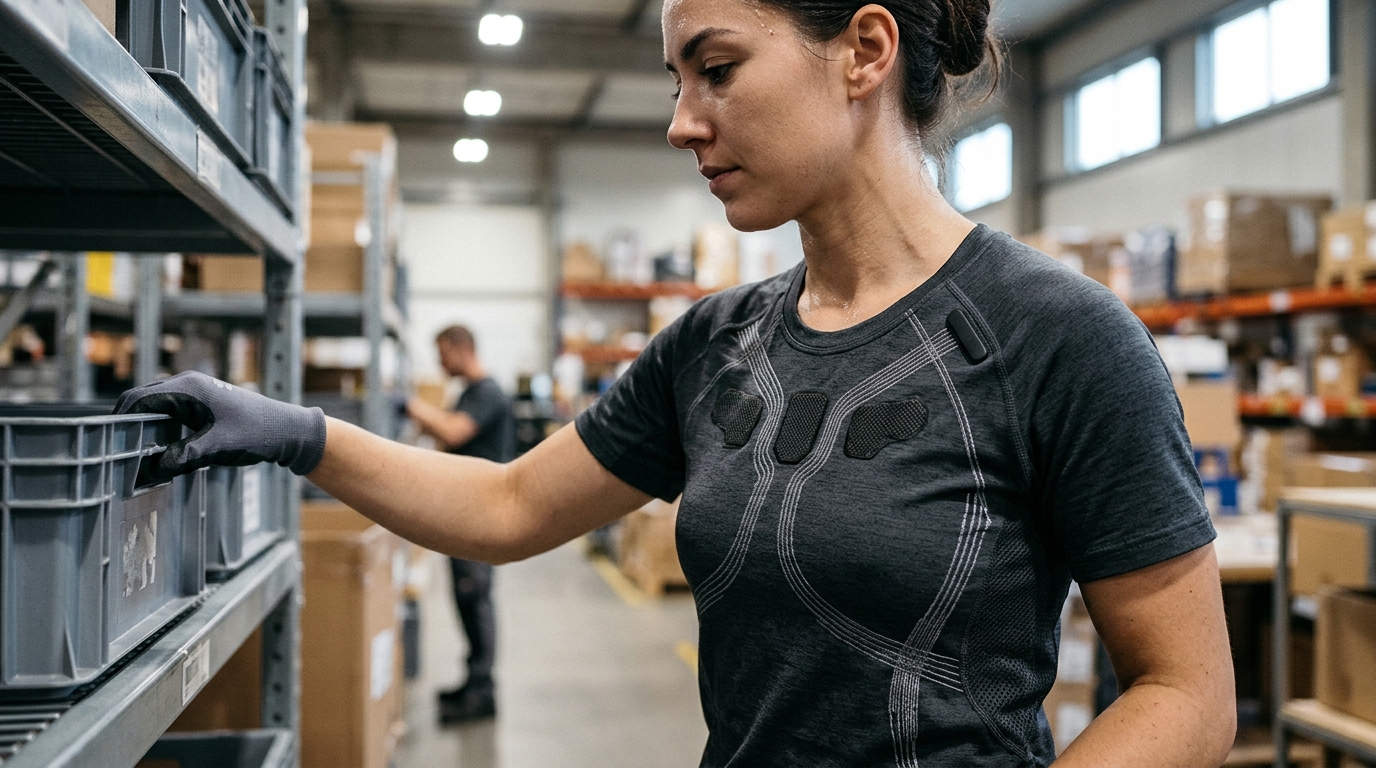
Engineers and occupational safety researchers have developed and validated SenseRisc, an instrumented smart shirt designed to protect workers through continuous physiological and motion monitoring. Reported in Wearable Technologies, the prototype integrates screen-printed graphene respiratory sensors, gel-free electrocardiogram electrodes, and a triaxial accelerometer to measure vital signs and movement directly during physical tasks. Rather than relying on isolated health indicators, the platform processes incoming signals in real time through an onboard framework that calculates an occupational Preventive Risk Index. In an initial laboratory trial involving eight healthy male participants performing standardized manual handling and aerobic exercises, the smart shirt successfully recorded respiratory dynamics, cardiac responses, and movement intensity, demonstrating the system’s ability to map multiple physiological parameters into a coherent, interpretable measure of worker physical fatigue.
Citing figures from the International Labour Organisation, the study notes that work-related illnesses and accidents caused approximately three million deaths globally in 2019, alongside 395 million non-fatal injuries. Although intelligent protective equipment and consumer fitness wearables have progressed rapidly, conventional commercial devices are rarely designed specifically for workplace safety. Earlier protective prototypes evaluated in hazardous domains, such as firefighting or forestry, typically gathered basic cardiac or galvanic skin responses without providing intelligent data processing or immediate user feedback. Furthermore, existing wearable monitoring solutions frequently concentrate on single parameters like thermal stress while omitting respiratory rate, leaving a critical gap in holistic worker assessment.
To address these limitations, the SenseRisc architecture operates across three integrated subsystems engineered for reliable sensing, efficient processing, and practical wearability. The primary physical component is a modified commercial T-shirt incorporating specialized sensor modules that record cardiovascular activity, chest expansion, and bodily movement. The second component is a mobile Android application serving as a central hub that links to embedded electronics via Bluetooth Low Energy, handles local logging, and transfers timestamped data to a secure cloud platform. The third subsystem is a local processing server running an intelligent algorithm that retrieves cloud-stored records, fuses physiological and movement indicators using a fuzzy logic model, and calculates the worker’s Preventive Risk Index. By relying on Bluetooth Low Energy, which operates reliably within typical one-meter wearable distances, the smart garment minimizes battery consumption, enabling uninterrupted data acquisition throughout an eight-hour work shift.
The shirt’s respiratory tracking apparatus utilizes four piezoresistive strain sensors printed directly onto fabric using a screen-printing process with polymeric paint loaded with graphene nanoplates. These textile strain gauges are wired via conductive threads and 2.5-millimeter jack connectors to a Respiration Electronic Platform containing an M0+ microcontroller and a 16-bit analog-to-digital converter. Powered by a 3.7-volt lithium-polymer battery, the platform applies a Howland circuit to deliver a constant current through each sensor, generating voltage fluctuations proportional to chest wall expansion during breathing cycles. Operating at a sampling frequency of 50 hertz, the raw respiratory signals pass through a third-order Butterworth bandpass filter with cutoff frequencies set at 0.05 hertz and 2 hertz, successfully eliminating slow baseline movement artifacts while capturing true ventilation waveforms.
To derive a single representative respiratory rate from the four sensor streams, the processing software segments filtered signals into non-overlapping 30-second windows and calculates power spectral density using Welch’s averaged periodogram estimator with 50 percent segment overlap. The channel exhibiting the highest spectral peak power is selected for that interval, and its dominant frequency is converted into breaths per minute. Meanwhile, cardiovascular monitoring is executed by a SeisMote module coupled to gel-free electrodes placed along the shirt’s inner surface. Capable of multi-node acquisition at 200 hertz with synchronization jitter below 0.2 milliseconds and over 16 hours of battery operation, the device transmits raw electrocardiogram signals via Bluetooth Low Energy. The software applies the Pan-Tompkins algorithm to identify QRS complexes, computes the inter-beat interval between successive R-peaks, and derives instantaneous heart rate in beats per minute.
Movement tracking is conducted by an STMicroelectronics SensorTile inertial measurement platform tucked into a chest pocket, which records triaxial acceleration alongside ambient pressure, temperature, and humidity at 100 hertz. An aggregate activity level metric is computed by taking the Euclidean norm of the three orthogonal acceleration axes, quantifying overall movement intensity regardless of direction. To interpret these multidimensional inputs, the system implements a fuzzy logic framework that maps respiratory rate, heart rate, and activity level into qualitative linguistic variables through trapezoidal membership functions. Three membership functions define respiratory patterns based on established clinical benchmarks, distinguishing bradypnea below 12 breaths per minute, normal respiration between 12 and 16 breaths per minute, and tachypnea. Heart rate is mapped across four trapezoidal functions representing low values below 60 beats per minute, normal resting rates between 60 and 100 beats per minute, and elevated tiers reflecting moderate and intense cardiovascular exertion.
Completing the fuzzy inference system, activity level is categorized into low and high states, while the output Preventive Risk Index is modeled across four output membership functions designating low, mid-low, mid-high, and high risk conditions. A rule base comprising 23 fuzzy rules translates parameter activations into appropriate risk tiers based on ergonomic stress principles. When vital signs remain within normal ranges during moderate physical tasks, the system assigns a low risk score. Conversely, anomalous combinations, such as marked tachycardia or respiratory distress coinciding with high physical activity, are mapped to elevated hazard levels. Computed periodically on the local server whenever data from the preceding 30 seconds is processed, the resulting risk index is transmitted back to the mobile application. The smartphone interface displays the calculated metric accompanied by a color-coded flag—green, yellow, or red—giving workers and safety managers an immediate visual appraisal of physical strain.
To validate the smart garment under controlled experimental conditions, researchers recruited eight healthy male participants with an average age of 26.6 years and a standard deviation of 3.6 years. The laboratory validation protocol was designed to induce varied physical demands across distinct tasks while examining how effectively the embedded sensors and fuzzy algorithm captured changing physiological states. The protocol comprised three standardized two-minute activities: repetitive lifting of a three-kilogram box from the ground, manual carrying of the same box while walking at approximately one meter per second regulated by a metronome, and vigorous jumping jacks to generate intense aerobic exertion. The complete sequence followed an initial sequence of lifting, moving, and jumping jacks, directly followed by a second repetition of the lifting and moving exercises. This repeated sequence enabled the research team to investigate cardiovascular and respiratory recovery dynamics following exhaustive exertion.
The experimental measurements demonstrated that the smart shirt reliably captured variations in physical exertion and physiological strain across the trial. Cardiovascular measurements showed heart rate rising from 75.61 ± 8.65 beats per minute at the start of testing to 127.77 ± 8.95 beats per minute by the end of the jumping jacks, followed by progressive recovery during the subsequent carrying and lifting tasks. Respiratory rate increased during early physical exertion, reaching peaks of 33.40 ± 22.92 breaths per minute during the first series, but decreased as fatigue mounted during jumping jacks before stabilizing at 14.84 ± 1.50 breaths per minute during the second round of lighter tasks. Non-parametric Mann-Whitney statistical tests confirmed significant differences in recorded physiological parameters between successive activities.
The Preventive Risk Index synthesized the interaction between activity demands and physiological load throughout the experimental protocol. During the initial lifting task, the average risk index remained low at 0.28 ± 0.13, rising to 0.74 ± 0.05 at the conclusion of the carrying exercise as respiratory frequency elevated. Crucially, when participants returned to the second round of box lifting while experiencing residual physical fatigue, the risk index rose to 0.76 ± 0.07. Under low-demand tasks, a worker’s physiology should normally resemble resting conditions; by registering elevated risk during low-impact tasks performed under persistent fatigue, the system effectively detected residual physical strain that conventional observations might overlook.
Subjective evaluations demonstrated strong overall usability alongside clear design targets for future garment iterations. Participants awarded the SenseRisc prototype an average System Usability Scale score of 91.25 ± 5.33, well above the established threshold of 68 that denotes acceptable system usability. A tailored seven-point Likert questionnaire indicated high satisfaction with garment weight and mobility, both averaging 6.12 ± 1.02, confirming that the smart shirt permitted unrestricted movement without feeling excessively heavy. Fabric breathability and skin sensitivity each received moderate ratings of 4.50, while adjustability scored 2.43 ± 1.20, identifying sizing flexibility as the most pressing area for ergonomic refinement. The authors emphasized that the prototype serves as an occupational safety instrument rather than a certified medical device, aiming to provide actionable risk insights in demanding environments. Planned future research will involve testing across diverse worker populations on active construction sites, developing varied garment sizes, and extending evaluations across full shifts.
Subject of Research: Multimodal wearable smart shirt and fuzzy logic system for occupational risk prevention
Article Title: SenseRisc: An instrumented smart shirt for risk prevention in the workplace
Article References: Tamantini, C., Marra, F., Di Tocco, J., Di Modica, S., Lanata, A., Cordella, F., Ferrarin, M., Rizzo, F., Stefanelli, M., Papacchini, M., Delle Site, C., Tamburrano, A., Massaroni, C., Schena, E., Zollo, L., & Sarto, M. S. (2025). SenseRisc: An instrumented smart shirt for risk prevention in the workplace. Wearable Technologies, 6, Article e20. https://doi.org/10.1017/wtc.2025.10
Image Credits: AI Generated
DOI: 10.1017/wtc.2025.10
Keywords: wearable technology, smart garments, occupational safety, Preventive Risk Index, electrocardiogram, respiratory rate, graphene sensors, accelerometer, fuzzy logic, workplace health, physical fatigue, System Usability Scale, Bluetooth Low Energy, physiological monitoring, piezoresistive sensors, cardiovascular monitoring, occupational ergonomics
News Source: Denise Maddox. (November 26, 2026). Smart Shirt Prototype Tracks Worker Vital Signs and Workplace Fatigue Risks. Scienmag.