A sequential extraction system combining ultrasound acoustic cavitation with pressurized liquid technology has established a highly efficient pathway for isolating antioxidant polyphenols and flavonoids from the foliage of the umbu-cajá tree. Chemical engineering researchers demonstrated that coupling dynamic high-pressure fluid flow with ultrasonic waves across an increasing polarity gradient achieves superior clean-up and yield compared to conventional and single-step methodologies. Operating at an isobaric pressure of ten megapascals, the sequential ultrasound-assisted pressurized liquid extraction protocol maximized the concentration of target bioactive molecules in dried plant extracts. The highest recovery was documented when ethanol served as the final extractor solvent, yielding a total phenolic content of 754.93 plus or minus 0.87 micrograms per gram of dried extract and a total flavonoid concentration of 742.05 plus or minus 5.12 micrograms per gram of dried extract. These enriched ethanolic fractions exhibited enhanced free radical scavenging capability against the 2,2-diphenyl-1-picrylhydrazyl radical, recording a half-maximal inhibitory concentration of 92.3 plus or minus 1.3 micrograms per milliliter, demonstrating the operational advantage of multi-stage pressurized acoustic processing.
The botanical source investigated in this research is Spondias bahiensis, an Anacardiaceous fruit tree native to the Brazilian Northeast that is locally known as umbu-cajá. Cultivation of this species extends across northeastern regions into northern Brazil, supporting an estimated regional agricultural production ranging between 15,000 and 20,000 metric tons per year. The commercial exploitation of umbu-cajá currently centers on fruit processing, generating regional consumer commodities such as frozen fruit pulp, bottled juices, and traditional jams. Emerging industrial interest also explores diversified applications, including fermented alcoholic beverages that remain unproduced on a broad industrial scale. Phytochemical literature regarding the parental ancestral lineages of the tree, Spondias mombin and Spondias tuberosa, has historically documented significant natural stores of bioactive secondary metabolites. These include notable phenolic acids and flavonoid derivatives such as gallic acid, ellagic acid, caffeic acid, chlorogenic acid, catechin, epicatechin, rutin, isoquercitrin, and varied quercetin structures, which exhibit biomedical antioxidant, antimicrobial, and anticancer properties in published scientific investigations.
Plant foliage utilized for the experimental extractions was collected from the Empresa Baiana de Desenvolvimento Agrícola located in the municipality of Itaberaba, Bahia, situated at coordinates longitude 40 degrees 18 minutes 14 seconds West and latitude 12 degrees 30 minutes 56 seconds South. Specimen vouchers were formally registered in the exsiccata collection of the University Tiradentes Herbarium in Aracaju under registration protocol number 0837. Prior to chemical processing, all harvested leaf samples underwent controlled convective drying at 40 degrees Celsius for 72 hours inside a hot-air circulation oven to stabilize the biological matrix. The dried foliage was subsequently milled and separated through Tyler series sieves to isolate uniform particles sized between 16 and 32 mesh. This specific particle dimension was selected to optimize fluid-solid contact without hindering ultrasonic wave propagation, while simultaneously preventing mechanical clogging within the stainless-steel pressurized extractor tubing to preserve an uninterrupted, constant solvent flow rate throughout dynamic operations.
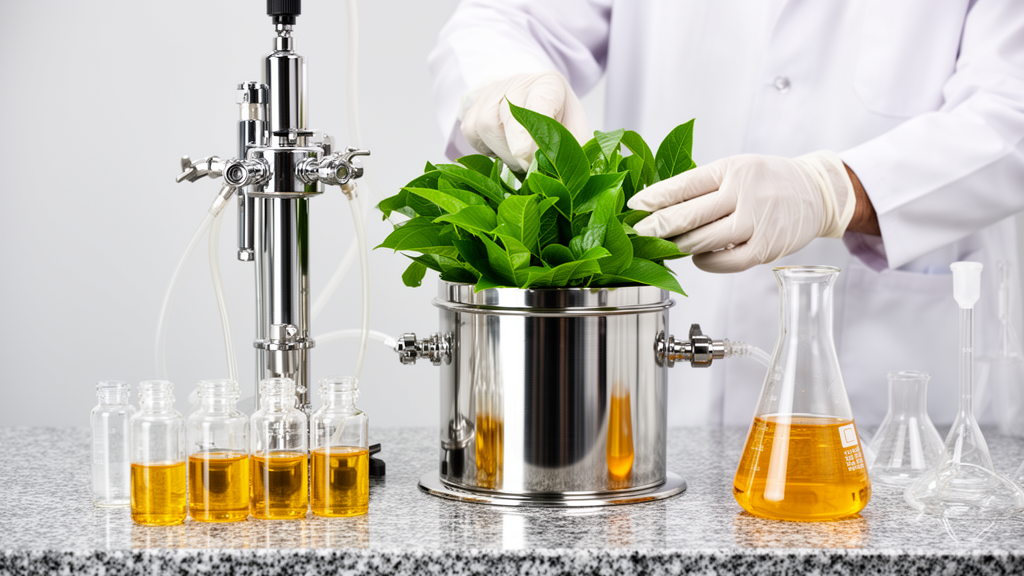
To overcome these historical limitations, the research team configured an experimental system that integrated an ultrasonic bath with a high-pressure extraction apparatus. The ultrasonic unit operated at a fixed frequency of 40 kilohertz with a maximum nominal power input of 200 watts. The pressurized liquid extraction circuit featured a 20-milliliter stainless-steel extractor cell connected to an Alliance Series III HPLC isocratic displacement pump for organic solvents and an Isco 260D syringe pump delivering compressed carbon dioxide. Temperature inside the vessel was maintained at 40 degrees Celsius by coupling the bath, while in-line pressure transducers and digital indicators verified strict isobaric regulation at ten megapascals with an established continuous mobile phase flow rate of one milliliter per minute.
To evaluate relative process performance, the experimental matrix compared four distinct operational configurations: standard atmospheric ultrasound-assisted extraction, conventional pressurized liquid extraction, combined single-step ultrasound-assisted pressurized liquid extraction, and sequential ultrasound-assisted pressurized liquid extraction. In the atmospheric ultrasound protocol, two grams of prepared leaf material were immersed in 120 milliliters of selected solvent within an Erlenmeyer flask and sonicated for 120 minutes at 40 degrees Celsius before paper filtration. In the dynamic pressurized liquid setup, two grams of biomass were loaded into the extractor cell under matching temperature, duration, and volumetric conditions. The hybrid single-step process applied acoustic waves and high hydrostatic pressure simultaneously. Following each run, residual organic solvents were completely evaporated inside a hot-air circulation oven held at 40 degrees Celsius, and all recovered dry extracts were stored protected from light and thermal exposure at minus four degrees Celsius prior to analytical quantification.
The sequential protocol, designated S-UAPLE, processed leaf biomass through three successive stages featuring solvents of increasing dielectric polarity: non-polar n-hexane, intermediate-polarity ethyl acetate, and polar ethanol. A critical technical refinement between stages involved flushing the pressurized extraction cell with compressed carbon dioxide. This intermediary gas purge purged residual solvent from the matrix, effectively drying the biomass bed in situ before the subsequent solvent was introduced. Single-step hybrid extraction trials demonstrated that applying ultrasound alongside ten megapascals of pressure increased overall extraction yields for all tested solvents relative to atmospheric sonication and non-sonicated pressurized extraction. When n-hexane was employed in the one-step hybrid system, the overall yield reached 4.1 plus or minus 0.1 percent, noticeably higher than the 2.5 plus or minus 0.1 percent obtained via atmospheric sonication and the 3.2 plus or minus 0.1 percent produced by pressurized liquid extraction alone.
During sequential extraction, the initial n-hexane phase removed lipophilic constituents, leaving a pre-purified biomass for the subsequent stages. Consequently, the individual yields for the succeeding solvents in the sequence were 1.7 plus or minus 0.1 percent for ethyl acetate and 2.1 plus or minus 0.1 percent for ethanol. Although these individual mass yields were lower than the corresponding single-step hybrid yields of 5.1 plus or minus 0.1 percent for ethyl acetate and 6.2 plus or minus 0.04 percent for ethanol, the sequential extraction selectively fractionated secondary metabolites. The initial removal of low-polarity components produced extracts with significantly enhanced target purity. The combination of ultrasonic cavitation bubbles and high-pressure fluid penetration facilitated cellular disruption, tissue detexturation, and rapid mass transfer through the biomass cell walls without exceeding the ten-megapascal threshold where acoustic cavitation efficiency diminishes.
Spectrophotometric quantification verified that the solvent polarity and the operational extraction mode exerted profound effects on the recovery of total phenolic compounds. Total phenolics were determined via the Folin-Ciocalteu colorimetric method, reacting sample aliquots with sodium carbonate at 50 degrees Celsius for 15 minutes before measuring optical absorbance at 745 nanometers against a gallic acid standard calibration curve. Across all comparative trials, ethanol recovered the highest quantity of phenolic compounds. In contrast, the sequential hybrid protocol achieved 754.9 plus or minus 1.0 micrograms of gallic acid equivalents per gram in its final ethanolic fraction, proving that preliminary washing with n-hexane and ethyl acetate eliminates interfering matrix substances and concentrates polar polyphenols.
Total flavonoid concentrations were determined through the aluminum nitrate colorimetric method, measuring absorbance at 415 nanometers against a high-purity rutin reference curve following thirty minutes of room-temperature incubation in the dark. Mirroring the phenolic outcomes, flavonoid abundance reached its highest levels in ethanolic extracts processed with pressurized acoustic assistance. When ethanol served as the third stage of the sequential protocol, the flavonoid concentration reached 742.05 plus or minus 5.12 micrograms of rutin equivalents per gram of dried extract. Microscopic and physical mechanisms induced by ultrasound—including superficial particle erosion, fragmentation, and sonocapillary fluid penetration—worked synergistically with the heightened solvent diffusivity provided by the ten-megapascal pressurized liquid environment, effectively accelerating the desorption and transport of flavonoid molecules from the cellular structures into the flowing solvent.
Reaction mixtures containing 400 microliters of sample and 2600 microliters of radical solution were incubated in darkness for 30 minutes before monitoring spectrophotometric absorbance reduction at 517 nanometers. All leaf extracts demonstrated observable antioxidant scavenging, with hybrid pressurized extracts consistently outperforming their non-pressurized and non-sonicated counterparts. The sequential ethanolic extract exhibited the highest antioxidant potency of the study, achieving a radical-scavenging half-maximal inhibitory concentration of 92.3 plus or minus 1.3 micrograms per milliliter, directly reflecting its elevated phenolic and flavonoid contents. The researchers concluded that sequential pressurized sonication provides an efficient separation platform for natural antioxidants, noting that future investigations should develop specialized high-pressure instrumentation to quantify real-time ultrasonic power dissipation under continuous-flow operating conditions.
Subject of Research: Ultrasonic pressurized liquid extraction of antioxidant polyphenols from umbu-cajá leaves
Article Title: Sequential separation process of antioxidant polyphenols from umbu-cajá (Spondias bahiensis P. Carvalho, Van den Berg & M. Machado) leaves by ultrasound-assisted pressurized liquid extraction
Article References: Amorim, C. R. B., Lopez, J. A., Franceschi, E., Borges, G. R., Dariva, C., & Santos, K. S. (2026). Sequential separation process of antioxidant polyphenols from umbu-cajá (Spondias bahiensis P. Carvalho, Van den Berg & M. Machado) leaves by ultrasound-assisted pressurized liquid extraction. Brazilian Journal of Chemical Engineering. https://doi.org/10.1007/s43153-026-00659-3
Image Credits: AI Generated
DOI: 10.1007/s43153-026-00659-3
Keywords: umbu-cajá, Spondias bahiensis, ultrasound-assisted extraction, pressurized liquid extraction, sequential extraction, phenolic compounds, flavonoids, antioxidant activity, DPPH assay, cavitation, extraction yield, biomass valorization, green extraction, ethanol extract, ethyl acetate, n-hexane, acoustic cavitation, phytochemicals
News Source: Bethany Barker. (November 26, 2026). Sequential Pressurized Liquid Extraction Boosts Antioxidant Polyphenol Yield From Umbu-Cajá Leaves. Scienmag.