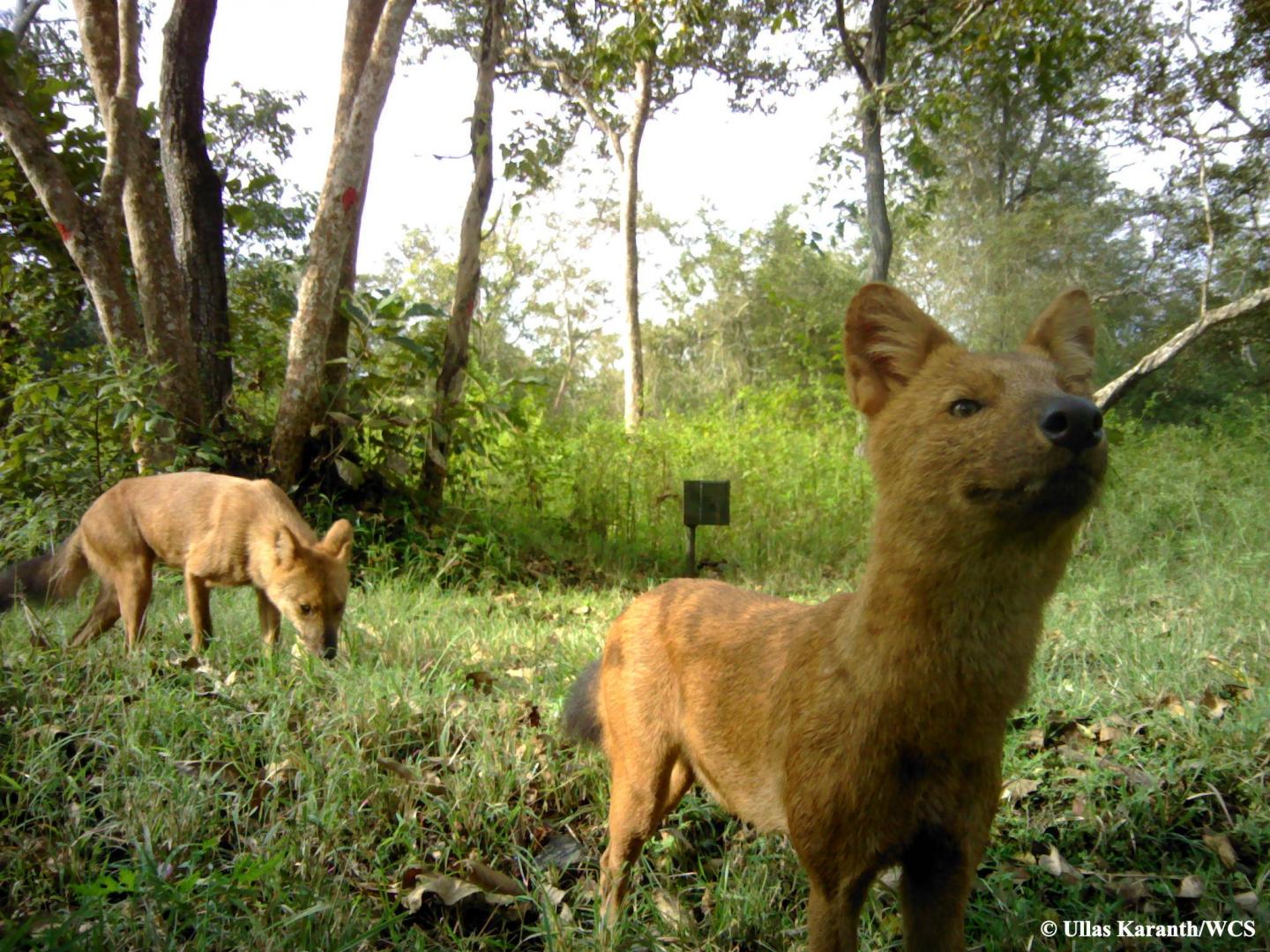
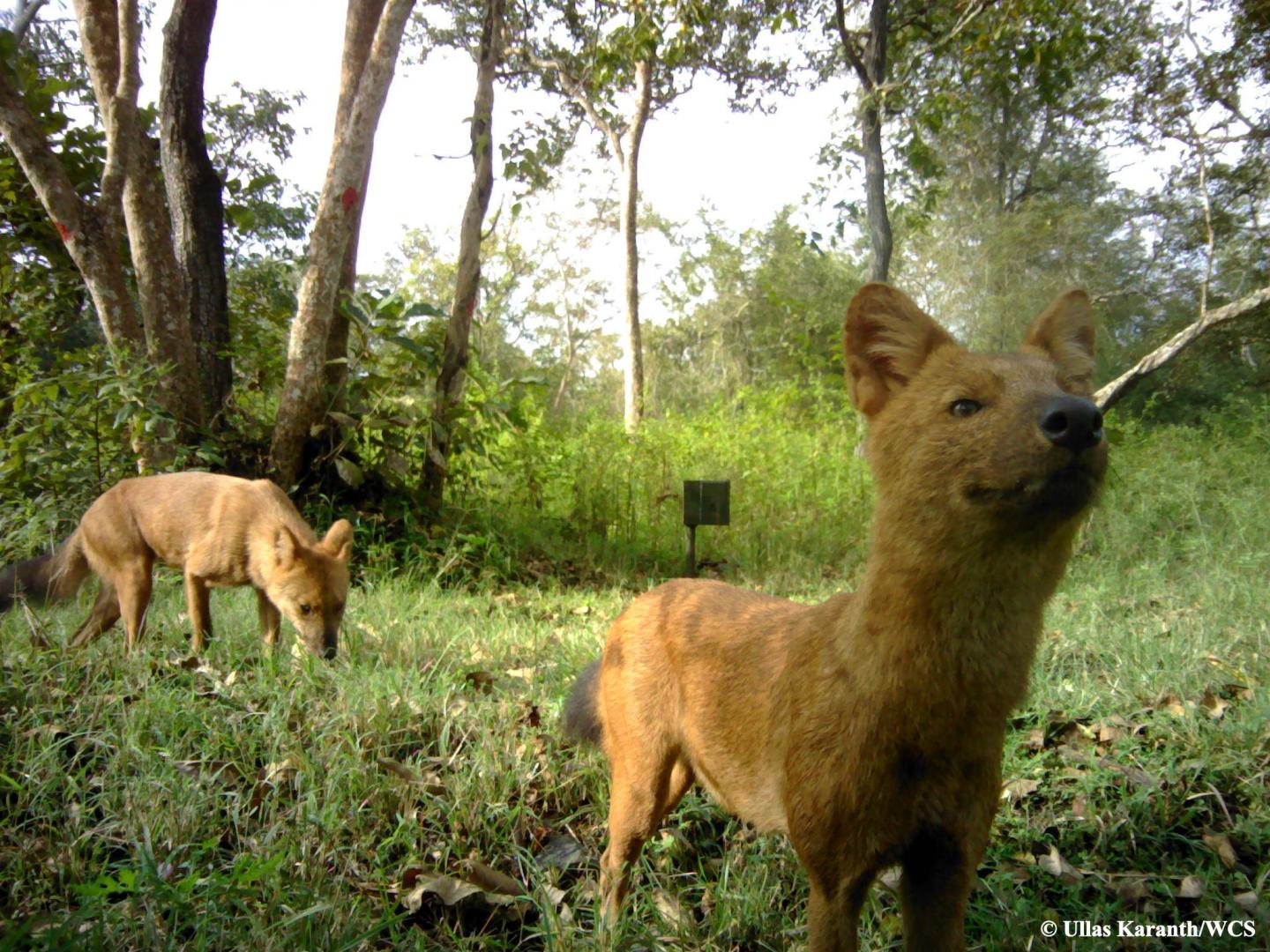
Credit: Ullas Karanth/WCS
- New study says despite direct competition, tigers, leopards, and dholes are living side by side in protected areas
- Tigers and dholes are classified as Endangered by IUCN; leopards are considered Vulnerable
"Tigers, leopards, and dholes are doing a delicate dance in these protected areas, and all are manging to survive." — Ullas Karanth, WCS Director for Science in Asia and lead author of the study
NEW YORK (Feb. 16, 2017) – A new WCS study in India shows that three carnivores — tigers, leopards, and dholes (Asian wild dog) — seemingly in direct competition with one other, are living side by side with surprisingly little conflict. Usually, big cats and wild canids live in different locations to avoid each other.
Yet in four relatively small reserves in India's wildlife-rich Western Ghats region, WCS researchers have found that they are co-existing, despite competing for much of the same prey, including sambar deer, chital, and pigs.
Using dozens of non-invasive camera traps for sampling entire populations, rather than track a handful of individuals, the research team recorded some 2,500 images of the three predators in action.
The authors found that in reserves with an abundance of prey, dholes, which are active during the day, did not come in much contact with the more nocturnal tigers and leopards. But in Bhadra Reserve where prey was scarcer, their active times overlapped, yet dholes still managed to avoid the big cats. In Nagarahole, a park teeming with all three carnivores and their prey, leopards actively to avoid tigers.
Overall, the authors say that these carnivores have developed smart adaptations to coexist, even while they exploit the same prey base. However, these mechanisms vary depending on density of prey resources and possibly other habitat features.
Said Ullas Karanth, WCS Director for Science in Asia and lead author of the study: "Tigers, leopards, and dholes are doing a delicate dance in these protected areas, and all are manging to survive. We were surprised to see how each species has remarkably different adaptations to prey on different prey sizes, use different habitat types and be active at different times. Because of small and isolated nature of these high prey densities in these reserves, such adaptions are helpful for conservationists trying to save all three."
Both tigers and dholes are classified as Endangered by IUCN; leopards are considered Vulnerable.
Understanding these separate yet overlapping species' needs is critical to managing predators and prey in small reserves, which is increasingly the scenario of the future. The authors say that by managing populations of flagship predators, like tigers, carefully overall biodiversity can also be conserved.
###
The study titled "Spatio-temporal interactions facilitate large carnivore sympatry across a resource gradient" authored by Dr. Ullas Karanth, Mr. Arjun Srivathsa, Dr. Divya Vasudev, Ms. Mahi Puri, Dr. Ravishankar Parameshwaran and Dr. Samba Kumar, appeared in the journal Proceedings of the Royal Society of London B: Biological Sciences in February 2017.
This research was supported by the Department of Biotechnology and Department of Science and Technology, Government of India; The Forest Department and Department of Science and Technology, Government of Karnataka; and the Liz Claiborne and Art Ortenberg Foundation.
WCS (Wildlife Conservation Society)
MISSION: WCS saves wildlife and wild places worldwide through science, conservation action, education, and inspiring people to value nature. To achieve our mission, WCS, based at the Bronx Zoo, harnesses the power of its Global Conservation Program in nearly 60 nations and in all the world's oceans and its five wildlife parks in New York City, visited by 4 million people annually. WCS combines its expertise in the field, zoos, and aquarium to achieve its conservation mission. Visit: newsroom.wcs.org Follow: @WCSNewsroom. For more information: 347-840-1242.
CONTACT:
Stephen Sautner
1-718-220-3682
[email protected]
Scott Smith
1-718-220-3698
[email protected]
Media Contact
Scott Smith
[email protected]
718-220-3698
@TheWCS
http://www.wcs.org