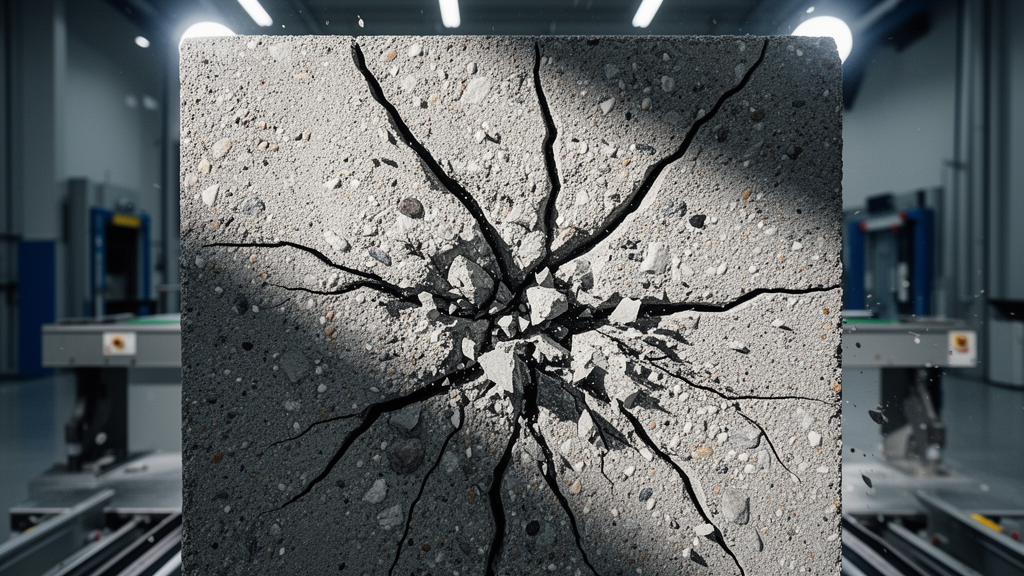
Computational engineers investigating the structural resilience of critical infrastructure have established a robust numerical protocol for simulating dynamic crack propagation and branching in concrete. Predicting how cracks initiate, bifurcate, and interact across complex trajectories is essential for evaluating the damage tolerance and safety of protective barriers, bridge girders, and large civil structures subjected to high-rate impacts. Because concrete is inherently quasi-brittle, it develops an extensive fracture process zone that transitions from distributed micro-cracking to localized macroscopic failure. Under intense dynamic or mixed-mode loading regimes, simple single-crack paths frequently destabilize into complex branching networks that govern how structural components absorb and dissipate kinetic energy. To capture these topological changes without encountering the severe numerical convergence failures typical of discrete crack-tracking approaches, the research team implemented a variationally consistent phase field formulation inside the commercial finite element platform Abaqus using a custom user element subroutine.
Traditional fracture assessment techniques have long struggled to represent spontaneous crack branching in quasi-brittle solids with sufficient numerical stability and engineering efficiency. Classical linear elastic fracture mechanics cannot adequately represent the finite strain-softening behavior of the concrete fracture process zone, while non-linear models relying on discrete cohesive zones or extended finite element enrichment frequently require predefined crack trajectories or complex tracking algorithms that falter when multiple crack fronts merge or bifurcate. The continuum damage formulation of the phase field method overcomes these geometric restrictions by smearing sharp material discontinuities across a regularized scalar damage field. In this approach, intact concrete is represented where the scalar variable equals zero, while completely separated fracture surfaces correspond to a value of one. Governed by energy minimization principles, the phase field naturally resolves crack nucleation, propagation, and topology bifurcation without remeshing, making it an attractive approach for high-throughput parametric studies of dynamic structural degradation.
The mathematical architecture implemented within the custom user element incorporates the quadratic degradation formulation known in damage mechanics as the AT-2 model. To correctly account for the high strain rates characteristic of dynamic impact events, the system balances kinetic energy, degraded elastic strain energy, regularized crack surface energy, and external work through explicit dynamic equations of motion. A critical feature of this formulation is the spectral decomposition of the small-strain tensor into distinct tensile and compressive components, ensuring that stiffness degradation acts strictly on positive principal strain states. This prevents unrealistic crack growth under pure compressive stress fields, an essential requirement for accurately modeling concrete components. While the global equation of motion is resolved dynamically, the governing Euler-Lagrange evolution equation for the damage field is evaluated quasi-statically at each time increment, an approach justified by the fact that internal damage evolution proceeds much faster than mechanical wave propagation across the structure.
To guarantee that cracks cannot artificially heal upon unloading, an internal history field variable is tracked and updated at every material integration point as an internal state-dependent variable within the user element routine. This history field continuously stores the maximum tensile strain energy density achieved up to the current increment, permanently enforcing irreversibility throughout the loading history. The finite element discretization reformulates the coupled balance laws into element-level displacement and phase-field residual vectors, which are iteratively evaluated by the solver alongside consistent tangent matrices. Following increment convergence in Abaqus, field variables including nodal displacements, phase-field damage contours, strain energy densities, and crack path coordinates are automatically transferred to a specialized MATLAB post-processing environment. This external analytical framework extracts fracture metrics, monitors spatial resolution consistency, and automates topological characterization, creating a repeatable simulation pipeline suitable for large-scale parametric evaluations.
Before evaluating complex dynamic branching in large plates, the researchers validated the topological objectivity of their user element implementation against the classical Brazilian disc benchmark under diametral compression. The plane stress numerical model comprised a circular disc fifty millimeters in diameter containing a fifteen-millimeter central notch inclined at forty-five degrees relative to the horizontal loading axis, establishing a severe mixed-mode stress state. By evaluating three different regularization length scales of zero point five, zero point seven five, and one point zero millimeter while scaling the local mesh size to remain at or below one-third of the length scale, the team verified the spatial convergence of the formulation. Curvilinear wing cracks consistently initiated at the notch tips and kinked toward the diametral loading points at identical angles, closely matching published experimental and numerical benchmarks. Furthermore, recorded force-displacement responses demonstrated characteristic brittle failure, with peak loads scaling systematically from approximately two hundred ten to two hundred fifty newtons as the regularization length narrowed.
Dynamic fracture behavior was subsequently investigated using a two-dimensional plane strain specimen consisting of a square concrete plate measuring two hundred by two hundred millimeters with a thickness of fifty millimeters, featuring an eighteen-millimeter-high central notch extending sixty-four millimeters inward from the boundary. Standard material parameters included a Young’s modulus of thirty-six gigapascals, a Poisson’s ratio of zero point eighteen, a tensile strength of three point eighty megapascals, a mass density of twenty-four hundred kilograms per cubic meter, and a baseline mode I critical fracture energy of sixty-five joules per square meter. A uniform finite element mesh consisting of four-node quadrilateral elements with a characteristic element size of zero point four millimeter was deployed throughout the fracture domain. Dynamic loading was applied by prescribing constant pulling velocities along the bottom edge of the central notch, establishing controlled kinetic energy influxes across distinct operational loading regimes.
Quasi-static baseline simulations of the notched concrete plate yielded a peak reaction force of one point six kilonewtons, confirming that the spatial discretization and material constants accurately represented the fundamental static stiffness of the material. When dynamic loading was introduced across increasing displacement rates, the numerical framework reproduced the experimentally observed increase in structural resistance known as the dynamic increase factor. At moderate strain rates below fifty reciprocal seconds, the dynamic increase factor exhibited a gradual, rate-dependent rise from one point zero to approximately one point five, reflecting the constitutive resistance of the concrete matrix. Beyond fifty reciprocal seconds, however, the dynamic increase factor escalated sharply, reaching three point three at a strain rate of ninety-two point six reciprocal seconds under a prescribed boundary velocity of four point three meters per second. This rapid surge aligns with classical dynamic crack branching thresholds where structural inertia and geometric energy dissipation demands dominate over simple material rate sensitivity.
Parametric simulations across pulling velocities ranging from sub-critical levels up to four point three meters per second revealed a distinct morphological transition in fracture behavior governed by kinetic energy influx. At loading velocities at or below one point four meters per second, cracking was strictly confined to a single, stable mode I fracture path that propagated horizontally across the specimen. As the velocity was elevated into an intermediate range between two point zero and two point six meters per second, the crack trajectory began to deviate from its straight trajectory, exhibiting minor directional instabilities and the onset of crack bifurcation. At severe velocities of three point three meters per second and above, the fracture process became intensely unstable, generating multiple diverging crack branches and complex interconnected crack networks. Under these high-rate regimes, kinetic energy accumulates much faster than a single propagating crack front can relieve through surface creation, forcing the crack tip to branch repeatedly to maintain macroscopic energy equilibrium.
The physical evolution of these fracture patterns directly matched quantitative measurements of kinetic dissipation and overall structural deformation. As the prescribed loading velocity increased from one point four to four point three meters per second, the total fracture energy dissipated within the regularized damage band rose substantially from fifty-seven point seven to seventy-seven point eight joules per meter. Over the same velocity interval, the peak recorded boundary displacement increased from zero point three three seven millimeters to one point four eight four millimeters. These kinematic and energetic shifts demonstrate that structural inertia, coupled with the creation of multiple secondary crack surfaces, effectively delays catastrophic global collapse under rapid loading. By compelling the material to activate redundant dissipative surfaces, dynamic crack branching allows the overall structural component to absorb significantly higher levels of total deformation and work before complete mechanical separation occurs.
To evaluate numerical stability and computational overhead, the research team performed detailed sensitivity analyses on both temporal resolution and the phase field regularization length scale. Temporal assessments conducted at a high loading velocity of three point three meters per second across increment counts ranging from five hundred to sixteen hundred fifty steps demonstrated that macroscopic crack trajectories remained remarkably stable, while finer secondary micro-branches became progressively resolved at smaller time steps. However, computational wall-clock time increased substantially from forty-seven to one hundred twenty-five minutes, indicating that intermediate increment densities of seven hundred fifty to one thousand steps offer an optimal balance between microstructural detail and execution cost.
To address mixed-mode fracture without the severe numerical convergence difficulties associated with tracking instantaneous local mode mixity ratios at every integration point, the authors developed a simplified scaling strategy for critical fracture energy. In heterogeneous concrete, cracks forced to deflect around hard coarse aggregates experience local shear stresses and mechanical aggregate interlock, which can elevate effective energy dissipation well beyond pure tensile values. The framework captured this phenomenon by introducing a dimensionless toughness scaling factor ranging from zero point five to two point zero applied to the baseline critical fracture energy. An eccentric dynamic tensile load offset by twenty millimeters from the notch plane was applied at three point three meters per second to generate asymmetric shear stresses. At a low scaling factor of zero point five, representing weak interfacial transition zones, the specimen underwent rapid, uncontrolled multi-branching immediately after crack initiation. Conversely, progressively increasing the scaling factor to one point five and two point zero steadily suppressed bifurcation, ultimately constraining the failure to a single stable curvilinear path governed entirely by mixed-mode stress gradients.
The study establishes an integrated computational operating window that ensures numerical stability and physical consistency when modeling dynamic fracture processes in quasi-brittle solids. The authors emphasized several inherent modeling assumptions, noting that their current implementation remains restricted to two-dimensional plane strain and plane stress formulations, which cannot capture complex three-dimensional out-of-plane crack twisting or triaxial stress states along the crack front. Furthermore, the material model treats concrete as an equivalent homogenized continuum rather than explicitly resolving discrete aggregates, cement paste, and pore networks. Future computational research will focus on extending the user element architecture to three-dimensional structural components, incorporating explicit mesoscale material heterogeneity, and performing direct dynamic experimental validations to expand the utility of this simulation protocol for high-throughput structural integrity assessments.
Subject of Research: Phase field finite element modeling of dynamic concrete crack propagation and branching
Article Title: Dynamic fracture and branching in concrete: a robust phase field finite element analysis
Article References: Vu, T. T. A., Ha, C. H., Phan, D. H., & Tran, P. (2026). Dynamic fracture and branching in concrete: a robust phase field finite element analysis. Archives of Civil and Mechanical Engineering, 26(4), Article 212. https://doi.org/10.1007/s43452-026-01571-w
Image Credits: AI Generated
DOI: 10.1007/s43452-026-01571-w
Keywords: concrete fracture, phase field method, crack branching, finite element analysis, user element, Abaqus, dynamic fracture mechanics, quasi-brittle materials, fracture process zone, dynamic increase factor, strain rate sensitivity, effective fracture toughness, structural mechanics, computational modeling, energy dissipation, interfacial transition zone
News Source: Denise Maddox. (November 26, 2026). Phase Field Finite Element Simulations Map Dynamic Concrete Fracture and Branching. Scienmag.