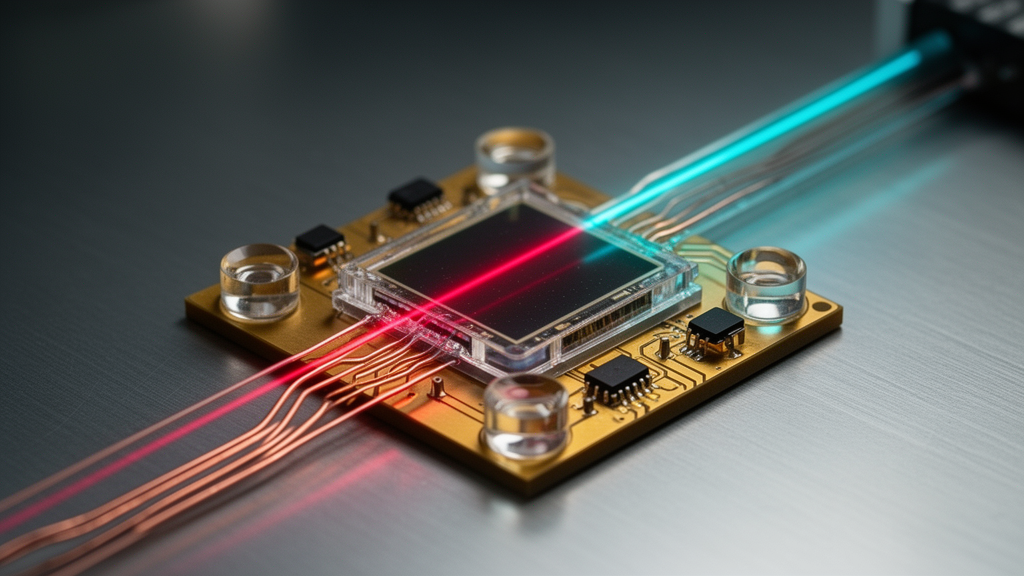
Researchers at the Rzhanov Institute of Semiconductor Physics have demonstrated a suite of specialized semiconductor optoelectronic components designed to advance quantum communications and miniature quantum frequency standards based on coherent population trapping. The experimental developments encompass planar InP/InGaAs/InP single-photon avalanche photodiodes operating in the telecommunication infrared spectrum, short-wavelength AlInAs quantum dot single-photon sources optimized for free-space links, and highly stable AlGaAs vertical-cavity surface-emitting lasers tuned to rubidium-87 transitions.
Quantum cryptography architectures rely on transmitting secret information encoded onto individual quantum objects, specifically single photons, across optical fiber or atmospheric channels. Under the principles of quantum mechanics, unauthorized interception or measurement cannot occur with absolute certainty without perturbing the quantum state, enabling the sender and recipient to generate a completely secure one-time binary key for symmetric cryptographic communications. To preserve strict transmission secrecy, light pulses must strictly contain no more than one photon, placing demanding operating thresholds on receiving detection units. Practical fiber-optic implementations in the 1.3 to 1.55 micrometer spectral window require detectors that exhibit quantum counting efficiencies exceeding 15 percent, dark noise rates beneath 50 kilohertz, high operational speeds, small geometric footprints, and low electrical power consumption.
While traditional photomultiplier tubes suffer from quantum efficiencies under 1 percent and superconducting nanowire detectors demand complex cryogenic cooling to liquid helium temperatures, semiconductor single-photon avalanche photodiodes offer an advantageous solid-state alternative when cooled to between 210 K and 230 K with thermoelectric Peltier microrefrigerators. To satisfy these performance requirements, the research team engineered an avalanche photodiode structure utilizing In0.53Ga0.47As solid solutions lattice-matched to an indium phosphide substrate. The diode incorporates separate absorption and multiplication regions within a circular cross-section mesa geometry having a working platform diameter of 20 micrometers, configured to receive incoming optical radiation directly through its planar face.
Within the photodiode structure, photogenerated electron-hole pairs are produced in an In0.53Ga0.47As absorbing layer, which features a band gap of approximately 0.75 electron-volts at 295 K. Under an applied electric field, the holes drift toward a wider-bandgap InP multiplication layer with a band gap of 1.35 electron-volts, triggering a self-sustaining avalanche current pulse when local electric field intensity reaches approximately 450 kilovolts per centimeter. To maximize carrier separation without inducing excessive tunnel currents, the electric field in the absorption layer is maintained between 10 and 100 kilovolts per centimeter, with layer thickness optimized between 1 and 2 micrometers to provide greater than 75 percent optical absorption. An intermediate n-type InP charging layer measuring 150 to 250 nanometers thick with a donor concentration of 10 to the seventeenth power per cubic centimeter tailors the electric field distribution, setting breakdown voltages between 45 V and 65 V, while a compositionally graded InGaAlAs interface layer suppresses hole trapping across the 0.6 electron-volt valence band discontinuity.
The underlying heterostructures were synthesized using molecular beam epitaxy to preserve structural purity and sharp hetero-interfaces, yielding background donor impurity concentrations of 6 times 10 to the fourteenth power per cubic centimeter in the InGaAs absorber and 1.2 times 10 to the fifteenth power per cubic centimeter in the InP avalanche region. Device planar processing incorporated a single-step zinc diffusion process to establish the p-region doping profile within the upper InP layer. When characterized at an operating temperature of 220 K, the fabricated detectors demonstrated a dark current of approximately 1.2 picoamperes near breakdown voltage, an order of magnitude lower than comparable commercial reference devices.
In parallel with detector engineering, the researchers advanced single-photon emitters for free-space and aerospace quantum cryptography by exploiting self-organized semiconductor quantum dots. Atmospheric quantum transmission encounters minimal absorption, negligible fluctuations in air refractive index, and peak silicon photodetector responsivity near the 770-nanometer spectral band, where preserving photon polarization states is essential. To shift emission toward this optimum short-wavelength window, epitaxial structures of AlxIn1-xAs quantum dots were grown on (001)-oriented gallium arsenide substrates inside a Riber C21 molecular beam epitaxy system, systematically evaluating aluminum fractions ranging from x equals 0 to 0.30 in increments of 0.05.
Atomic force microscopy revealed that Al0.1In0.9As quantum dot ensembles formed with surface densities around 8 times 10 to the ninth power per square centimeter. Photoluminescence spectra obtained at 295 K verified that tailoring the aluminum content induced a hypsochromic spectral shift extending up to 200 nanometers into the short-wave spectrum, successfully encompassing the targeted 770-nanometer atmospheric band. To enhance external quantum efficiency and facilitate isolated optical excitation, low-density Al0.2In0.8As quantum dots were embedded into a vertical Fabry-Perot microcavity tuned to a resonant wavelength of approximately 770 nanometers.
The microcavity architecture was bounded by distributed Bragg reflectors comprising alternating quarter-wavelength layers of Al0.3Ga0.7As and Al0.94Ga0.06As, configured with 17 periods in the lower bottom mirror and 3 periods in the upper output mirror. A one-wavelength-thick Al0.3Ga0.7As spacer held the quantum dot active layer at its central antinode, producing an optical cavity with a quality factor of approximately 100 and a resonance spectral width of 10 nanometers. Cryogenic microphotoluminescence conducted at 10 K under 15 microwatts of continuous-wave 700-nanometer excitation resolved an isolated excitonic emission peak centered at 767 nanometers.
The resulting second-order photon correlation function exhibited a sharp antibunching dip at zero delay time, with g2(0) reaching approximately 0.04. This pronounced suppression of multi-photon generation demonstrates true sub-Poissonian quantum statistics, confirming the viability of these solid-state nanostructures as high-fidelity single-photon sources for satellite and atmospheric cryptographic links.
Addressing the instrumentation needed for miniature quantum frequency standards, the researchers developed compact vertical-cavity lasers operating on the coherent population trapping effect. Coherent population trapping in vapor cells containing rubidium-87 atoms provides an atomic reference capable of stabilizing frequencies to relative uncertainties between 10 to the negative tenth power and 10 to the negative twelfth power, within modular physical volumes of only several cubic centimeters. These compact standards require highly efficient, narrow-linewidth single-mode semiconductor emitters operating with threshold currents on the order of milliamperes and current modulation bandwidths reaching tens of gigahertz.
The vertical-cavity laser was synthesized via molecular beam epitaxy onto (001) n-GaAs substrates as an intricate 1,156-layer heterostructure with layer thicknesses calibrated to within 1 percent accuracy under continuous substrate rotation. The optical cavity comprises a 28-period p-doped upper Bragg reflector providing 99.7 percent reflectivity and a 35.5-period n-doped lower Bragg reflector providing 99.9 percent reflectivity, separated by an optical wavelength thickness containing three undoped 8-nanometer Al0.07Ga0.93As quantum wells. Thin two-nanometer compositionally graded transition layers were inserted at internal mirror boundaries to decrease parasitic series resistance, while an AlGaOx current and optical confinement aperture was produced through selective wet thermal oxidation of a 49-nanometer Al0.98Ga0.02As layer at 420 degrees Celsius.
Testing of the fabricated 300 by 300 micrometer laser chips confirmed that devices featuring oxide aperture diameters of 3 micrometers or less maintained strictly single-transverse-mode operation with stable linear polarization along the [110] crystallographic axis across the full operating range up to 2 milliamperes. The lasers exhibited threshold currents of approximately 0.4 milliamperes, a differential slope efficiency of 0.5 milliwatts per milliampere, and higher-order transverse mode suppression ratios reaching 50 decibels. Operating at approximately 1.5 milliamperes with 0.5 milliwatts of optical output, the emission wavelength matched the 794.8-nanometer D1 transition of rubidium-87 atoms, displaying a predictable thermal tuning coefficient of 0.059 nanometers per Kelvin that permits precise electrothermal locking to the atomic standard.
Subject of Research: Development of semiconductor detectors, emitters, and lasers for quantum communication systems and miniature atomic frequency standards
Article Title: Photon Detectors and Emitters for Quantum Communication Systems and Quantum Frequency Standards
Article References: Preobrazhenskii, V. V., Chistokhin, I. B., Ryabtsev, I. I., Haisler, V. A., & Toropov, A. I. (2024). Photon Detectors and Emitters for Quantum Communication Systems and Quantum Frequency Standards. Bulletin of the Russian Academy of Sciences: Physics, 88(9), 1478-1484. https://doi.org/10.1134/s1062873824707724
Image Credits: AI Generated
DOI: 10.1134/S1062873824707724
Keywords: quantum cryptography, single-photon avalanche photodiodes, quantum frequency standards, coherent population trapping, vertical-cavity surface-emitting lasers, quantum dots, AlInAs, InGaAs, molecular beam epitaxy, single-photon emitters, rubidium atoms, Hanbury Brown-Twiss interferometry, dark count rate, distributed Bragg reflectors, semiconductor optoelectronics, quantum key distribution
News Source: Katie Riggs. (November 26, 2026). Optoelectronic Components Advance Quantum Cryptography and Compact Atomic Frequency Standards. Scienmag.