A comprehensive biophysical review synthesized by researcher Kalyan Kumar Banerjee evaluates the fundamental thermodynamic and physical principles that govern how antimicrobial peptides interact with, penetrate, and disrupt biological membranes. As the global escalation of antimicrobial resistance undermines conventional small-molecule pharmacology, structural membrane disruption has emerged as a resilient alternative mechanism. Traditional antibiotic therapies depend upon precise lock-and-key interactions with specific microbial receptor proteins or specialized intracellular metabolic enzymes, creating an evolutionary vulnerability where a single genomic point mutation can restructure receptor morphology and confer high-level clinical resistance. In contrast, host-defense antimicrobial peptides typically contain between 10 and 60 amino acid residues organized into amphipathic motifs that directly target the macro-structural integrity of the lipid bilayer itself. Because the lipid bilayer constitutes an indispensable physiological barrier required for metabolic transport, cellular ion homeostasis, and adenosine triphosphate synthesis, microorganisms cannot easily redesign their entire envelope composition without facing unsustainable fitness and energetic costs, which makes the development of pronounced resistance against membrane-active biophysical agents remarkably rare.
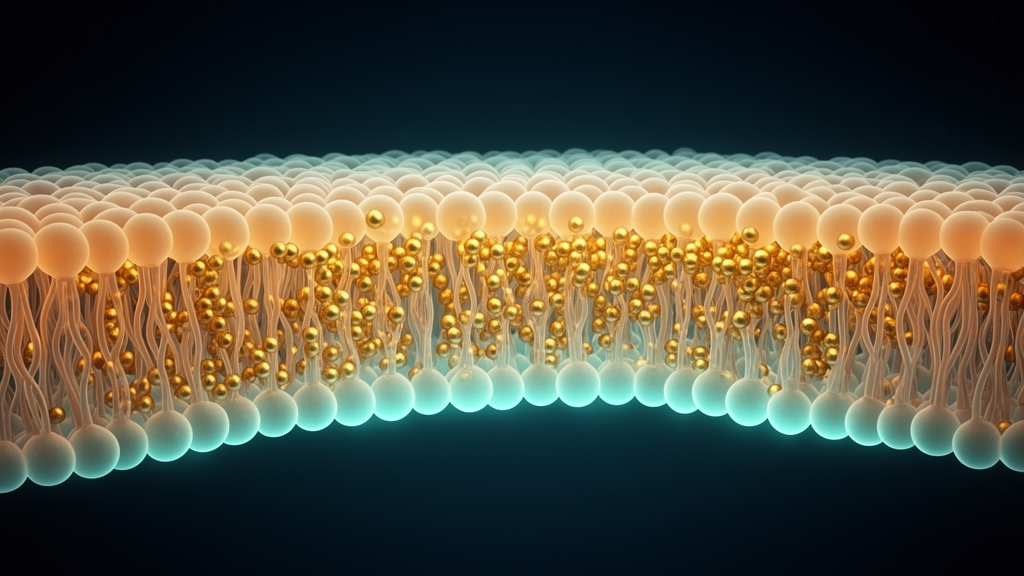
The molecular basis of target selectivity between invading pathogens and host organisms stems from an evolutionary divergence in membrane lipid composition and surface electrostatics. Bacterial cell envelopes are heavily enriched with anionic phospholipids, including phosphatidylglycerol, cardiolipin, and outer lipopolysaccharide leaflets, establishing a strong negative surface charge density across the microbial perimeter. Eukaryotic plasma membranes, in sharp contrast, are composed predominantly of neutral zwitterionic lipids, particularly phosphatidylcholine and phosphatidylethanolamine, while being structurally reinforced by high concentrations of sterols, primarily cholesterol. Cationic residues situated along host-defense peptide sequences exploit this macroscopic dichotomy through long-range electrostatic attraction, driving initial recruitment toward the microbial surface. However, analytical evaluations demonstrate that cholesterol serves as far more than an inert structural obstacle or steric shield within host tissues. Rather, cholesterol behaves as an active biophysical regulator that dynamically modulates interfacial double-layer electrostatics, lateral lipid packing, membrane curvature, and bilayer elasticity, ultimately redirecting the mechanistic trajectories of bound peptides between distinct physical modes of destructive action.
Peptide accumulation at the aqueous-lipid boundary initiates through electrostatic capture followed by localized conformational folding and charge compensation. In bulk aqueous solution, unstructured antimicrobial peptides adopt disordered random coil conformations that minimize unfavorable entropic penalties. As positively charged basic residues, predominantly lysine and arginine, migrate toward exposed anionic phosphate headgroups, electrokinetic profiling via Zeta potential analytics reveals that complete surface charge neutralization and subsequent overcharge compensation take place at substantially lower peptide-to-lipid ratios in anionic phosphatidylglycerol environments than in zwitterionic phosphatidylcholine matrices. Upon localized accumulation, rapid desolvation forces the peptide backbone into secondary amphipathic arrangements, such as amphipathic alpha-helices, as verified by circular dichroism and solid-state nuclear magnetic resonance investigations. This structural segregation places cationic side chains along one helical face to secure phosphate coordination while projecting hydrophobic residues from the opposing face, positioning the molecule to engage directly with the nonpolar hydrocarbon core of the target bilayer.
The depth and spatial orientation of membrane-associated peptides are quantitatively described by the classical two-state model developed by Huang. At low peptide-to-lipid concentrations below a critical thermodynamic threshold, folded amphipathic helices embed shallowly within the hydrophilic headgroup zone, orienting strictly parallel to the membrane surface in what is defined as the surface-bound or S-state. In this shallow alignment, peptides function as molecular wedges that selectively expand the surface area of the outer lipid leaflet relative to the unperturbed inner leaflet, creating asymmetric lateral strain and causing pronounced bilayer thinning. When local peptide concentrations rise and surpass the critical threshold, this asymmetric lateral pressure becomes energetically unsustainable for the membrane lattice. To alleviate the accumulated mechanical strain, the bound peptides undergo a synchronized and cooperative reorientation, inserting perpendicularly into the hydrophobic core to occupy the transmembrane insertion state, or I-state. This vertical insertion drives the self-assembly of stable transmembrane pores that trigger single-vesicle leakage and subsequent lytic death.
Although the classical two-state model accounts for standard perpendicular pore insertion, biophysical reviews identify an expansive spectrum of alternative disruption topologies across different peptide families. Under the carpet model, peptides accumulate horizontally across the lipid interface while remaining entirely restricted to the S-state without deep core penetration. Upon exceeding a critical surface concentration threshold, these surface-associated peptides exert a detergent-like action that breaks down bilayer line tension, disintegrating the continuous lamellar structure into mixed micellar fragments. In the barrel-stave model, exemplified by alamethicin, perpendicularly inserted peptides self-assemble into a cylindrical bundle where nonpolar surfaces face outward toward host lipid acyl chains while polar residues line a central, water-filled channel. By comparison, the toroidal pore model, adopted by Magainin 2 and the core peptide NK-2, involves extreme localized monolayer bending where outer and inner leaflets continuously merge through the pore lumen, creating a hybrid channel lined symmetrically by both peptide helices and intercalated phospholipid headgroups. Other documented modes include transient disordered toroidal pores, non-lytic translocation mechanisms targeting intracellular nucleic acids as seen with buforin II and indolicidin, and localized electroporation-like phenomena where dense cationic clustering exceeds the dielectric breakdown threshold of the bilayer.
To quantitatively model the relationship between experimental electrokinetic observations and the thermodynamic constants governing peptide adsorption, researchers apply the classical Gouy-Chapman double-layer analytical framework. In this framework, the mathematical relationship connecting the electrokinetic potential measured at the hydrodynamic slipping plane to the membrane surface charge density is calculated using the Grahame equation, accounting for relative water permittivity, vacuum permittivity, the Boltzmann constant, absolute temperature, electrolyte valence, and bulk ionic concentration. When monovalent counter-ions such as sodium assemble and bind to exposed anionic lipid headgroups, the resulting attenuation of surface charge density is evaluated through a modified Langmuir adsorption isotherm to compute the structural binding constant. Within these formulations, the local cation concentration immediately adjacent to the membrane-water interface is connected to the bulk solution concentration by a Boltzmann distribution factor, which mathematically compensates for electrostatic shielding across the diffuse electrical double layer.
Cholesterol suppresses perpendicular pore formation by altering the mechanical stiffness and localized lateral pressure profile of the host lipid matrix. Macroscopically, cholesterol acts as an efficient condensing agent that increases lipid acyl chain ordering and elevates the bilayer bending rigidity modulus. This heightened bending rigidity imposes a steep thermodynamic activation barrier that resists the severe curvature deformations required to assemble toroidal pores or induce carpet-like micellar breakdown. Simultaneously, cholesterol radically reshapes the internal lateral pressure profile across the bilayer depth coordinate. Cholesterol condensation increases repulsive lateral pressure within the hydrophilic headgroup region and the upper hydrocarbon chains, while reducing lateral pressure within the deep hydrophobic core. This elevated interfacial pressure profile establishes a potent mechanical and steric barrier that directly resists initial peptide entry into the upper hydrocarbon leaflet, effectively trapping amphipathic helices at the hydrophilic water-lipid interface.
In multicomponent biomimetic membranes, cholesterol drives lateral phase separation by segregating homogeneous bilayers into coexisting liquid-ordered and liquid-disordered domains. Experimental biophysical measurements establish that antimicrobial peptide permeabilization is predominantly restricted to the more fluid and flexible liquid-disordered sectors. Although certain peptides partition into these fluid microdomains and cause localized solute leakage, the surrounding continuous network of mechanically resilient liquid-ordered phase preserves the overall structural integrity of the vesicle, preventing generalized fragmentation. Moreover, systematic literature evaluations indicate that cholesterol activity is highly context-dependent: while uniform liquid-ordered domains resist penetration, the phase boundaries between liquid-ordered and liquid-disordered regions possess significant line tension and lateral packing defects that can actively facilitate peptide accumulation and insertion. Additionally, the regulatory role of cholesterol depends heavily on host lipid acyl chain saturation; fluid unsaturated systems such as mixtures of dioleoylphosphatidylcholine and dioleoylphosphatidylglycerol permit monovalent cation binding and headgroup reorientation under cholesterol inclusion, whereas saturated dipalmitoyl or dimyristoyl matrices undergo severe chain ordering that expels interfacial ions and establishes an impenetrable insertion barrier.
The biophysical capacity of cholesterol to dynamically redirect peptide mechanisms rather than merely acting as an inert barrier is demonstrated by the mammalian-derived core peptide NK-2, a 27-amino-acid cationic fragment obtained from porcine NK-lysin. Real-time phase-contrast optical microscopy tracking giant unilamellar vesicles reveals that NK-2 exhibits distinct kinetic behaviors depending strictly on sterol presence. When giant unilamellar vesicles composed of sterol-free anionic phospholipids are synthesized in sucrose and suspended in an equiosmolar glucose solution, they display a bright optical halo produced by the refractive index mismatch across the intact bilayer. Upon exposure to NK-2, the peptide inserts into the sterol-free matrix to form stable toroidal pores, enabling an unrestricted exchange of internal sucrose for external glucose that eliminates the optical refractive mismatch and produces a continuous decay in phase-contrast intensity over time.
When cholesterol is introduced into the target vesicle composition at concentrations between 10 and 20 mole percent, the optical and biophysical response undergoes a complete transformation. Instead of undergoing standard pore permeabilization and contrast decay, the cholesterol-containing vesicles exhibit rapid and widespread vesicle-vesicle aggregation, culminating in massive multi-vesicle clustering. Dynamic light scattering and Zeta potential analytics confirm that cholesterol entirely prevents single-vesicle pore permeabilization by trapping NK-2 helices in the surface-bound S-state at the hydrophilic interface. Prevented from inserting perpendicularly into the hydrocarbon core by the increased membrane stiffness, the accumulated cationic peptides alter the interfacial electrostatic landscape and generate intense localized lateral stress. This surface confinement forces the exposed hydrophobic sectors of adjacent surface-bound peptides to interact with neighboring lipid bilayers, establishing intermolecular electrostatic and hydrophobic bridges that cross-link adjacent membranes together. This kinetic aggregation process leads to extensive macroscopic vesicle clustering, total structural collapse, and catastrophic contents leakage, demonstrating that cholesterol actively switches the peptide mechanism from microscopic single-vesicle pore formation to cooperative macroscopic membrane aggregation.
Despite the high efficacy and target selectivity displayed by peptides such as NK-2 against broad-spectrum bacterial pathogens like Escherichia coli and protozoan parasites like Plasmodium falciparum, translating these membrane-active agents into systemic clinical therapies involves resolving critical pharmacological challenges. Natural unmodified peptides composed of standard L-amino acids suffer from rapid in vivo proteolytic degradation by host serum proteases, such as trypsin and chymotrypsin, as well as bacterial enzymes, resulting in limited biological half-lives. Structural engineering strategies designed to overcome this instability include substituting D-amino acids, backbone cyclization, terminal capping, and developing peptidomimetics such as peptoids and beta-peptides. Furthermore, candidate peptides must be balanced to prevent non-specific systemic toxicity and erythrocyte hemolysis, which occur when excessive hydrophobicity or hydrophobic moments trigger off-target interactions with host cells. Researchers must also address physiological salt sensitivity, where approximately 150 millimolar sodium chloride screens electrostatic attraction, alongside high-affinity serum albumin binding that reduces free drug concentrations. By harnessing advanced drug delivery platforms such as liposomes, nanoparticle carriers, and hydrogels, and tuning cholesterol-to-lipid ratios within delivery vehicles, bioengineers can leverage interfacial electrostatics and membrane mechanics to design resilient non-receptor-targeted antimicrobial therapies.
Subject of Research: Biophysical regulation of antimicrobial peptide membrane insertion and selectivity by cholesterol and interfacial electrostatics
Article Title: Cholesterol and interfacial electrostatics dynamically regulate antimicrobial peptide membrane insertion and selective lytic mechanism
Article References: Banerjee, K. K. (2026). Cholesterol and interfacial electrostatics dynamically regulate antimicrobial peptide membrane insertion and selective lytic mechanism. Discover Molecules, 3(1), Article 41. https://doi.org/10.1007/s44345-026-00080-w
Image Credits: AI Generated
DOI: 10.1007/s44345-026-00080-w
Keywords: antimicrobial peptides, cholesterol regulation, lipid bilayers, interfacial electrostatics, Gouy-Chapman model, Two-State model, NK-2 peptide, Magainin 2, membrane permeabilization, vesicle aggregation, membrane bending rigidity, lateral pressure profile, antimicrobial resistance, phase segregation, biomimetic membranes, zeta potential
News Source: Bethany Barker. (November 26, 2026). Cholesterol Dynamically Regulates Antimicrobial Peptide Insertion and Selective Membrane Disruption. Scienmag.