Evaluating drought adaptation across Brassicaceae oilseed species has become vital for determining bioclimatic suitability in arid regions as global climate shifts intensify. Current worldwide production of brassica oilseeds, led predominantly by rapeseed and canola (Brassica napus), exceeds 85 million tons annually according to FAOSTAT metrics, representing approximately 15 percent of global vegetable oil for human nutrition and serving as the third most valuable vegetable oil commodity after palm and soybean. Concurrently, related species such as Brassica carinata (Ethiopian mustard) and Camelina sativa (false flax) are gaining international attention as low-input bioenergy feedstocks and industrial oil resources capable of producing valuable lipid profiles on marginal lands and under poor-quality irrigation regimes. Despite these economic benefits, severe water deficits trigger drastic yield reductions across all three crops, exposing production vulnerabilities across semi-arid cropping regions such as the six million acres comprising Western Canada’s brown soil zone in Palliser’s Triangle. In a synthesis published in Plant Stress, researchers Muhammad Rizwan, Daiqing Huang, Zhigang Liu, Isobel Parkin, Christina Eynck, Leon Kochian, and Allan Feurtado evaluated how recent advances in integrated multi-omics, machine learning, and high-throughput phenotyping can resolve physiological mechanisms of water adaptation and guide the de novo engineering of drought-resilient plant ideotypes.
Plants deploy three major, potentially complementary strategies to withstand water-deficit conditions: drought escape, drought avoidance, and physiological drought tolerance. Drought escape depends on accelerated phenological development, where early flowering and rapid maturation enable plants to complete seed production prior to the onset of severe seasonal moisture deficits. Conversely, drought avoidance strategies preserve internal tissue hydration by balancing root water acquisition with minimized transpirational losses through stomatal closure and cuticle fortification. For example, B. carinata accession Ames 2779 (S.23), originating from the Bonga region of Ethiopia, deposits 1356 micrograms per square decimeter of protective leaf surface wax compared to just 289 micrograms per square decimeter in a Swedish accession. Transgenic camelina lines such as C2x2.9.1 expressing MYB96 transcription factor insertions similarly accumulate up to 288.10 micrograms per square decimeter of cuticular wax to restrict non-stomatal moisture escape. Tissue-level tolerance operates through osmotic adjustment driven by osmolytes like proline, glycine betaine, and soluble sugars to maintain turgor pressure under low water potentials, though investigators caution that osmolyte accumulation can merely reflect stress severity rather than functional adaptation.
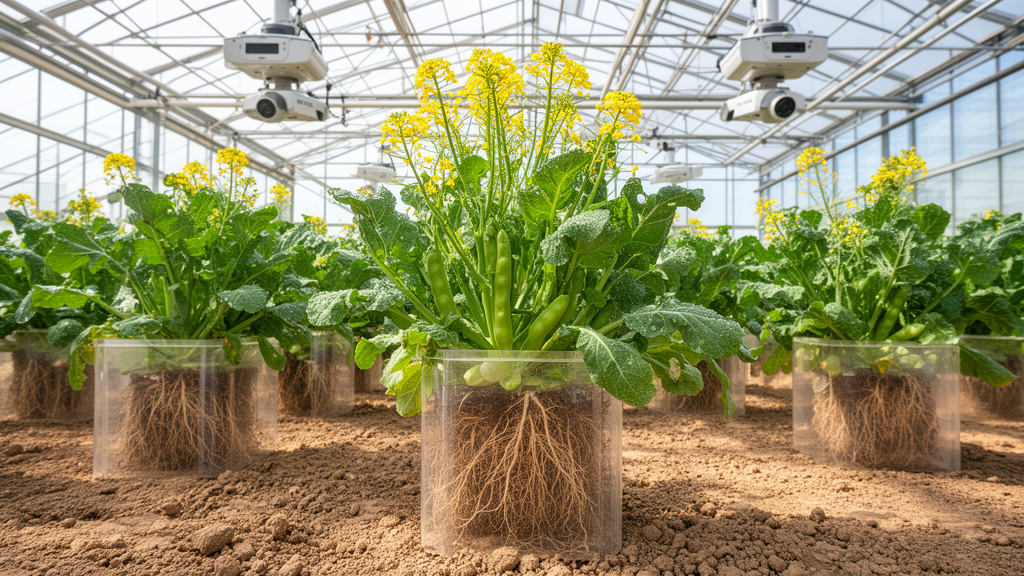
Root system architecture (RSA) and shoot system architecture (SSA) govern resource capture and allocation dynamics, representing critical components for water-limited agronomic performance. Seed attributes establish the initial foundation for emergence and early root elongation under moisture stress, with mucilage layers in camelina seed coats contributing 7 to 10 percent of total seed mass to facilitate moisture retention during imbibition. As roots encounter dry soil profiles, endogenous abscisic acid (ABA) signaling induces hydraulic adjustments and downregulates root-specific aquaporins, specifically plasma membrane intrinsic proteins (PIPs) and tonoplast intrinsic proteins (TIPs) in B. napus, while upregulating foliar aquaporin expression to maintain leaf water balance. Although deep taproot penetration below 70 centimeters allows access to subsoil moisture reserves in dryland ecosystems, species-specific allocation strategies diverge significantly. Experimental observations indicate that while B. napus often increases its root-to-shoot biomass ratio by up to 91 percent during water deficits, it exhibits greater root length and root branching in wet surface soils rather than universally elongating roots under dry conditions. Furthermore, genetically constrained trade-offs between root biomass accumulation and flowering time in B. napus highlight the challenge of combining rapid phenological escape with vigorous root exploration within a single genotype.
To reconcile architectural trade-offs, the review authors formulated an exploratory de novo ideotype framework contrasting drought-susceptible phenotypes with idealized drought-adapted profiles across seedling, reproductive, and maturity phases. In the early seedling phase (15 to 30 days after sowing), the proposed drought-resilient ideotype targets a total root length of 1200 centimeters or greater for B. napus and B. carinata and 600 centimeters or greater for C. sativa, compared to baseline susceptible values of approximately 320, 340, and 100 centimeters, respectively. Primary root length targets are set at 35 to 40 centimeters for the larger brassicas and 25 centimeters for camelina, paired with root-to-shoot ratios of 0.30 or higher. For the reproductive phase (55 to 75 days after sowing), the ideotype envisions total root lengths exceeding 3000 centimeters in B. napus and 3200 centimeters in B. carinata, root surface areas reaching 3500 square centimeters, and primary root depths surpassing 65 to 70 centimeters. Concurrently, idealized shoot structures specify erect leaf angles of 30 degrees or less, branch angles under 25 degrees, and pod angles below 25 degrees (45 degrees in camelina) to optimize canopy light distribution, lower specific leaf area, and maintain photosynthetic assimilation while minimizing transpirational water loss.
The target model specifies pod densities exceeding 2.0 to 2.5 per centimeter, seeds per silique reaching 22 to 25, thousand-seed weights of at least 4.5 grams in brassicas and 2.0 grams in camelina, and improved harvest index values of 0.35 to 0.40. At the field plot scale, this architecture is designed to support high stand densities ranging from 400,000 plants per hectare in B. napus and B. carinata to 2.2 million plants per hectare in C. sativa, sustaining target seed yields above 5.0 to 6.0 tons per hectare under water-limited scenarios. However, the authors explicitly emphasize that these numerical targets represent comparative hypotheses derived from maximum literature values rather than rigid, universal breeding prescriptions. Because high plant densities can accelerate soil moisture depletion and individual traits like enlarged root mass incur significant carbon metabolic costs, individual trait extremes must be systematically validated across regional rainfall and soil regimes.
Advanced high-throughput phenotyping (HTP) deployed on ground and unmanned aerial vehicle (UAV) platforms enables non-destructive, repeated quantification of dynamic canopy architecture and stress indicators across large breeding populations. Proximal hyperspectral and multispectral cameras have proven effective at detecting physiological stress, where vegetation metrics such as the Red-Green index reliably separate water-deprived rapeseed lines from well-watered controls. In field trials, UAV imaging has accurately quantified flowering dates and reproductive intensity, though platform resolution must be calibrated carefully because small camelina flowers are detected with lower accuracy than larger canola blooms. Below ground, non-invasive imaging technologies including 3D rhizotrons, X-ray computed tomography, magnetic resonance imaging (MRI), and positron emission tomography (PET) allow three-dimensional visualization of root system architecture in soil matrices. Nevertheless, the authors note that these controlled-environment screening tools often display discrepancies when compared against destructive field sampling, underscoring that structural root phenotypes alone do not prove active in situ water uptake without companion physiological confirmation under representative soil conditions.
Integrating machine learning (ML) and deep learning (DL) algorithms with HTP workflows accelerates automated feature extraction, stress classification, and trait prediction. In spring-type B. napus, automated image analysis paired with linear and Huber regression models successfully predicted raceme branch numbers with 91 percent accuracy, while random forest classifiers distinguished mild drought stress with an area under the receiver operating characteristic curve (AUC-ROC) of 0.85. In field-grown winter oilseed rape, hyperspectral reflectance coupled with random forest regression estimated root-zone soil moisture content in the top 20 centimeters with a validation coefficient of determination (R2) of 0.944, though accuracy diminished substantially at deeper soil depths down to 60 centimeters. Other architectures, including decision tree-based segmentation models, support vector machines, and convolutional neural networks, have demonstrated utility for segmenting flowering areas, predicting leaf nitrogen status, and classifying stressed seed morphology via platforms like SeedML. However, the review highlights that stress classification based on canopy reflectance often detects passive environmental damage rather than heritable adaptive resilience, necessitating rigorous cross-validation across diverse genetic backgrounds and multi-year field trials.
Genomic dissection has expanded through next-generation sequencing, yielding fourteen assembled genomes for B. napus, sixteen for C. sativa, and four for B. carinata, which underpin genome-wide association studies (GWAS) and quantitative trait locus (QTL) mapping. Quantitative mapping has identified recurrent drought-associated genomic intervals across B. napus chromosomes A4, A6, A10, C4, and C9 linked to germination rates, root elongation, and yield-based drought susceptibility indices. Transcriptomic investigations across drought-stressed brassicas have identified thousands of differentially expressed genes governing hormone signaling, photosynthetic machinery, and secondary metabolism. Notably, functional experiments have begun moving beyond statistical associations to confirm causal mechanisms: natural variation in the transcription factor BnaA9.NF-YA7 was demonstrated to negatively regulate drought tolerance in B. napus via ABA-mediated stomatal control, while transgenic overexpression of BnaA01.CIPK6 directly improved drought resistance.
Proteomic and metabolomic analyses reveal the biochemical shifts governing cellular survival and metabolic trade-offs under progressive moisture limitation. In B. napus proteomic investigations, drought-tolerant accessions partition into distinct strategies: water-saving cultivars (such as Californium and Cadeli) accumulate proteins associated with nitrogen assimilation, ATP synthesis, and redox homeostasis, whereas water-spending cultivars (such as Navajo and Viking) increase abundance of proteins related to photosynthesis and energy mobilization to sustain rapid growth. Post-translational modifications also regulate functional responses, as exemplified by the dephosphorylation of beta-carbonic anhydrase 1 (beta-CA1) at Tyr207 during drought tolerance responses. Concurrently, metabolomic profiling detects marked increases in free amino acids, organic acids, soluble sugars, and proline across drought-stressed tissues. In B. carinata leaves subjected to polyethylene glycol-induced osmotic stress, targeted profiling demonstrated rapid accumulation of proline, gamma-aminobutyric acid (GABA), ABA, phenylalanine, tryptophan, and leucine. However, high accumulation of defensive secondary metabolites, such as flavonoids in camelina and glucosinolates in carinata, frequently correlates with depressed seed oil synthesis, presenting direct trade-offs between stress hardiness and harvest quality.
Translating these multi-omics insights into commercial cultivars requires unified systems biology approaches capable of bridging molecular networks with multi-environment field reality. Most existing integrated investigations remain restricted to dual-layer transcriptomic and metabolomic datasets in B. napus, leaving high-performing resilient alternatives like B. carinata and C. sativa critically under-characterized in proteomics and multi-omics integration. The authors conclude that overcoming the polygenic complexity of drought resilience demands standardized phenotyping protocols, adherence to FAIR data management standards, and rigorous validation across multi-location breeding networks. By linking high-throughput root and shoot phenotyping with predictive machine learning and targeted genome editing, breeders can systematically test ideotype hypotheses to develop climate-resilient oilseed crops with stable yields and protected oil quality.
Subject of Research: Systems biology, phenomics, and ideotype design for drought resilience in Brassicaceae oilseed crops
Article Title: Integrative approaches to drought-resilience in Brassicaceae oilseed crops: Multi-omics, machine learning, and ideotype design
Article References: Rizwan, M., Huang, D., Liu, Z., Parkin, I., Eynck, C., Kochian, L., & Feurtado, A. (2026). Integrative approaches to drought-resilience in Brassicaceae oilseed crops: Multi-omics, machine learning, and ideotype design. Plant Stress, Article 101617. https://doi.org/10.1016/j.stress.2026.101617
Image Credits: AI Generated
DOI: 10.1016/j.stress.2026.101617
Keywords: Brassicaceae, Brassica napus, Camelina sativa, Brassica carinata, Drought Resilience, Crop Ideotype, High-Throughput Phenotyping, Multi-Omics, Machine Learning, Root System Architecture, Osmotic Adjustment, Plant Breeding, Aquaporins, Cuticular Wax, Water Use Efficiency, Transcriptomics, Proteomics, Metabolomics
News Source: Alan Morgan. (November 26, 2026). Integrated Phenotyping and Multi-Omics Frameworks Propose Drought-Resilient Oilseed Crop Ideotypes. Scienmag.