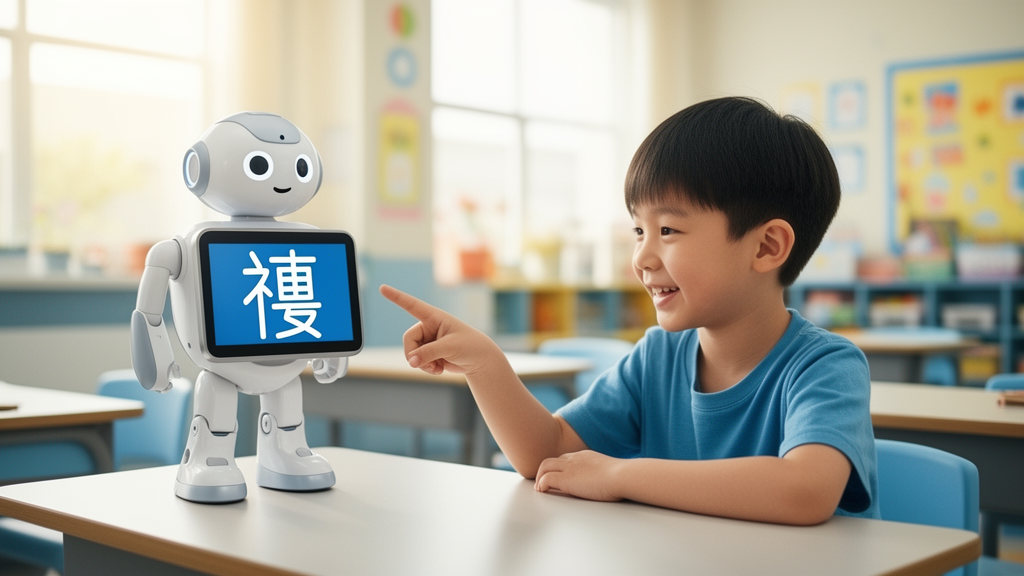
Integrating an artificial intelligence-enabled social robot into regular second-grade Chinese language lessons was associated with greater improvements in children’s Chinese character recognition compared to standard classroom instruction, according to a quasi-experimental mixed-methods study published in the journal AI, Brain and Child. Conducted by researchers Hay Mar Myat Kyaw, Lin Zou, Yixun Li, and Dandan Wu, the investigation examined whether deploying a companion robot alongside teacher instruction influenced specific foundational literacy competencies and psychological engagement among primary school students in China. Across an eight-week instructional cycle, eighty-seven typically developing, native Chinese-speaking children across two intact Grade 2 classrooms completed identical curricular coursework, with one classroom utilizing an interactive robot to support structured lessons and the other receiving traditional teacher-led instruction. The resulting evidence revealed that while both cohorts demonstrated developmental gains in literacy measures over time, the presence of the robot provided an outcome-specific benefit confined primarily to character recognition. Other reading domains, including silent reading fluency, oral reading fluency, passage reading comprehension, and reading motivation, demonstrated no statistically significant between-group divergence, indicating that robotic assistance functions as an outcome-selective supplementary tool rather than a generalized educational remedy.
The study was designed to evaluate educational robotics embedded within mandatory curriculum routines rather than isolated extracurricular programs or researcher-designed instructional units. A total of eighty-seven students participated, with forty-four children (twenty-two girls) assigned to the experimental classroom and forty-three children (twenty-girls) composing the comparison group. Both classes followed identical learning objectives, textbooks, and pacing schedules designated by the school’s Grade 2 Chinese curriculum. The intervention spanned eight weekly instructional sessions, beginning with an initial introductory orientation followed by seven core reading units. In the experimental classroom, the teacher integrated a commercial, child-oriented social companion robot to facilitate multiple pedagogical functions during literacy activities. The mechanical agent assisted with teacher-guided read-aloud demonstrations, supplied oral vocabulary explanations, conducted question-and-answer exchanges with students, and delivered immediate feedback following student responses.
To rigorously assess reading performance, the researchers administered a comprehensive battery of five standardized literacy and affective instruments before and immediately after the eight-week intervention period. The evaluation assessed Chinese character recognition, silent reading fluency, oral reading fluency, passage reading comprehension, and reading motivation. At the baseline pre-test assessment, statistical evaluations indicated that the two intact classrooms were well-matched across four of the five measured parameters, displaying no statistically significant pre-intervention differences in character recognition, oral reading fluency, passage comprehension, or reading motivation scores. However, an independent samples t-test identified a statistically significant baseline discrepancy in silent reading fluency, where the experimental cohort scored substantially higher than the comparison cohort prior to the introduction of the robot. This initial imbalance necessitated targeted statistical adjustments in subsequent analyses to ensure that post-intervention differences were not erroneously attributed to the robotic platform when they simply reflected pre-existing variations between the two student cohorts. Beyond the quantitative psychometric testing, the investigators gathered qualitative interview data from a subsample of thirty-three children in the experimental group to understand student experiences directly.
The primary quantitative outcome supporting the robot’s classroom utility occurred in Chinese character recognition, assessed through a two-way repeated-measures analysis of variance. This statistical test revealed a highly significant main effect of time, indicating that both classrooms demonstrated substantial growth in recognizing written characters over the eight-week duration. The main effect of classroom group was not statistically significant, but the analysis yielded a statistically significant interaction between group and time with a small effect size. While both student groups improved significantly from baseline to the post-test evaluation, children in the robot-supported classroom achieved a larger mean improvement of 8.023 points compared to a mean gain of 5.047 points observed among peers in the traditional instruction classroom. The researchers observed that Chinese orthography features profound visual and orthographic complexity, requiring young learners to memorize intricate stroke configurations while linking abstract visual forms with specific phonological pronunciations and semantic meanings. The robot’s systematic oral repetition, character pronunciation modeling, explicit lexical definitions, and corrective auditory prompts appeared well-tailored to reinforce these visual-auditory associations, thereby explaining the targeted advantage observed in character-level acquisition.
In contrast to the clear relative improvement observed for character recognition, results concerning silent reading fluency proved more nuanced and ultimately showed no definitive treatment advantage. A two-way repeated-measures analysis of variance initially identified a significant main effect of time favoring post-test performance, alongside a significant main effect of group and a statistically significant group-by-time interaction favoring the experimental classroom. However, detailed examination revealed that this statistical interaction stemmed primarily from the pre-test disparity: the experimental group began the study with significantly superior silent reading fluency compared to the control group, yet at the post-test assessment, the two groups showed no statistically significant difference. To correct for this pre-existing gap, the researchers conducted a one-way analysis of covariance controlling for baseline silent reading scores, non-verbal intelligence, oral vocabulary knowledge, and the home reading environment. In this adjusted model, the between-group difference was non-significant, demonstrating that the observed pattern reflected simple statistical convergence between classrooms rather than an intervention-driven effect. The researchers noted that while the robot effectively delivered spoken words and localized definitions, silent reading fluency demands sustained, rapid, and independent visual-textual processing, a cognitive skill that interactive verbal robotics does not directly exercise.
Assessments of oral reading fluency and passage reading comprehension similarly demonstrated an absence of differential intervention benefits between the two educational environments. Two-way repeated-measures analyses of variance revealed no statistically significant group-by-time interaction effects for either oral reading fluency or passage reading comprehension. To confirm the validity of these null findings and assess the strength of the evidence, the research team conducted Bayesian two-way analyses of variance following established quantitative interpretation guidelines. The computed Bayes factors yielded moderate evidence against an interaction effect for oral reading fluency and very strong evidence against an interaction effect for passage reading comprehension. Exploratory within-group paired-samples t-tests revealed that children in both the experimental and comparison conditions made statistically significant gains in oral reading fluency over time, whereas neither group achieved statistically significant improvements in passage reading comprehension across the eight-week study window. The authors highlighted that passage comprehension requires complex inference generation, narrative synthesis, and continuous text processing, which exceeded the basic factual interaction routines and relatively short communicative sequences provided by the general-purpose robot.
Evaluations of reading motivation followed a parallel statistical trajectory, failing to establish a measurable between-group motivational advantage for the robot-enhanced classroom. A two-way repeated-measures analysis of variance across overall reading motivation scores and individual motivational subscales revealed no statistically significant interaction effects between classroom assignment and time. Bayesian analysis provided moderate evidence against a between-group interaction effect for overall reading motivation, confirming that traditional classroom teaching and robot-assisted instruction produced statistically equivalent developmental trajectories over the study period. Despite the absence of a between-group disparity, exploratory within-group paired-samples t-tests identified a statistically significant increase in overall reading motivation within the experimental group from pre-test to post-test, while the comparison group exhibited no statistically significant within-group change across overall motivation or individual subscales. The researchers cautioned that while this within-group rise highlights positive classroom dynamics, it cannot be interpreted as causal evidence that robotic integration outperforms traditional teaching methods, as within-group comparisons do not control for confounding environmental and teacher-specific influences inherent in non-randomized single-classroom comparisons.
To contextualize these statistical patterns, researchers examined qualitative interview responses collected from thirty-three students in the experimental cohort before and after the intervention. Pre-intervention interviews indicated that seventy-eight point seventy-nine percent of the children had previously encountered artificial intelligence robots, primarily within domestic home environments or commercial settings such as hotels and shopping centers, whereas none had experienced robotic tools within an academic classroom. Following the eight-week program, ninety point ninety-one percent of interviewed students reported enjoying their robot-assisted lessons, with only a single child expressing dislike. When describing the aspects they appreciated, thirty-nine point thirty-nine percent pointed to educational support, specifically praising the robot’s expressive storytelling, vocabulary explanations, and immediate error correction. An additional twenty-seven point twenty-seven percent emphasized interactive engagement through question-and-answer routines, while other students highlighted the robot’s encyclopedic knowledge, entertaining behaviors such as dancing, and even memorable amusement during occasional technical malfunctions. These interview accounts indicated that children perceived the embodied device not merely as a novelty, but as an active, accessible partner that supported instructional tasks and sustained situational classroom interest.
Despite widespread enthusiasm, children’s qualitative feedback also illuminated several practical and operational drawbacks that complicated classroom ecology. Although sixty-nine point seven percent of interviewees reported no negative impressions, twelve point twelve percent noted that the robot caused classroom disruption by interrupting teacher instruction or breaking lesson flow. Performance limitations were also highlighted: individual students reported that the machine occasionally skipped words during passages, articulated phrases unclearly, or delivered complicated explanations that were difficult to understand. One student wished the robot displayed more emotional warmth during poetry recitations, while another found dramatic readings of storm-themed passages frightening. Analyzing these observations through the Classroom Ecology Paradigm and initiation-response-evaluation discourse frameworks, the authors observed that an embodied robot acts simultaneously as a pedagogical resource and a competing center of visual and auditory attention. While dynamic robotic movement and vocalization facilitate shared attention during whole-class storytelling and vocabulary drill work, those identical physical behaviors can disrupt the focused concentration required for independent silent reading and complex sentence processing.
The authors underscored several structural limitations that constrain the generalizability of their conclusions and outline priorities for subsequent educational research. Because the investigation was conducted within a single primary school using only two intact classrooms, the intervention condition was completely confounded with classroom membership, teacher characteristics, and distinct peer dynamics, precluding definitive causal inferences. Furthermore, the assessment tool for reading comprehension demonstrated modest internal consistency with a Cronbach’s alpha of zero point sixty-eight, which may have reduced statistical sensitivity to detect subtle comprehension differences. Implementation fidelity was not systematically tracked across conditions, with only one technical malfunction formally documented in supplementary logs, leaving the precise equivalence of instructional exposure unmeasured. Additionally, the technology employed was an off-the-shelf child companion robot rather than an artificial intelligence platform custom-engineered for language pedagogy. The investigators concluded that future research must implement larger multi-site randomized trials, deploy active technological comparison groups such as tablet applications, track individual interaction fidelity, and develop specialized robots whose linguistic and conversational capacities align directly with complex comprehension goals.
Subject of Research: Educational robotics and early literacy development in primary Chinese language classrooms
Article Title: Integrating an AI robot into a Chinese language classroom: A mixed-methods study
Article References: Myat Kyaw, H. M., Zou, L., Li, Y., & Wu, D. (2026). Integrating an AI robot into a Chinese language classroom: A mixed-methods study. AI, Brain and Child, 2(1), Article 23. https://doi.org/10.1007/s44436-026-00049-z
Image Credits: AI Generated
DOI: 10.1007/s44436-026-00049-z
Keywords: artificial intelligence in education, robot-assisted language learning, Chinese character recognition, primary education, educational technology, reading fluency, reading comprehension, reading motivation, quasi-experimental design, classroom ecology, mixed-methods research, early literacy, social robots, pedagogical technology, second-grade reading, elementary classrooms, instructional technology
News Source: Denise Maddox. (November 26, 2026). Classroom AI Robots Support Second-Grade Chinese Character Recognition in New Study. Scienmag.