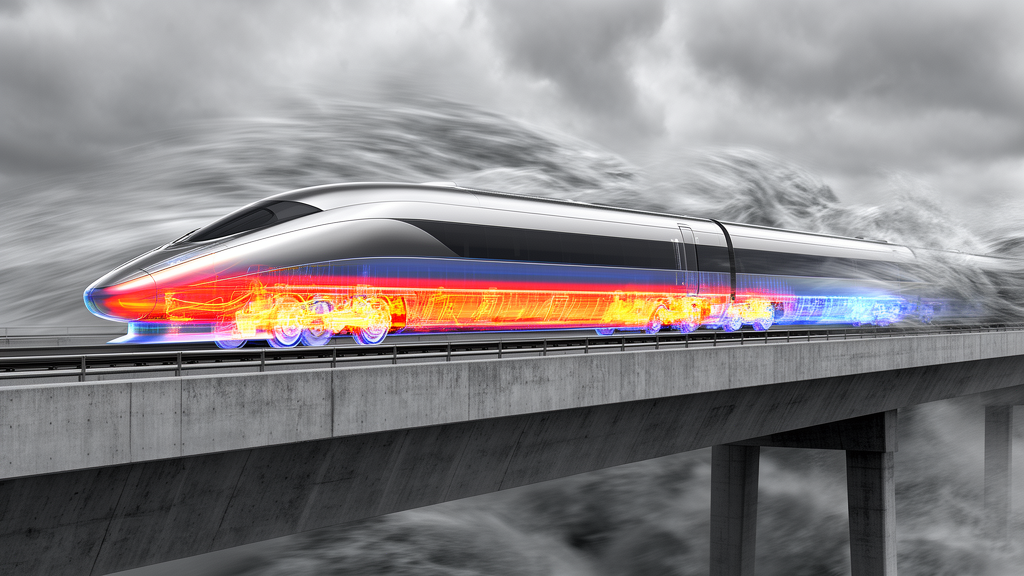
Researchers have developed an advanced stochastic vibration framework based on the probability density evolution method to evaluate the dynamic behavior and operational safety of high-speed train-bridge systems subjected to turbulent crosswinds. The comprehensive investigation, published in Railway Engineering Science by Zheng Li, Jianfeng Mao, Zhiwu Yu, Guangwen Zhang, Xi Wang, and Lei Xu, resolves a persistent engineering challenge in modern railway transport: accurately capturing the complete probabilistic characteristics of vehicle and bridge vibrations without incurring prohibitive computational costs. By directly solving the generalized density evolution equation for the coupled wind-vehicle-bridge system, the proposed methodology captures instantaneous probability density functions and transient response evolutions across time. Crucially, the validation demonstrated that this analytical framework reduces computational execution time by one to two orders of magnitude compared to traditional Monte Carlo simulations, while maintaining a maximum discrepancy of less than two percent. These findings provide a rigorous mathematical and physical foundation for evaluating operational reliability when trains traverse long-span bridges in extreme wind environments.
The rapid expansion of high-speed railway networks has increasingly required tracks to cross challenging geographic terrains, including deep canyons, coastal regions, and expansive river valleys that necessitate long-span bridges. In such exposed environments, intense natural crosswinds pose a critical threat to train running safety, as aerodynamic forces alter vehicle-bridge contact dynamics and elevate risks of car body overturning, derailment, and diminished passenger comfort. Natural wind is characterized by strong spatio-temporal turbulent fluctuations that cannot be captured by conventional deterministic design gusts or single wind time histories. Furthermore, the combined vehicle-bridge assembly forms a complex, multi-degree-of-freedom, strongly non-linear structural system driven by wheel-rail contact mechanics, suspension geometry, and structural girder deformation. While traditional random vibration approaches utilizing spectral analysis or equivalent linearization offer computational efficiency, they rely on Gaussian assumptions that inevitably fail to capture extreme response tails. Conversely, standard Monte Carlo methods demand tens of thousands of dynamic simulations to resolve low-probability, high-consequence safety hazards, making full-scale risk quantification computationally intractable.
To establish an accurate physical representation of vehicle dynamics, the authors constructed a three-dimensional multi-body model based on the operational specifications of the CRH3 high-speed train. The vehicle configuration comprises two end motor cars and intermediate trailer cars, with each four-axle vehicle modeled with thirty-eight degrees of freedom. Six kinematic degrees of freedom—covering longitudinal, lateral, and vertical displacements alongside roll, yaw, and pitch rotations—are assigned to the rigid car body and both bogies, while each of the four wheelsets possesses five kinematic degrees of freedom. The primary and secondary suspension assemblies connecting wheelsets, bogies, and the car body are simulated through equivalent linear spring and viscous dashpot elements to preserve computational feasibility during stochastic analysis. The governing equation of motion for the train incorporates random structural parameter vectors, including car body mass, rotational moments of inertia, suspension spring stiffness, and damping coefficients, alongside stochastic external excitation vectors originating from track irregularities and dynamic crosswind loads.
The spatial track-bridge interaction model was assembled using the finite element method to capture continuous dynamic coupling between structural layers. Steel rails are represented as continuous Timoshenko beam elements resting upon the track slab, while the underlying ballastless track slab and supporting layers are modeled using spatial shell elements. Bridge piers and the main girder box structure are discretized into spatial Timoshenko or Euler-Bernoulli beam elements according to their structural slenderness ratios, with discrete spring-damper elements representing track fasteners and the cement asphalt mortar layer. Wheel-rail interaction mechanics are modeled in both vertical and lateral directions to ensure realistic force transmission across the contact interface. Vertical normal contact forces are calculated via non-linear Hertzian contact theory using an empirical contact constant for worn wheel profiles, while contact points are tracked using the trace method. Lateral contact forces are derived from Kalker’s linear creep theory and subsequently corrected through Johnson-Vermeulen non-linear creep theory using a friction coefficient of 0.25.
Wind load modeling across the coupled system accounts for distinct aerodynamic mechanisms acting simultaneously on the bridge structure and the moving railway vehicles. Aerodynamic loads acting on the bridge girder are calculated via quasi-steady theory, comprising static wind forces, turbulent buffeting forces, and self-excited aeroelastic forces defined by flutter derivatives obtained from wind tunnel experiments. For the train, aerodynamic loads applied at the car body centroid include static drag, lift, and overturning moments, which depend directly upon the relative wind velocity and wind yaw angle resulting from the vector addition of vehicle speed and crosswind speed. Vehicle buffeting forces induced by fluctuating turbulent winds are simulated using a dynamic spatial interpolation technique over multi-point longitudinal grid nodes distributed along the travel path, preserving longitudinal correlation across both vehicle and bridge domains. Unsteady wind velocity fluctuations are generated using the type II stochastic harmonic function method, which incorporates probability-dependent shaping attributes and satisfies Wiener-Khinchin energy equivalence conditions across discretized frequency intervals.
To account for spatial track irregularities, the researchers incorporated the standard German low-interference power spectral density, spanning cutoff spatial frequencies from 0.04 to 3.14 radians per meter for vertical profile, alignment, cross-level, and gauge variations. Modeling a system with eighty-six basic random variables presented severe sampling challenges, as the variables exhibit mixed statistical distributions, ranging from normally distributed concrete elastic moduli and car body masses to uniformly distributed wind phases and track frequencies. Traditional uniform design methods struggle within heterogeneous probability spaces; therefore, the authors introduced the number-theoretic method for multi-objective probability distributions, designated as NTM-mp. Grounded mathematically in the Koksma-Hlawka inequality and Rosenblatt coordinate transformations, NTM-mp maps non-uniform random dimensions into an independent uniform hypercube. This transformation produces a low-discrepancy set of four hundred representative discrete points, each assigned an identical initial probability of one over four hundred, ensuring optimal coverage of the parameter space with minimal sample dispersion.
The theoretical core of the stochastic solution lies in the generalized probability density evolution method, which decouples deterministic dynamic integration from the evolution of random variables. The assembled non-linear equations of motion for the coupled vehicle, track, and bridge systems are first decoupled into modular sub-matrices to optimize numerical stability before being transformed into a first-order state-space vector representation. By applying Reynolds transport theorem to the conservation of probability across the combined state and parameter space, the authors derived the generalized probability density evolution equation governing the joint probability density function. This hyperbolic partial differential equation is solved numerically using a bilateral difference scheme incorporated with total variation diminishing limiters to eliminate numerical oscillations. Structural dynamic time histories for each representative point are computed via the unconditionally stable Newmark-beta numerical integration algorithm, after which numerical integration across the parameter space yields the continuous, time-varying probability density functions of system responses.
The proposed stochastic framework was applied to a numerical case study of a rail-road hybrid girder cable-stayed bridge featuring a span arrangement of 3 × 60 + 108 + 736 + 108 + 3 × 60 meters and a double-track railway layout. Highway traffic lanes were assumed empty to isolate crosswind-induced effects on train operation. Under single-track operating conditions with a sixteen-car train traveling at 300 kilometers per hour in a 20-meter-per-second crosswind, the probability density surface of the vertical car body displacement was tightly enveloped by mean plus-or-minus three standard deviation curves, matching a 99.99 percent probability guarantee. For mid-span bridge vertical displacement, results obtained from four hundred PDEM calculations matched validation benchmarks from 9,999 Monte Carlo simulations almost perfectly, exhibiting a maximum difference between bounds of seven millimeters and a peak error of only 1.98 percent. Furthermore, PDEM completed the analysis in 490 minutes compared to 10,000 minutes required by Monte Carlo simulation.
Simulations evaluating double-track operations, where two sixteen-car trains pass each other in opposite directions at 300 kilometers per hour, revealed substantial dynamic amplification. When the trains converge at the bridge mid-span under concurrent crosswinds and track irregularities, the maximum lateral bridge displacement nearly doubles compared to single-track conditions. The eighth car body exhibited a maximum absolute lateral displacement of approximately 60 millimeters, creating a 40-millimeter differential relative to the bridge girder that was accommodated by lateral deformation of the secondary suspension without causing wheel flange climbing. Comparative testing confirmed that four hundred PDEM runs required just 500 minutes versus 9,500 minutes for 9,999 Monte Carlo iterations, with an error of merely 1.64 percent. Running safety evaluations for the third train’s leading wheelset demonstrated an extreme lateral wheel-rail force of 18.8 kilonewtons, well beneath the 41-kilonewton limit, and an extreme derailment coefficient of 0.28, remaining comfortably within the 0.6 regulatory safety threshold.
Parametric analyses exploring wind speeds from 5 to 30 meters per second and train velocities from 50 to 400 kilometers per hour highlighted critical operational thresholds for railway safety management. Lateral bridge displacement expanded by 68.6 percent as wind speed rose from 10 to 30 meters per second, while mid-span bridge vertical acceleration surged nearly fivefold, exceeding the 1.0 meter per second squared design code limit when wind speeds surpassed 20 meters per second. Although the vehicle-bridge system maintained structural and running stability under tested single-track configurations, double-track operations in crosswinds above 20 meters per second produced severe dynamic amplifications that require train operating speeds to be restricted to 250 kilometers per hour or below. The authors acknowledged that aerodynamic interference between passing trains was represented through independent force superposition and that field experimental validation remains necessary, recommending that future research integrate computational fluid dynamics and high-speed railway monitoring data to refine stochastic parameters.
Subject of Research: Stochastic vibration analysis and running safety of high-speed train-bridge systems under crosswind action using the probability density evolution method.
Article Title: Stochastic vibration analysis of high-speed vehicle–bridge system under crosswind action based on probability density evolution method
Article References: Li, Z., Mao, J., Yu, Z., Zhang, G., Wang, X., & Xu, L. (2026). Stochastic vibration analysis of high-speed vehicle–bridge system under crosswind action based on probability density evolution method. Railway Engineering Science. https://doi.org/10.1007/s40534-026-00444-5
Image Credits: AI Generated
DOI: 10.1007/s40534-026-00444-5
Keywords: probability density evolution method, high-speed railway, vehicle-bridge interaction, crosswind dynamics, cable-stayed bridge, stochastic vibration, Monte Carlo method, running safety, derailment coefficient, wheel-rail contact mechanics, track irregularity, German track spectrum, number-theoretic method, turbulent wind loads, buffeting forces, CRH3 train, double-track operation, speed restrictions
News Source: Denise Maddox. (November 26, 2026). Probability Method Pinpoints High Speed Train Vibration Risks in Crosswinds. Scienmag.