A comprehensive comparative evaluation of six distinct deep learning architectures demonstrates that no single artificial intelligence model dominates maritime vessel classification across varying visual operational conditions and task complexities. When tested on sea-surface imagery to determine the presence of a ship under varying weather states such as cloudy, foggy, rainy, and sunny environments, the lightweight convolutional neural network MobileNetV2 achieved the highest overall accuracy of 0.9972 and recorded the fewest misclassifications on a dedicated 1077-image test partition. However, extending the exact same architectures and input pipelines to independent multi-class benchmark datasets revealed marked shifts in relative architectural superiority. On a five-class ship-type classification benchmark, an ImageNet-pretrained Vision Transformer attained the leading weighted F1-score of 0.9244, while on a six-class coastal video surveillance dataset, a manually designed baseline convolutional neural network outperformed all pre-trained alternatives with an accuracy of 0.9612 and a weighted F1-score of 0.9613. These systematic findings demonstrate that predictive efficacy, computational demand, and error distributions in maritime domain awareness remain fundamentally dependent on specific vessel taxonomies, input preprocessing choices, and operational deployment platforms.
Maritime security and domain awareness have confronted intensifying operational challenges over the past decade, driven by illicit maritime trafficking, unregulated fishing activities, environmental infractions, and covert vessel movements across international shipping corridors. Commercial shipping accounts for approximately 80 percent of global trade volume, while undersea cables support virtually all international data communications, ensuring that unmonitored maritime disruption rapidly propagates across global supply chains and digital infrastructure. Conventional maritime surveillance has historically relied on radar sweeps, manual human watchkeeping, and periodic satellite overviews, which can struggle to identify small craft or operate reliably across dynamic illumination, surface reflections, and heavy sea states. Deep-learning-based computer vision systems have emerged as critical tools to automate continuous external observation, processing visual sensor streams from uncrewed aerial vehicles and uncrewed surface vessels in near real time. Nevertheless, practical operational deployment remains constrained by limited annotated domain imagery, challenging cross-domain transferability, and the finite onboard memory and power budgets of deployed autonomous platforms.
To investigate these constraints rigorously, researchers structured the primary operational task around binary vessel-versus-background recognition, designated within the SEAGUARD operational project as ship detection while methodologically executed as frame-level image classification without bounding-box localisation. The primary experimental dataset comprised 6104 maritime images sourced from the Ship Detection Image Dataset, representing diverse weather phenomena and changing solar illumination. Before partitioning the data, the investigative team calculated pairwise cosine similarity over convolutional neural network embeddings to identify and eliminate near-duplicate and highly similar frames with similarity values exceeding 0.95. This rigorous curation prevented near-identical sea states from contaminating both the training and evaluation splits, yielding an evaluated corpus of 2860 vessel images (46.9 percent) and 3244 background-only images (53.1 percent). The mildly imbalanced corpus was then split into a training partition of 3879 images, a validation set of 1148 images, and an independent test set of 1077 images containing exactly 579 background scenes and 498 vessel instances.
The experimental framework evaluated six distinct deep learning models, spanning a custom-built base convolutional neural network, four established pre-trained transfer learning architectures, and an attention-based Vision Transformer. The author-developed baseline CNN accepted 224 by 224 by 3 pixel inputs and incorporated six convolutional blocks with 3 by 3 kernels and rectified linear unit activations, progressively scaling filter counts from 32 to 256. Batch normalization was integrated into initial blocks to stabilize training dynamics, max-pooling layers reduced spatial dimensionality, and a dropout rate of 0.3 was applied within deeper layers to mitigate overfitting before routing flattened feature representations into a 64-neuron fully connected layer and a sigmoid output unit. The four transfer learning models—Xception, VGG16, MobileNetV2, and EfficientNetV2L—were initialized with ImageNet pre-trained weights and deployed as frozen feature extractors, restricting gradient updates entirely to newly attached fully connected classification layers to evaluate the inherent representational power of each pre-trained backbone.
A central methodological pillar of the study was the strict enforcement of architecture-specific input preprocessing, rectifying an inconsistency frequently observed in applied transfer learning literature. Pre-trained deep models are optimized under particular normalization regimes during large-scale training, and empirical performance degrades when target maritime data distributions diverge from these historical conditions. Consequently, Xception was fed 299 by 299 pixel images scaled to the interval between minus one and positive one, leveraging depthwise separable convolutions that decouple spatial filtering from pointwise channel mixing. MobileNetV2 received 224 by 224 pixel inputs mapped to the identical minus-one to one interval, employing inverted residual blocks with linear bottlenecks to conserve memory. In contrast, VGG16 followed the historical Caffe convention at 224 by 224 resolution, converting input color channels from RGB to BGR order and subtracting ImageNet per-channel means without dividing by pixel range, leaving inputs on an unbounded scale. EfficientNetV2L required 480 by 480 pixel images but completely bypassed external rescaling; because its architecture incorporates an internal Rescaling layer, passing externally normalized inputs would double-normalize the imagery and degrade feature extraction.
The transformer paradigm was represented by the google/vit-base-patch16-224 checkpoint, which processes visual inputs through self-attention mechanisms originally designed for sequence modelling in natural language processing. The Vision Transformer divides each 224 by 224 pixel image into a 14 by 14 grid of non-overlapping 16 by 16 pixel patches, producing 196 discrete tokens. Each patch is flattened into a 768-dimensional vector and projected linearly alongside a prepended learnable classification token, accompanied by spatial positional embeddings to establish a sequence of 197 tokens. This sequence passes through 12 transformer encoder layers, each comprising multi-head self-attention with 12 heads, layer normalization, and Gaussian Error Linear Unit feed-forward sublayers with residual connections. The ImageNet-derived encoder weights containing 85,798,656 parameters were frozen entirely, and an attached classification head of 49,346 trainable parameters—mirroring the Keras configurations with a 64-unit ReLU layer and a two-unit softmax output—was optimized using Adam at full FP32 precision, using inputs normalized by mean and standard deviation values of 0.5 per channel.
Across all evaluated architectures, training-time data augmentation was applied strictly to the training split, incorporating random rotations, width and height shifts, shear transformations, zoom factors, and horizontal flipping, alongside random resized cropping and color jitter for the Vision Transformer pipeline. Crucially, stochastic augmentation was entirely omitted during validation and testing, and dataset shuffling was disabled during evaluation to preserve exact prediction-to-label alignment. Training execution relied on adaptive learning-rate scheduling via ReduceLROnPlateau, halving learning rates after five consecutive epochs of stagnant validation loss down to a minimum threshold of 10⁻6, coupled with early stopping across a patience interval of 10 epochs. Model selection was governed by ModelCheckpoint, which preserved the specific network weights that yielded the lowest validation loss rather than the terminal training epoch, enabling consistent, reproducible, and unbiased comparative assessment.
On the primary binary ship-presence task, all six architectures achieved test accuracies clustered between 0.9926 and 0.9972 across the 1077 unseen evaluation images, demonstrating that headline accuracy alone is insufficient to guide operational model selection. MobileNetV2 achieved the top accuracy of 0.9972 and an F1-score of 0.9970, generating only three misclassifications across the entire test set. Remarkably, both MobileNetV2 and Xception recorded perfect empirical recall scores of 1.0000 by detecting all 498 vessel instances without a single missed ship, corresponding to an exact Clopper–Pearson 95 percent confidence interval of 0.9926 to 1.0000. However, the distribution of classification errors varied critically between architectures: all three errors produced by MobileNetV2 were false alarms where background sea surfaces were labelled as vessels, whereas VGG16 produced five total errors but achieved the lowest false-alarm count with only two Type I errors. Xception, EfficientNetV2L, and the Vision Transformer tied with six total errors each (accuracy 0.9944), yet Xception produced six false alarms and zero missed vessels, while EfficientNetV2L and the Vision Transformer each distributed their errors symmetrically into three false alarms and three missed vessels, and the base CNN yielded eight misclassifications.
To evaluate computational viability on edge hardware, the researchers conducted an exhaustive computational benchmark timing inference in a standardized PyTorch runtime on an NVIDIA GeForce RTX 5090 GPU with 32 gigabytes of VRAM. MobileNetV2 exhibited the lowest theoretical computational demand at 0.613 GFLOPs and a model footprint of 2.3 million parameters, while EfficientNetV2L demanded 112.875 GFLOPs, 471.3 megabytes of parameter memory, and an extensive peak memory footprint of 32.22 gigabytes. Nevertheless, runtime inference throughput diverged sharply from theoretical floating-point operation counts due to framework execution structures. The native PyTorch implementation of the Vision Transformer achieved the highest throughput of 911.7 frames per second at an average latency of 6.1 milliseconds per image despite requiring 35.126 GFLOPs. Conversely, the five Keras models executed through the PyTorch backend of Keras 3 incurred layer-call overheads that disproportionately penalized architectures composed of many granular layers, slowing MobileNetV2 to 61.5 frames per second and EfficientNetV2L to 8.1 frames per second with 441.2 milliseconds of latency, reinforcing that FLOPs reflect intrinsic architectural complexity while throughput reflects software framework interaction.
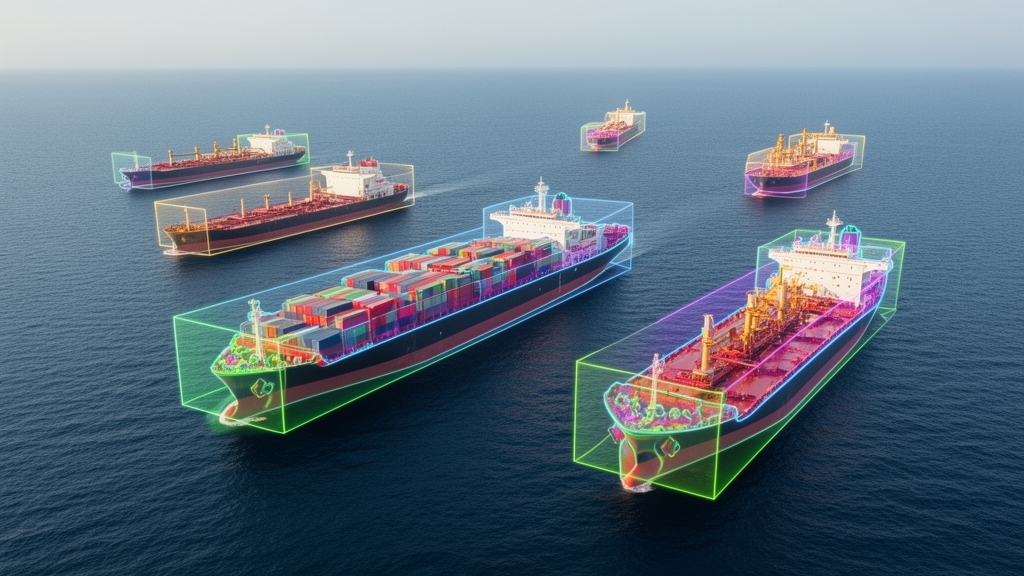
To verify whether the near-perfect binary classification results reflected genuine visual generalizability rather than an easily separable dataset, the authors re-evaluated the identical pipelines without architectural modification across two independent public multi-class benchmarks. On the Game of Deep Learning: Ship dataset, covering 6252 images across five categories—Cargo, Military, Carrier, Cruise, and Tankers—overall accuracies dropped into the 0.8785 to 0.9243 range, confirming the increased difficulty of fine-grained ship typing. The Vision Transformer led this five-class task with an accuracy of 0.9243 and a weighted F1-score of 0.9244, followed by EfficientNetV2L at 0.9062, showing superior handling of visually ambiguous categories where Cargo and Tanker exhibited the lowest per-class recall across all models. Conversely, on the SeaShips dataset comprising coastal surveillance imagery of six categories—Ore carrier, bulk cargo carrier, general cargo ship, container ship, fishing boat, and passenger ship—5825 single-label images were evaluated after removing 1175 multi-category frames. In this setting, the manually designed baseline CNN delivered the highest overall accuracy of 0.9612 and weighted F1-score of 0.9613, followed by EfficientNetV2L at 0.9509, whereas the Vision Transformer attained 0.8961 accuracy. These divergent rankings confirm that optimal architecture selection in maritime surveillance cannot be generalized, requiring mission planners to balance specific target taxonomies, false-alarm tolerance, and edge computational capacity.
Subject of Research: Deep learning architectures and model-specific preprocessing for maritime vessel image classification
Article Title: Artificial intelligence for maritime security comparing convolutional neural network and vision transformer architectures under model specific preprocessing
Article References: Gocer, I., Bhuiyan, Z., Ahmad, S., & Hasan, R. (2026). Artificial intelligence for maritime security comparing convolutional neural network and vision transformer architectures under model specific preprocessing. Discover Informatics, 1(1), Article 46. https://doi.org/10.1007/s44564-026-00047-6
Image Credits: AI Generated
DOI: 10.1007/s44564-026-00047-6
Keywords: Computer Vision, Maritime Security, Convolutional Neural Networks, Vision Transformer, MobileNetV2, EfficientNetV2L, Xception, VGG16, Transfer Learning, Ship Detection, Image Classification, SeaShips Dataset, Game of Deep Learning Ship Dataset, Model Preprocessing, Inference Latency, Edge Deployment, Computational Benchmark
News Source: Blake Davidson. (November 25, 2026). Computer Vision Models Exhibit Distinct Trade-Offs in Maritime Ship Classification. Scienmag.