

• HOME
  • NEWS
  • EXPLORE
    • CAREER
      • Companies
      • Jobs
    • EVENTS
    • iGEM
      • News
      • Team
    • PHOTOS
    • VIDEO
    • WIKI
  • BLOG
  • COMMUNITY
    • FACEBOOK
    • INSTAGRAM
    • TWITTER
Tuesday, December 23, 2025
BIOENGINEER.ORG
No Result
View All Result
  • Login
  • HOME
  • NEWS
  • EXPLORE
    • CAREER
      • Companies
      • Jobs
        • Lecturer
        • PhD Studentship
        • Postdoc
        • Research Assistant
    • EVENTS
    • iGEM
      • News
      • Team
    • PHOTOS
    • VIDEO
    • WIKI
  • BLOG
  • COMMUNITY
    • FACEBOOK
    • INSTAGRAM
    • TWITTER
  • HOME
  • NEWS
  • EXPLORE
    • CAREER
      • Companies
      • Jobs
        • Lecturer
        • PhD Studentship
        • Postdoc
        • Research Assistant
    • EVENTS
    • iGEM
      • News
      • Team
    • PHOTOS
    • VIDEO
    • WIKI
  • BLOG
  • COMMUNITY
    • FACEBOOK
    • INSTAGRAM
    • TWITTER
No Result
View All Result
Bioengineer.org
No Result
View All Result
Home BIOENGINEERING

Molecular ‘magnets’ could improve cancer immunotherapy

Bioengineer by Bioengineer
February 8, 2018
in BIOENGINEERING
Reading Time: 2 mins read
0
Share on FacebookShare on TwitterShare on LinkedinShare on RedditShare on Telegram
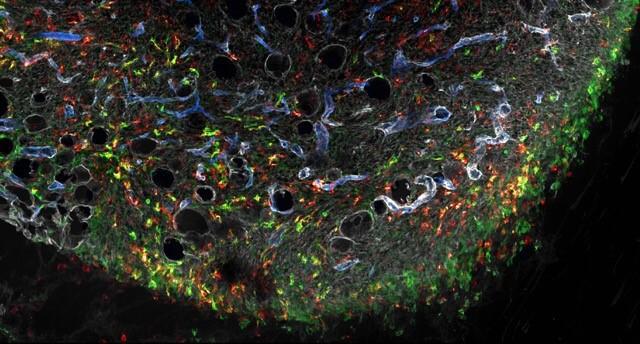
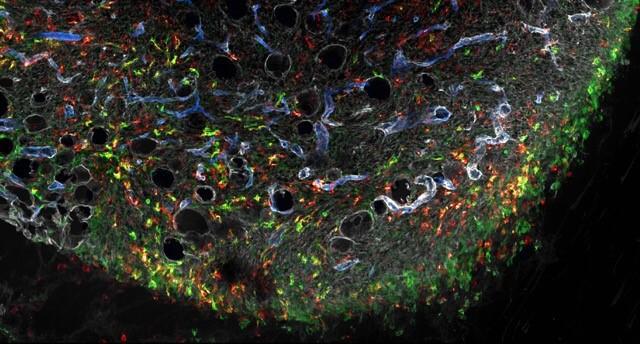
IMAGE

Credit: Professor Caetano Reis e Sousa, Francis Crick Institute

Chemicals that attract specialised immune cells toward tumours could be used to develop better immunotherapies for cancer patients, according to new research published in Cell.

Scientists at the Francis Crick Institute have discovered that immune cells called Natural Killer cells accumulate in tumours and release chemicals that attract specialised dendritic cells (cDC1) – white blood cells known for triggering anti-cancer immune responses – to the tumour.

Genes associated with Natural Killer cells and cDC1 correlated with cancer patient survival in a dataset of over 2,500 patients with skin, breast, neck and lung cancers.* A similar correlation was seen in an independent group of breast cancer patients, with a particularly positive outcome for women with triple negative breast cancer, which typically has a poor prognosis.**

"Our findings have given us a renewed appreciation of the importance of Natural Killer cells and cDC1 in the immune response against cancer," says Professor Caetano Reis e Sousa, Senior Group Leader at the Crick, who led the study. "It's still early days, but attracting more cDC1 to tumours could be the basis of a new immunotherapy for cancer patients."

The team also showed that prostaglandin E2 (PGE2), a molecule produced by some cancer cells, suppresses Natural Killer cell activity and reduces the responsiveness of cDC1 to the chemical attractants. This suggests that blocking PGE2 with aspirin might help boost the effectiveness of immunotherapies by restoring cDC1 levels in tumours.

"Now that we know a bit better how this key anti-cancer response works, we can look at identifying other ways in which cancers get around it," says Caetano. "This understanding will ultimately help us to develop new immunotherapy approaches to help more patients."

Professor Karen Vousden, Cancer Research UK's chief scientist, said: "This interesting research reveals more about the way the body's immune system interacts with cancer, exposing one way in which cancer can avoid attack.

"Studies like this highlight the complexity of this relationship and may reveal another way in which the immune system can be harnessed to treat cancer. It's vital that work continues to help make immunotherapies more effective and beneficial to more patients."

###

The paper ' NK cells stimulate recruitment of cDC1 into the tumor microenvironment promoting cancer immune control' is published in Cell.

*Data from The Cancer Genome Atlas

**Data from the KM Plotter Database

Media Contact

Harry Dayantis
[email protected]
020-379-63606
@thecrick

http://www.crick.ac.uk

Original Source

https://www.crick.ac.uk/news/science-news/2018/02/08/molecular-%E2%80%98magnets%E2%80%99-could-improve-cancer-immunotherapy/ http://dx.doi.org/10.1016/j.cell.2018.01.004

Share12Tweet8Share2ShareShareShare2

Related Posts

IMAGE

Ferrets, cats and civets most susceptible to coronavirus infection after humans

December 10, 2020
IMAGE

Deep Longevity publishes an epigenetic aging clock of unprecedented accuracy

December 8, 2020

How poor oral hygiene may result in metabolic syndrome

December 8, 2020

New findings shed light on the repair of UV-induced DNA damage

December 8, 2020
Please login to join discussion

POPULAR NEWS

  • Nurses’ Views on Online Learning: Effects on Performance

    Nurses’ Views on Online Learning: Effects on Performance

    70 shares
    Share 28 Tweet 18
  • NSF funds machine-learning research at UNO and UNL to study energy requirements of walking in older adults

    71 shares
    Share 28 Tweet 18
  • Unraveling Levofloxacin’s Impact on Brain Function

    54 shares
    Share 22 Tweet 14
  • Exploring Audiology Accessibility in Johannesburg, South Africa

    51 shares
    Share 20 Tweet 13

About

We bring you the latest biotechnology news from best research centers and universities around the world. Check our website.

Follow us

Recent News

Hydrocolloids Boost Orally Disintegrating Film Performance

Muscle Bursting Signals Impulse Control Issues in Parkinson’s

Racial Gaps in Cardiovascular Risk Control in Obesity

Subscribe to Blog via Email

Enter your email address to subscribe to this blog and receive notifications of new posts by email.

Join 70 other subscribers
  • Contact Us

Bioengineer.org © Copyright 2023 All Rights Reserved.

Welcome Back!

Login to your account below

Forgotten Password?

Retrieve your password

Please enter your username or email address to reset your password.

Log In
No Result
View All Result
  • Homepages
    • Home Page 1
    • Home Page 2
  • News
  • National
  • Business
  • Health
  • Lifestyle
  • Science

Bioengineer.org © Copyright 2023 All Rights Reserved.
