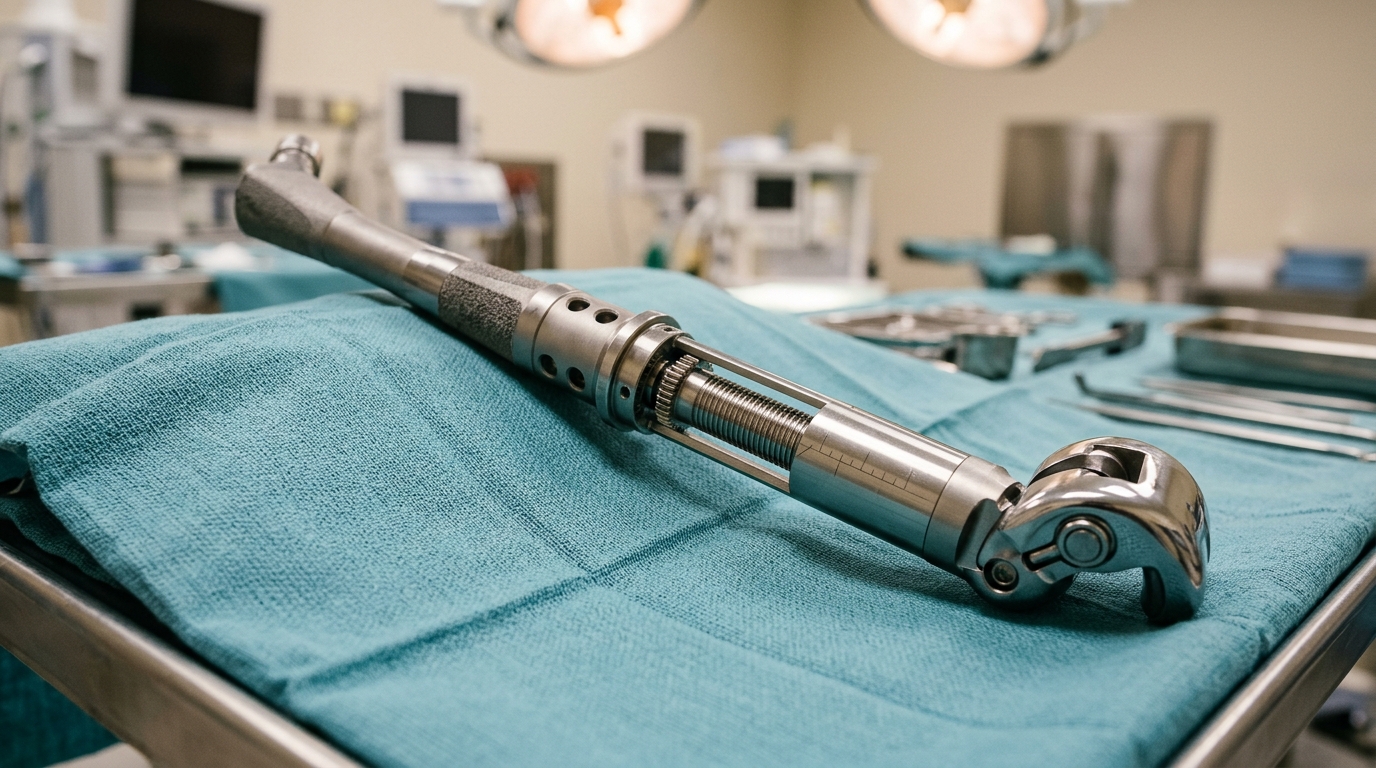
In lower limb reconstruction for skeletally immature children and adolescents treated for malignant bone tumors, expandable endoprostheses achieve favorable functional recovery with a pooled Musculoskeletal Tumor Society score of 82.9 percent, yet they carry a substantial clinical burden with a pooled complication rate reaching 58.0 percent. These findings stem from a systematic literature review and single-cohort meta-analysis published in the Annals of Surgical Oncology by an orthopedic oncology team led by M. Piezzo, O. Tinelli, P. Malfi, R. Garofalo, F. Fazioli, and R. Pezzella. Managing malignant bone sarcomas in growing pediatric patients poses an enduring clinical challenge because resecting tumors around growth plates often induces severe limb-length discrepancies. Expandable implants have gained widespread clinical utilization over recent decades to preserve limb length as pediatric patients mature. By synthesizing four decades of published clinical experience, this investigation establishes quantitative benchmarks for limb salvage, confirming that while expandable hardware preserves mobility and supports acceptable five-year overall survival, families and surgeons must navigate frequent adverse events, mechanical challenges, and reoperations.
The investigation was conducted in accordance with the Cochrane Handbook for Systematic Reviews of Interventions and structured around the Preferred Reporting Items for Systematic Reviews and Meta-Analyses guidelines, with its protocol prospectively registered under identifier CRD420251240697 in the PROSPERO database. Reviewers carried out electronic database searches across PubMed, Embase, and Web of Science to capture clinical studies published from January 1, 2000, through October 9, 2025. The investigators paired Boolean strings covering growing prostheses, endoprosthetic limb salvage, and bone malignancies with manual screening of reference lists from retrieved full-text papers and review articles. Search records were imported into Rayyan for duplicate removal and multi-stage screening. Initial database queries yielded 810 candidate citations, which were narrowed after removing 178 duplicates down to 632 unique titles and abstracts. Two independent reviewers evaluated these records against predefined eligibility criteria, eliminating 567 citations primarily due to non-matching populations, publication formats, or study designs, before retrieving 65 full-text articles for detailed eligibility assessments.
Eligibility criteria restricted the meta-analysis to original prospective cohorts, retrospective studies, and case series documenting expandable endoprosthetic reconstruction of the lower limb among skeletally immature pediatric patients with primary malignant bone tumors. Studies were required to report functional scores, prosthetic survival durations, or explicit complication data. The authors excluded investigations focusing on skeletally mature individuals, upper limb tumor reconstructions, articles not published in English, and non-peer-reviewed literature such as conference abstracts, letters, and narrative reviews. Following full-text evaluation, 38 reports were excluded because their participant populations failed to satisfy inclusion criteria. Ultimately, 27 unique clinical studies comprising 1055 patients satisfied all predefined benchmarks. Within this collective cohort, patients underwent expandable endoprosthetic reconstructions between 1982 and 2019. The mean participant age at surgery was 10.0 years, ranging from 2.0 to 16.0 years, with a median follow-up duration of 5.44 years spanning up to 24.0 years. Histological diagnoses were predominantly osteosarcoma, representing 88.8 percent of cases, alongside 10.4 percent Ewing sarcoma and 0.9 percent rarer malignancies.
Methodological quality across the 27 included studies was systematically appraised using the Methodological Index for Non-Randomized Studies instrument, yielding a mean score of 10.44 out of a maximum ideal non-comparative score of 16, placing the literature in the moderate-quality category. Individual study scores ranged from 7 to 14. Although most investigated cohorts formulated clear clinical aims, enrolled consecutive participants, and achieved adequate follow-up intervals, significant methodological constraints persisted. The majority of published reports were retrospective single-center series that lacked prospective statistical power calculations and displayed vulnerabilities regarding the unbiased assessment of clinical endpoints. Incomplete reporting of outcome variance across published literature presented a notable analytical hurdle. Because meta-analytic weighting relies directly on variance data, missing statistics threatened to exclude valuable cohorts. The researchers addressed this pragmatic challenge by calculating standard errors using standard deviation approximations derived from reported ranges, adopting an imputed fixed standard deviation of 11.0 across cohorts lacking variance reporting to enable pooled inverse-variance synthesis without disproportionate study weighting.
Functional status was evaluated as the primary clinical endpoint using the Musculoskeletal Tumor Society rating system, with raw scores converted to percentage scales to facilitate standardized quantitative comparisons across heterogeneous reports. Across all 1055 evaluable patients, the pooled random-effects estimate for the mean functional score was 82.9 percent, bounded by a 95 percent confidence interval from 80.5 to 85.3 percent. Statistical heterogeneity across the analyzed cohorts was considerable, reflected by an inconsistency index of 92.4 percent and a p-value below 0.001. Despite this between-study variance, reported study-specific functional averages consistently clustered between 75 and 90 percent. These functional scores demonstrate that when surgical reconstruction successfully heals and complications are controlled, expandable endoprosthetic devices allow pediatric patients to regain high levels of daily physical performance, ambulation, and age-appropriate activity. The researchers highlighted that these favorable functional outcomes align with broader oncologic literature demonstrating that successful limb salvage provides functional advantages compared with primary surgical amputation in pediatric extremity sarcoma management.
Oncologic and long-term device durability outcomes revealed contrasting trajectories between overall patient survival and hardware retention over time. Across nine studies incorporating 540 patients, the pooled five-year overall patient survival rate reached 76.0 percent, with a 95 percent confidence interval spanning from 54.7 to 89.2 percent and moderate between-study heterogeneity characterized by an I-squared value of 68.4 percent. The authors emphasized that overall survival in pediatric bone sarcoma is primarily dictated by intrinsic tumor biology, staging, and systemic chemotherapeutic response rather than surgical reconstructive technique. Conversely, prosthetic survival analysis encompassing 648 patients demonstrated a pooled five-year implant survival rate of 60.0 percent, with a 95 percent confidence interval of 55.0 to 66.0 percent, alongside a five-year endoprosthetic failure-free survival rate of 65.1 percent. Moderate heterogeneity was observed among these survival cohorts, with an I-squared value of 47.4 percent. The substantial gap between overall patient survival and five-year implant survival underscores that preserving growing limbs requires a high tolerance for subsequent surgical revisions.
The investigation documented an extensive complication burden, analyzing 29 distinct clinical cohorts derived from the 27 included studies, as one investigation reported results separately for distinct anatomical sites. The overall pooled complication rate reached 58.0 percent across the pooled patient population, with a 95 percent confidence interval extending from 48.0 to 67.0 percent. Inter-study variability was substantial, showing an I-squared index of 79.6 percent, with individual cohort complication rates ranging from roughly 10 percent to greater than 90 percent, though most clustered between 40 and 70 percent. To examine technological influences on adverse outcomes, the researchers conducted an exploratory subgroup meta-analysis classifying implants by expansion mechanism into minimally invasive, non-invasive, mixed, or transitional systems. Among 18 cohorts evaluable for isolated mechanisms, the pooled complication rate was 39.0 percent across four minimally invasive cohorts and 53.0 percent across 14 non-invasive cohorts. However, random-effects comparative testing demonstrated no statistically significant difference between these mechanisms, yielding a p-value of 0.317 and high residual heterogeneity.
Adverse events and surgical failures were categorized descriptively according to the standardized Henderson and International Society of Limb Salvage classification framework, covering soft tissue failure, aseptic loosening, structural failure, infection, and tumor recurrence. Because multiple adverse events frequently occurred within individual patients over extended follow-up intervals, formal statistical pooling of specific failure subtypes was precluded. Across both minimally invasive and non-invasive cohorts, type III structural failure emerged as the single most prevalent mode of failure, accounting for 33.1 percent and 29.1 percent of reported failure events, respectively. Among mixed implant cohorts, type I soft-tissue failures occurred most frequently at 31.6 percent, followed by type IV infections at 23.4 percent and type III structural failures at 21.5 percent. Notably, deep periprosthetic infection rates were comparable between invasive or minimally invasive devices and non-invasive implants, registering 11.6 and 11.4 events per 100 patients, respectively, with Fisher exact testing showing no statistically significant difference between cohorts.
The review evaluated clinical trade-offs associated with evolving prosthetic designs, noting that non-invasive magnetically activated mechanisms allow gradual outpatient expansion via external magnetic fields, successfully minimizing the pain, stiffness, and repeated hospitalizations historically necessitated by open surgical lengthening procedures. However, the synthesized evidence demonstrates that non-invasive expansion technologies do not eliminate mechanical breakdowns, structural failures, joint instability, or periprosthetic infections. In third-generation non-invasive models, including the Stanmore JTS and Repiphysis systems, structural failures remained the leading complication category, reflecting the mechanical vulnerability inherent to intricate internal lengthening mechanisms operating under repetitive pediatric musculoskeletal loads. Sensitivity analyses evaluating the influence of individual investigations, including leave-one-out models and the exclusion of first-generation Biomet implants, confirmed that the primary functional and implant survival estimates remained stable. Beyond biomechanical metrics, the authors highlighted that successful limb preservation confers profound psychosocial value by enhancing adolescent self-esteem and body image, explaining why patients and families frequently express high long-term satisfaction despite encountering repeated reoperations.
Interpreting the meta-analytic findings requires careful consideration of key methodological limitations inherent to the retrospective nature of pediatric orthopedic oncology literature. Most included studies represented single-center experiences spanning more than three decades of technological evolution, during which surgical techniques, implant metallurgy, lengthening protocols, and adjuvant chemotherapy regimens changed considerably. Furthermore, reliance on imputed standard deviation values for functional outcome pooling introduces analytical uncertainty, although sensitivity analyses supported the robustness of primary estimates. The authors concluded that expandable endoprostheses represent an effective, functional limb-salvage reconstructive modality for skeletally immature bone sarcoma patients, balancing satisfactory midterm oncologic survival and favorable mobility against an expectedly high complication burden. Future progress in the field will require multi-institutional prospective registries utilizing standardized outcome metrics, uniform reporting of Henderson and International Society of Limb Salvage failure categories, and rigorous clinical comparisons between expandable devices, biological reconstructions, rotationplasty, and emerging three-dimensional printed patient-matched prostheses to optimize lifelong durability for pediatric cancer survivors.
Subject of Research: Expandable endoprostheses for pediatric lower limb bone sarcoma reconstruction
Article Title: Clinical Outcomes, Implant Survival, and Complications of Expandable Endoprostheses for Lower Limb Reconstruction in Skeletally Immature Patients with Bone Sarcoma: A Systematic Review and Single-Cohort Meta-Analysis
Article References: Piezzo, M., Tinelli, O., Malfi, P., Garofalo, R., Fazioli, F., & Pezzella, R. (2026). Clinical Outcomes, Implant Survival, and Complications of Expandable Endoprostheses for Lower Limb Reconstruction in Skeletally Immature Patients with Bone Sarcoma: A Systematic Review and Single-Cohort Meta-Analysis. Annals of Surgical Oncology. https://doi.org/10.1245/s10434-026-20730-0
Image Credits: AI Generated
DOI: 10.1245/s10434-026-20730-0
Keywords: expandable endoprostheses, pediatric oncology, bone sarcoma, osteosarcoma, Ewing sarcoma, limb salvage surgery, Musculoskeletal Tumor Society, MSTS functional score, prosthesis survival, complication rate, Henderson ISOLS classification, structural failure, non-invasive expansion, minimally invasive expansion, lower limb reconstruction, orthopedic oncology, MINORS tool, overall survival
News Source: Nathaniel Bowman. (November 24, 2026). Expandable Prostheses Deliver Strong Function but High Complications in Pediatric Sarcoma. Scienmag.