A group of researchers of the University of Barcelona (UB) have described a key interaction to understanding growth control in the vinegar fly (Drosophila melanogaster). According to the study, published in the journal of the European Molecular Biology Organization (EMBO), EMBO Reports, the interaction between the transcription factor Cabut and the protein Yorkie (YAP/TAZ in humans) is necessary for tissue and organ regeneration and growth. The study could have biomedical implications as the protein Yorkie is associated with different types of cancer; to avoid the interaction between Cabut and Yorkie could be a potential therapeutic target.
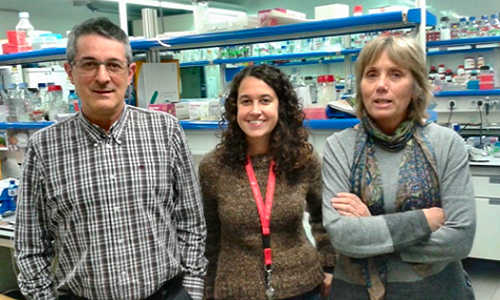
The scientific paper is signed by researchers Marina Ruiz-Romero, Florenci Serras and Montserrat Corominas, from the Department of Genetics of the UB and the Institute of Biomedicine of the UB (IBUB).
Cabut is a transcription factor, in other words, a type of protein bound, directly or indirectly, to DNA involved in genetic information transmission that regulates gene expression. “Cabut is associated with growth regulation and cell proliferation, but little was known about its downstream target genes or its precise mechanism of action until now”, affirms Marina Ruiz-Romero, first author of the scientific article.
A study with high-throughput sequencing techniques
In order to know its mechanism of action, researchers used a high-throughput sequencing technique named ChIP-Seq. With this technique, they determine Cabut bound regions in the entire genome. Then, the UB research team compared the results obtained with several databases until they found another protein that appeared in the same regions: Yorkie.
Next, they proved experimentally that both proteins (Cabut and Yorkie) were together and depend on each other to control growth. “With different genetic experiments we analysed what happened if one of them was depleted and we concluded that both need each other to enhance and control growth”, says Montserrat Corominas.
New insights into tumour evolution understanding
The study provides new insights into the understanding of tumour development. In fact, Yorkie mammalian homologs YAP and TAZ work as transcriptional co-activators in growth processes; their overexpression is associated with uncontrolled growth and cancer. Drugs targeting the Hippo signalling pathway have not been successful, so it would be interesting to act on the factors that interact with it. “Studies with human cells are much more difficult because each gene has more copies, but the goal would be to avoid Yorkie bind with other factors to block the activity. Results led us to think that Cabut could be a potential target”, emphasises Montserrat Corominas.
To study uncontrolled cell proliferation
UB researchers continue studying tissue regeneration mechanisms. “Regeneration and cancer have many things in common; however, the first one is a controlled proliferation, but the second is an uncontrolled proliferation that causes a tumour. The aim is to observe how Yorkie works in these two contexts in order to know better tumour mechanisms”, explains Marina Ruiz-Romero.
In future studies, the UB research team will continue using the vinegar fly as a model to identify new genes involved in these processes. “Basic research is essential to find biomedical applications. In this sense, many aspects about development, cancer and regeneration are known thanks to the drosophila”, concludes Montserrat Corominas.
Story Source:
The above story is based on materials provided by Universidad de Barcelona.