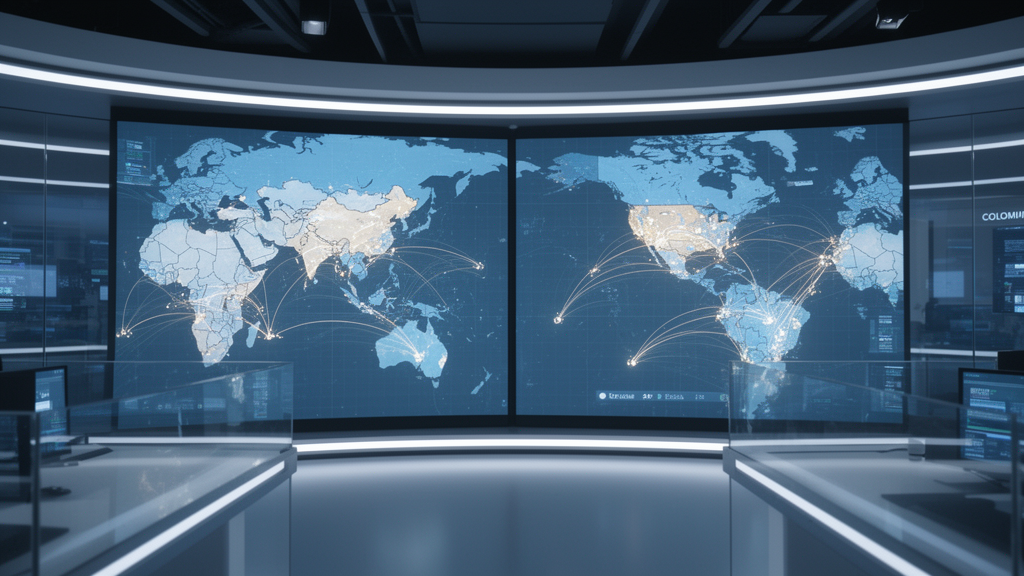
Researchers using computational text analytics and time-series modeling identified patterns of sequential alignment between Russian and Colombian news media during the 2022 Russia-Ukraine conflict. By evaluating a corpus of more than 38,000 Spanish- and Russian-language news articles published between 2013 and 2023, the investigation tracked how geopolitical narratives circulated across distinct linguistic and regional media ecosystems, noting that the period surrounding the 2022 invasion generated the clearest alignment patterns.
The analytical workflow relied on a six-stage pipeline that integrated multilingual named entity recognition, document-level sentiment scoring, e5-large-instruct embeddings, BERTopic clustering, and a semi-automated human-large language model labeling system. The researchers tracked narrative salience and evaluative tone over time by converting article coverage into weekly, log-normalized series. These time series were subsequently evaluated using linear regression alongside Granger causality tests evaluated at lags of one to four weeks.
Across four key macro-narratives—Security & Conflict, Diplomacy, Economy, and Politics & Society—the coverage exhibited sequential alignment, where volume fluctuations in narrative attention were frequently followed by shifts in evaluative tone. Statistical evaluations revealed that 32 of 44 target-topic pairs exhibited significant lag structures prior to false-discovery rate correction at a threshold of p less than 0.05, with 25 of those pairs remaining statistically significant following Benjamini–Hochberg adjustment.
In contrast, categories with lower geopolitical salience, including Technology, Health, and Off-topic reporting, demonstrated far less consistent temporal coupling across the two national media environments. The authors highlighted this divergence as descriptive context rather than a formal experimental control. Additionally, the study noted that the broader 2013 to 2023 text corpus also captured the 2014 conflict period, though the strongest coherence remained concentrated around 2022.
The authors emphasized that these observed lag structures provide a descriptive view of temporal coupling rather than evidence of direct causal influence or coordinated messaging between outlets. Instead, the patterns reflect narrative mimicry, characterized by recurring convergence in framing and sentiment. By combining transformer-based semantic representations with human-in-the-loop interpretation and classical time series, the team demonstrated a reproducible computational framework for examining transnational discourse trajectories.
Subject of Research: Computational analysis of narrative alignment between Russian and Colombian news coverage
Article Title: A language modeling approach to identifying Russian information confrontation in Colombia
Article References: Parson, J., & Jaramillo, A. (2026). A language modeling approach to identifying Russian information confrontation in Colombia. Computational Humanities Research, 2, Article e12. https://doi.org/10.1017/chr.2026.10031
Image Credits: AI Generated
Keywords: Russian media, Colombian media, language modeling, narrative mimicry, time-series modeling, Granger causality, multilingual text analytics, BERTopic clustering, e5-large-instruct embeddings, named entity recognition, sentiment scoring, geopolitical narratives, Russia-Ukraine conflict, media ecosystems, Benjamini-Hochberg adjustment, computational humanities, transnational discourse
News Source: Denise Maddox. (November 23, 2026). Study Identifies Sequential Alignment Between Russian and Colombian News Narratives. Scienmag.