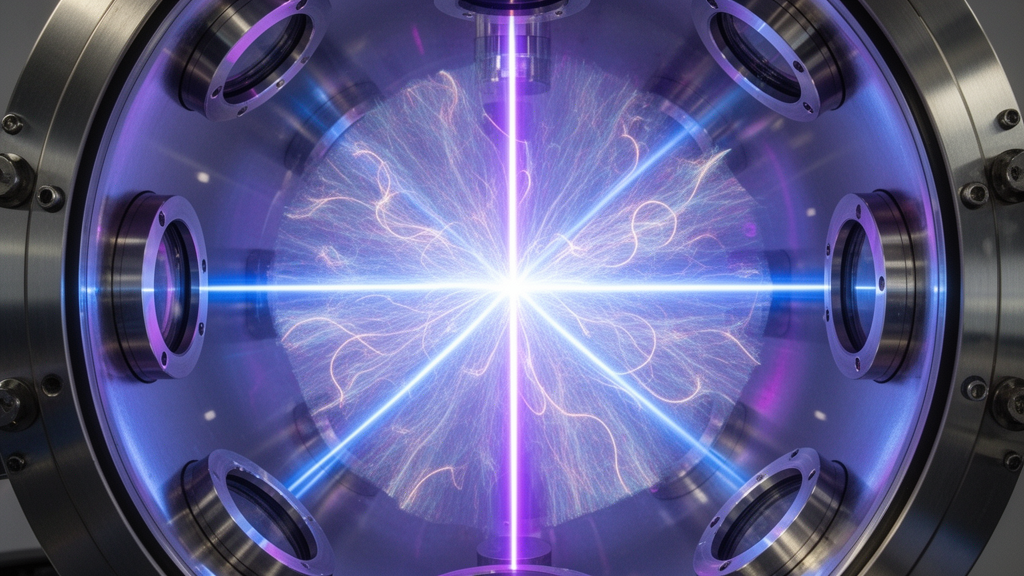
In an experimental campaign at the ELI-Beamlines facility in the Czech Republic, researchers investigating laser-plasma interactions discovered that thin foil targets exploding during laser irradiation produce an order-of-magnitude increase in stimulated Raman scattering reflectivity compared to thick targets. Conducted on the high-power L4n laser line at the P3 Plasma Physics platform, the study systematically compared how thick and thin planar targets respond to high-energy nanosecond pulses. By combining full-aperture backscatter diagnostics with two-dimensional hydrodynamic modeling, the team demonstrated that laser-plasma instabilities exhibit fundamentally different growth mechanisms in exploding underdense plasmas compared to classical ablation plumes. The findings provide critical experimental benchmarks for understanding parametric instability growth, an ongoing hurdle in the development of direct-drive inertial confinement fusion and commercial inertial fusion energy schemes.
Inertial confinement fusion research has accelerated following the demonstration of ignition and energy gain exceeding unity at the National Ignition Facility, prompting exploration of direct-drive schemes, shock ignition, shock-augmented ignition, and fast ignition. A persistent challenge across these approaches is the growth of laser-plasma instabilities, primarily stimulated Raman scattering, stimulated Brillouin scattering, and two-plasmon decay. These parametric instabilities involve resonant coupling of incident laser light into two daughter waves within target plasma. Raman and Brillouin scattering redirect substantial fractions of incident laser energy into backscattered light, impairing absorption and implosion efficiency. Furthermore, stimulated Raman scattering couples energy into electron plasma waves that damp into suprathermal hot electrons, which can pre-heat cryogenic fusion fuel and degrade compression. Decoupling these interactions using planar targets allows dedicated, isolated measurements of parametric instability growth under well-characterized conditions.
The experiments leveraged the capabilities of the L4n laser line at ELI-Beamlines, which combines high pulse energies with a repetition rate of one shot every three minutes. This contrasts with traditional high-energy facilities operating at intervals of 45 to 90 minutes, enabling over 600 shots across diverse irradiation conditions during the campaign. The L4n neodymium-glass laser generated fundamental pulses at 1053 nanometers with output energies between 450 and 650 joules. A potassium dihydrogen phosphate crystal converted the light to the second harmonic wavelength of 526.5 nanometers with 24 to 30 percent efficiency. Shorter wavelengths are advantageous for fusion because they raise the intensity thresholds required to trigger laser-plasma instabilities while enhancing collisional absorption within the plasma.
Laser pulses were focused onto planar targets inside the target chamber using a 2.6-meter focal length lens operating at f/10.2. In unsmoothed beam configurations, the temporal profile was approximately square with a 2.3-nanosecond duration. Optical aberrations in the unsmoothed beam formed a 70-micrometer focal spot containing hotspots that reached a maximum average intensity of 2.6 times 10 to the 15th power watts per square centimeter. For comparison shots, a distributed phase plate eliminated aberrations, producing a 2.7-nanosecond Gaussian profile and expanding the spot diameter to 320 micrometers, which lowered the maximum average intensity to 5.5 times 10 to the 13th power watts per square centimeter. Targets consisted of 200-micrometer polyvinyl chloride foils or thin polyethylene terephthalate foils of 0.9, 2, or 3 micrometers, each coated with a 50-nanometer aluminum layer to prevent early light transmission.
To measure backscattered instability growth, the platform utilized an integrated full-aperture backscatter diagnostic station on the beam transport line. Light reflected down the incident laser focusing cone was collected through a leaky turning mirror in the collimated transport line and directed into a Schmidt-Cassegrain telescope system. Calibrated beamsplitters divided the light toward calorimeters equipped with bandpass filters to isolate stimulated Raman and Brillouin scattering energies. Concurrently, portions of the backscattered light were routed to two imaging streak spectrometers to resolve spectral and temporal dynamics. The Raman spectrometer employed a 150 lines per millimeter grating calibrated against mercury-argon spectral lines across the 600 to 900 nanometer band, while the Brillouin spectrometer utilized an 1800 lines per millimeter grating providing higher spectral resolution over a narrow band between 523.5 and 528.5 nanometers.
Because in situ plasma parameters could not be measured directly during high-intensity shots, researchers conducted numerical simulations using the two-dimensional hydrodynamic code DUED to reconstruct plasma conditions. Modeling an irradiated 200-micrometer target with the unsmoothed laser profile predicted an expanding front-surface ablated plasma with electron temperatures between 0.4 and 1.2 kiloelectronvolts and an exponential density scale length of approximately 104 micrometers between 0.01 and 0.20 of critical density. Modeling the thick target under smoothed beam irradiation yielded a longer density scale length of roughly 181 micrometers alongside cooler electron temperatures of 0.3 to 0.5 kiloelectronvolts. In sharp contrast, DUED simulations of thin 2-micrometer targets revealed that the material exploded during the laser pulse, causing the peak electron density to rapidly become under-critical, falling below 0.25 of critical density after approximately 1.0 nanosecond.
Backscatter diagnostics confirmed pronounced physical differences between thick targets and exploding thin foils. Calorimetry revealed that thick targets irradiated without beam smoothing exhibited a stimulated Raman scattering reflectivity of approximately 0.01 percent, consistent with previous planar experiments. Conversely, thin targets subjected to comparable laser intensities produced a tenfold surge in total Raman reflectivity, reaching approximately 0.3 percent, with the strongest signals recorded from 2-micrometer foils. Streaked spectral images showed that Raman emission from thick targets remained confined between 700 and 800 nanometers, corresponding to convective growth driven in ablated front plasma at electron densities between 0.05 and 0.11 of critical density. Theoretical threshold calculations indicated that convective Raman growth in thick targets required an intensity of roughly 4 times 10 to the 15th power watts per square centimeter, exceeding average intensity and occurring primarily within localized hotspots. For exploded foils, convective thresholds near the parabolic density peak dropped tenfold, allowing Raman scattering to grow vigorously below average beam intensities.
Spectral measurements from thin exploding targets uncovered a dynamic wavelength shift absent in thick targets. In 0.9, 2, and 3-micrometer foils, stimulated Raman backscatter initiated near 750 nanometers and shifted to shorter wavelengths over time, reaching a lower limit of approximately 660 nanometers. By extracting temporal density and temperature values from DUED simulations at the parabolic density peak, researchers showed that dropping density and temperature drive scattered light to shorter wavelengths. The sharp cut-off near 660 nanometers aligns with the onset of strong thermal Landau damping on the daughter electron plasma wave. Calculating the product of the Langmuir wavevector and the plasma Debye length demonstrated that when this parameter surpasses 0.3, Landau damping suppresses wave growth. Across all thin foil thicknesses, the threshold value of 0.3 occurred near 680 nanometers, explaining why different target thicknesses exhibited an identical lower wavelength cut-off, though kinetic inflation and filamentation could also influence damping dynamics.
Observations of stimulated Brillouin scattering revealed equally distinct temporal and spectral signatures across target configurations. Streaked spectra recorded an overall Doppler blue-shift in backscattered light, reaching maximum shifts of approximately negative 1.8 nanometers relative to the 526.5-nanometer incident laser wavelength. Every shot exhibited a prominent early-time spectral feature that initiated near a negative 1.0 nanometer shift before rapidly moving back toward the fundamental laser wavelength within roughly 200 picoseconds. The team attributed this initial excursion to the Dewandre effect, wherein rapid target ionization by the leading edge of the laser pulse alters electron density, modifying the time-dependent phase velocity and optical path length to the critical surface. At later times, plasma expansion governed the spectral shift, with hydrodynamic modeling showing that expanding ablation plumes produce velocities reaching several hundred kilometers per second, generating Doppler blue-shifts between negative 0.5 and negative 1.5 nanometers corresponding to Brillouin scattering driven across densities from 0.06 to 1.0 of critical density.
Target thickness also exerted a decisive influence on the temporal persistence and spectral evolution of stimulated Brillouin scattering. While Brillouin emission from 200-micrometer targets and 3-micrometer foils persisted throughout the laser pulse, emission from 0.9-micrometer and 2-micrometer targets terminated prematurely. Assuming emission began with the laser pulse, the team measured an average Brillouin duration of 1.1 plus or minus 0.2 nanoseconds for 0.9-micrometer foils and 1.6 plus or minus 0.4 nanoseconds for 2-micrometer foils. Comparison with DUED simulations confirmed that thin targets had fully exploded by these times, with maximum central electron densities falling to 0.06 and 0.07 of critical density, respectively. This matched the lower density limit of 0.06 critical density derived from thick-target maximum wavelength shifts, confirming that Brillouin scattering ceases once plasma density drops below this cut-off. Additionally, the maximum wavelength shift in thin targets decreased over time, a trend explained by hydrodynamic predictions of post-explosion thermal cooling that lowers the local sound speed.
Introducing the distributed phase plate altered interaction dynamics by creating a spatial distribution of optical speckles and lowering average intensity, though it did not completely extinguish instability growth. For thick targets irradiated with the smoothed beam, Raman reflectivity fell below calorimeter detection thresholds, and spectral emission narrowed to between 750 and 780 nanometers with no low-density emission. Thin foils under smoothed irradiation reached a reduced peak Raman reflectivity of approximately 0.01 percent, while Brillouin spectra displayed two distinct emission lobes matching power peaks in the Gaussian temporal pulse. Despite lower average intensity, instability emission persisted in higher-density regions because localized speckles in the high-intensity statistical tail exceeded ponderomotive self-focusing thresholds. Calculating the filamentation figure of merit across the plasma profile yielded values well above unity, driven largely by the long f/10.2 focusing geometry. The authors emphasized that future fusion facility designs must evaluate final optical f-numbers to suppress filamentation, while highlighting how high-repetition-rate laser facilities will accelerate parametric instability research.
Subject of Research: Stimulated Raman and Brillouin scattering dynamics in thick and exploded foil laser-plasma interactions
Article Title: Experimental investigation of stimulated Raman scattering and stimulated Brillouin scattering growth in thick and exploded foil targets
Article References: Hume, E., Cristoforetti, G., Koester, P., Atzeni, S., Batani, D., Condamine, F., Fauvel, G., Fisher, B., Masson-Laborde, P.-E., Laštovička, T., Singappuli, D., Singh, R. L., Sokol, M., Theobald, W., Wasser, F., Zähter, Ş., Woolsey, N. C., & Gizzi, L. A. (2026). Experimental investigation of stimulated Raman scattering and stimulated Brillouin scattering growth in thick and exploded foil targets. High Power Laser Science and Engineering, 14, Article e102. https://doi.org/10.1017/hpl.2026.10159
Image Credits: AI Generated
Keywords: stimulated Raman scattering, stimulated Brillouin scattering, laser-plasma instability, inertial confinement fusion, ELI-Beamlines, L4n laser line, exploding foil targets, distributed phase plate, optical beam smoothing, Dewandre effect, Landau damping, filamentation figure of merit, full-aperture backscatter diagnostic, DUED hydrodynamic code, ponderomotive self-focusing, convective instability threshold, polyethylene terephthalate targets
News Source: Denise Maddox. (November 23, 2026). Exploding Foil Targets Drive Tenfold Surge in Stimulated Raman Scattering. Scienmag.