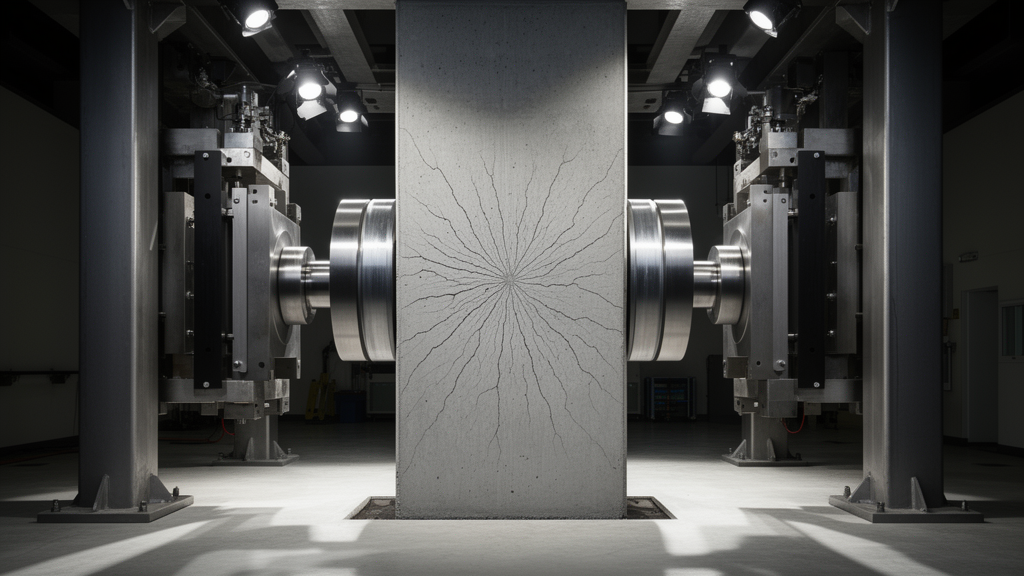
A comprehensive state-of-the-art review published in the journal Archives of Civil and Mechanical Engineering reveals that existing building standards mischaracterize the internal bursting forces and splitting capacities of bottle-shaped concrete struts in non-flexural structural members. Authored by structural researchers Matthew Cluse, Reza Hassanli, and Zhihang Xue, the investigation demonstrates that widely accepted analytical formulas fail to capture the physical transition between boundary-restricted and unrestricted stress fields. When heavy concentrated loads bear down on deep structural components, compressive stresses naturally disperse outward along curved trajectories. This lateral spreading induces internal transverse tensile stresses, commonly called bursting forces, through the concrete core. Because plain concrete exhibits low tensile strength, these transverse stresses can cause sudden longitudinal splitting long before the material reaches its direct compressive capacity. The researchers discovered that conventional regulatory provisions consistently assume worst-case constant divergence angles, ignoring compelling experimental and numerical evidence that bursting forces drop sharply as the ratio of strut length to nodal bearing width decreases.
In standard structural design practice, engineers frequently analyze beam elements using classical Euler-Bernoulli flexural theory, which relies on the fundamental assumption that plane sections remain plane under loading. However, the review emphasizes that flexural beam theory becomes physically invalid in non-flexural members and discontinuity regions, known as D-regions, where internal strain distributions are highly non-linear. Based on Saint-Venant’s principle, localized disturbance zones extend away from geometric changes, concentrated reactions, or applied forces to a distance roughly equal to the overall member depth. In structural members where the clear shear span to depth ratio is less than or equal to two, adjacent discontinuity regions overlap completely, converting the entire element into a non-flexural component such as a deep transfer beam or pile cap. In these non-flexural zones, load transfer mechanisms are dominated by compressive struts and tension ties. If practicing engineers inappropriately apply cross-sectional bending equations instead of recognized discontinuity models, they overlook critical bursting stresses, resulting in structures with significantly less load-carrying capacity than analytical calculations suggest.
To represent internal load paths accurately within non-flexural concrete zones, design standards permit linear elastic stress analysis, non-linear numerical modeling, and strut-and-tie analysis. Strut-and-tie models conceptualize the structural concrete as a hypothetical internal truss composed of compressive concrete struts, steel tension ties, and intersecting nodal zones. Concrete struts are formally classified into three distinct categories: prismatic struts, fan-shaped struts, and bottle-shaped struts. Prismatic struts maintain uniform width because external boundaries or adjacent stress fields prevent the compressive stress field from expanding, meaning no internal transverse stresses develop. Fan-shaped struts diverge at constant angles with negligible trajectory curvature, similarly preventing the development of transverse tensile forces. In contrast, bottle-shaped struts represent diverging compressive stress fields where curved stress trajectories generate significant internal bursting forces. The review notes that current design codes present conflicting and inconsistent criteria for distinguishing fan-shaped compression fields from bottle-shaped struts, often forcing engineers to make conservative assumptions regarding transverse reinforcement requirements.
A critical shortcoming identified by the authors involves the standard two-type classification framework currently adopted by international concrete codes, including Eurocode EN 1992-1-1. Existing specifications divide bottle-shaped struts into partial discontinuity regions, corresponding to narrow elements where member width is less than or equal to half the strut length, and full discontinuity regions, which encompass wider elements. In narrow elements, the lateral boundaries of the concrete restrict stress dispersion, creating two independent disturbed zones separated by an intermediate linear strain field. As the concrete element width increases beyond half the strut length, the opposing discontinuity regions begin to overlap at mid-span, altering the internal stress distribution. The authors demonstrate that the conventional two-category model represents an oversimplification because it ignores the continuous physical transition between boundary-restricted stress fields and fully unrestricted stress fields. To rectify this deficiency, the authors propose a refined three-type model that explicitly differentiates separate partial discontinuity regions, restricted full bottle-shaped struts, and unrestricted full bottle-shaped struts.
When calculating bursting forces for strut-and-tie analysis, regulatory standards calculate total transverse tension from the axial compressive force and the tangent of the strut divergence angle. For full discontinuity regions in wide elements, international design codes enforce fixed divergence angles based on worst-case empirical assumptions. For instance, AS 3600:2018 and EN 1992-1-1:2023 adopt a constant divergence slope where the tangent of the dispersion angle equals one-half, while the New Zealand standard NZS 3101 adopts one divided by two-point-five. The review reveals that these constant divergence angles introduce excessive conservatism, particularly for struts possessing small length-to-bearing-width ratios. Multiple experimental studies examined by the research team indicate that the actual dispersion angle immediately prior to concrete cracking varies widely between twenty and thirty degrees, corresponding to tangent values between zero-point-thirty-six and zero-point-fifty-eight. More significantly, empirical measurements demonstrate a consistent downward trend in induced bursting forces as strut length decreases relative to nodal width, directly contradicting the static values mandated by current codes.
The review also exposed severe mathematical and physical anomalies in current building formulas used to evaluate the cracking capacity of unreinforced bottle-shaped struts. Under Australian Standard AS 3600:2018, designers are permitted to omit transverse bursting reinforcement only when the concrete tensile cracking capacity is at least double the calculated ultimate bursting force. The standard estimates the length of the internal bursting zone by subtracting the width of the connecting nodal zone from the total length of the strut. The cracking capacity is subsequently calculated by applying a reduction factor of zero-point-seven across the concrete tensile capacity over this estimated bursting zone length. The authors point out that when the strut length is equal to or less than the nodal zone width, this standard equation produces a bursting zone length of zero or a negative value. Consequently, the formula predicts negative cracking capacity and makes it impossible to design short struts with wide bearings without transverse reinforcement, despite plain concrete displaying substantial load resistance in physical testing.
To evaluate alternative formulations, the authors systematically compared several published analytical models that estimate the cracking capacity of bottle-shaped struts as direct linear functions of strut length and concrete tensile strength. Earlier proposals by researchers such as Sahoo, Goodchild, and Crawford assumed uniform or triangular tensile stress distributions across designated portions of the strut axis, arriving at cracking capacities proportional to the strut length multiplied by concrete tensile strength. When plotted against varying geometric ratios, these alternative models avoid the negative capacity paradox inherent in standard regulatory formulas. Furthermore, experimental testing on reinforced and unreinforced concrete panels demonstrates that the applied compressive load required to initiate cracking actually increases as the bearing area ratio expands. This observed behavior strongly indicates that transverse bursting forces decrease while cracking capacity remains stable as bearing zones widen, highlighting an urgent need for regulatory committees to revise the current subtractive bursting zone formula in favor of validated mechanical models.
The researchers also evaluated experimental investigations comparing localized panel specimens against full-scale structural members, uncovering surprising failure mechanisms governed by internal arching. In experimental studies conducted by Ferreira and colleagues, unreinforced hexagonal concrete panels designed to replicate isolated bottle-shaped struts failed in a sudden, brittle manner immediately upon reaching the tensile splitting strain limit. Conversely, full-scale unreinforced deep beam specimens exhibited a substantially less brittle structural response. Although initial inclined shear cracks developed within the deep beam web when tensile deformation capacity was exceeded, the members did not experience immediate catastrophic collapse. Instead, internal arching action redistributed stresses effectively, allowing the deep beams to sustain significant additional compressive loading prior to ultimate failure. Although both specimen configurations ultimately achieved similar overall efficiency factors relative to idealized prismatic models, the distinct failure progressions demonstrate that local isolated panel tests cannot fully replicate the complex load redistribution mechanisms present in full-scale structures.
Extending two-dimensional design models into three-dimensional non-flexural concrete components, such as thick foundation pile caps and complex beam-column joints, presents another unresolved challenge highlighted by the review. While building standards frequently mandate running two separate, orthogonal two-dimensional analyses to design for spatial stress dispersion, this practice introduces arbitrary assumptions regarding the effective thickness of the internal bursting zone. Experimental research on plain concrete cylinders subjected to concentric circular loading demonstrates that three-dimensionally dispersing compressive stress fields are inherently stronger than their two-dimensional counterparts. In three-dimensional stress fields, the lateral spread of compression in multiple directions generates substantial triaxial confining stresses around the loaded nodes. These confining pressures dramatically enhance nodal load capacity, precluding crushing failures at the bearings and ensuring that structural capacity is governed purely by internal splitting along the strut axis. However, existing design codes provide no unified analytical procedure to quantify this triaxial enhancement accurately.
The synthesis of current literature highlights that existing design methodologies penalize structural efficiency by mandating excessive bursting reinforcement in heavy transfer elements where unreinforced plain concrete cores possess inherent reserve capacity. The authors conclude that future research must prioritize extensive experimental testing on truly unrestricted three-dimensional concrete specimens, particularly those featuring low strut-length-to-nodal-width ratios. Establishing validated three-type boundary classifications and mathematically consistent bursting equations will allow structural engineers to predict crack initiation reliably. Ultimately, closing the existing gap between conservative theoretical standards and real-world construction detailing will enable more economical concrete member designs, reducing unnecessary steel consumption while preserving structural safety margins across modern infrastructure projects.
Subject of Research: Structural engineering analysis of bottle-shaped compressive struts in non-flexural concrete members
Article Title: Behaviour of bottle-shaped struts in non-flexural concrete members: state-of-the-art-review
Article References: Cluse, M., Hassanli, R., & Xue, Z. (2026). Behaviour of bottle-shaped struts in non-flexural concrete members: state-of-the-art-review. Archives of Civil and Mechanical Engineering, 26(6), Article 268. https://doi.org/10.1007/s43452-026-01634-y
Image Credits: AI Generated
DOI: 10.1007/s43452-026-01634-y
Keywords: bottle-shaped struts, non-flexural concrete, strut-and-tie analysis, bursting forces, discontinuity regions, cracking capacity, compressive stress dispersion, deep beams, pile caps, structural concrete design, transverse tensile stress, nodal zones, triaxial confinement, reinforcement detailing, shear span depth ratio, concrete splitting failure
News Source: Denise Maddox. (November 23, 2026). Review Challenges Standard Concrete Strut Models for Predicting Internal Bursting Forces. Scienmag.