• HOME
  • NEWS
  • EXPLORE
    • CAREER
      • Companies
      • Jobs
    • EVENTS
    • iGEM
      • News
      • Team
    • PHOTOS
    • VIDEO
    • WIKI
  • BLOG
  • COMMUNITY
    • FACEBOOK
    • INSTAGRAM
    • TWITTER
Saturday, March 28, 2026
BIOENGINEER.ORG
No Result
View All Result
  • Login
  • HOME
  • NEWS
  • EXPLORE
    • CAREER
      • Companies
      • Jobs
        • Lecturer
        • PhD Studentship
        • Postdoc
        • Research Assistant
    • EVENTS
    • iGEM
      • News
      • Team
    • PHOTOS
    • VIDEO
    • WIKI
  • BLOG
  • COMMUNITY
    • FACEBOOK
    • INSTAGRAM
    • TWITTER
  • HOME
  • NEWS
  • EXPLORE
    • CAREER
      • Companies
      • Jobs
        • Lecturer
        • PhD Studentship
        • Postdoc
        • Research Assistant
    • EVENTS
    • iGEM
      • News
      • Team
    • PHOTOS
    • VIDEO
    • WIKI
  • BLOG
  • COMMUNITY
    • FACEBOOK
    • INSTAGRAM
    • TWITTER
No Result
View All Result
Bioengineer.org
No Result
View All Result
Home Headlines

Antimicrobial silicone invented at KTU: New generation product for medical purposes

Bioengineer.org by Bioengineer.org
January 29, 2018
in Headlines, Health, Science News
Reading Time: 2 mins read
0
Share on FacebookShare on TwitterShare on LinkedinShare on RedditShare on Telegram
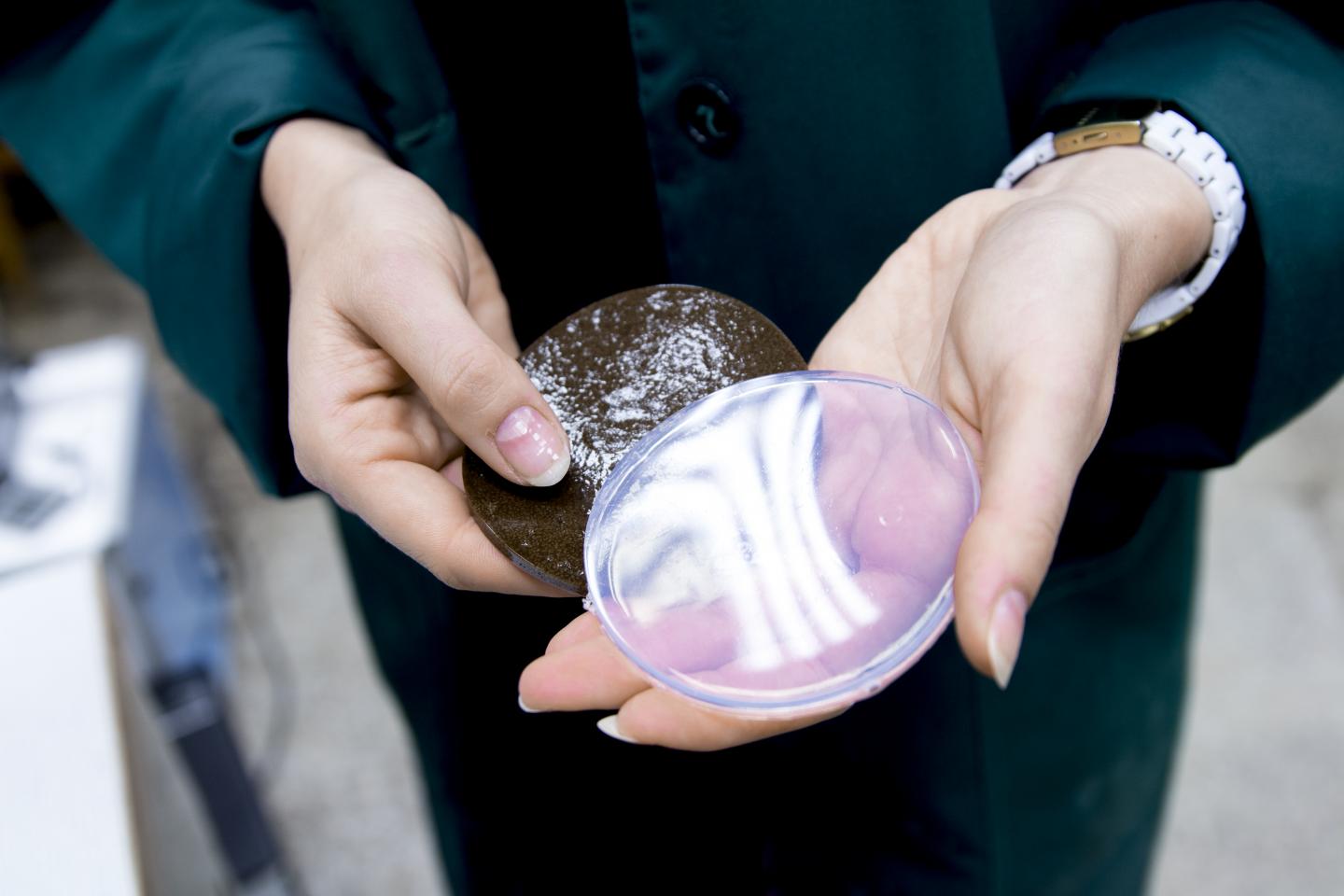
IMAGE

Credit: KTU

Kaunas University of Technology (KTU) laboratories often serve as birthplaces of unique products, such as antimicrobial silicone invented by a KTU PhD student Aiste Lisauskaite and her supervisor Dr Virginija Jankauskaite. The researchers believe that the new product will be extremely useful both for household and medical purposes.

Lisauskaite, who is a PhD student at the KTU Faculty of Mechanical Engineering and Design, Department of Materials Engineering, has presented her invention at the Life Sciences Baltics Conference last year. Her innovation was selected as one of the top five at the Conference, and received enormous attention of industry professionals from various countries.

"The silicone has antimicrobial effect both on gram-positive and on gram-negative microbial strains and fungi. Its antimicrobial effect can be used in various situations, when there is a risk to acquire bacterial infection", says Lisauskaite.

Antimicrobial silicone can be used in hospitals, health care centres and in other similar institutions.

"The new product can be used in blood, urinary and respiratory catheters, it can be applied for various tubes and implants, and used for many different medical purposes. The household usage ranges from children toys' lining, transport or packaging", Lisauskait? is convinced.

Catheters or silicones, dipped in or coated with silver compounds have been already used for some time. However, the antimicrobial silicone developed at KTU is based on completely different technology and different materials. So far, it is a unique product in the world.

The researchers have been working on the production of the antimicrobial silicone for 4 years.

"I have received many inquiries into the idea and its commercialisation. In the future, I hope not only to develop my ideas, of which I have a lot of, but also to introduce competitive and advanced products to the market", says Lisauskaite, a young researcher at KTU.

Paulius Kozlovas, technology transfer manager at KTU National Innovation and Entrepreneurship Centre is convinced that the innovative technology has broad commercialisation possibilities.

"We can definitely see that businesses today are more and more interested into innovative solutions. Aiste's product has broad application possibilities, and we have already applied for European patent. After acquiring the patent and having the product's intellectual rights protected, we will be able to proceed with discussions with potential investors. I see huge potential of success in international markets and the possibility to attract foreign investors to Lithuania", says Kozlovas.

###

Media Contact

Aldona Steponaviciute
[email protected]
370-612-55857
@ktunews
Pradinis puslapis

Share12Tweet8Share2ShareShareShare2

Related Posts

Cutaneous Lesion Location: Key to Head Injury Risk?

March 27, 2026
Biochar Boosts Forest Resilience Against Acid Rain by Restoring Essential Soil Nitrogen

Biochar Boosts Forest Resilience Against Acid Rain by Restoring Essential Soil Nitrogen

March 27, 2026

Two Salk Scientists Honored as 2025 AAAS Fellows

March 27, 2026

Starburst Winds Drain Supernova Energy Quickly

March 26, 2026
Please login to join discussion

POPULAR NEWS

  • blank

    Revolutionary AI Model Enhances Precision in Detecting Food Contamination

    96 shares
    Share 38 Tweet 24
  • Imagine a Social Media Feed That Challenges Your Views Instead of Reinforcing Them

    1003 shares
    Share 397 Tweet 248
  • Uncovering Functions of Cavernous Malformation Proteins in Organoids

    54 shares
    Share 22 Tweet 14
  • Promising Outcomes from First Clinical Trials of Gene Regulation in Epilepsy

    51 shares
    Share 20 Tweet 13

About

We bring you the latest biotechnology news from best research centers and universities around the world. Check our website.

Follow us

Recent News

In-Sensor Cryptography Links Physical Process to Digital Identity

Can Psychosocial Factors Influence Cancer Risk?

Depression Factors in Elderly: Pre vs. Post-COVID Analysis

Subscribe to Blog via Email

Success! An email was just sent to confirm your subscription. Please find the email now and click 'Confirm' to start subscribing.

Join 78 other subscribers
  • Contact Us

Bioengineer.org © Copyright 2023 All Rights Reserved.

Welcome Back!

Login to your account below

Forgotten Password?

Retrieve your password

Please enter your username or email address to reset your password.

Log In
No Result
View All Result
  • Homepages
    • Home Page 1
    • Home Page 2
  • News
  • National
  • Business
  • Health
  • Lifestyle
  • Science

Bioengineer.org © Copyright 2023 All Rights Reserved.