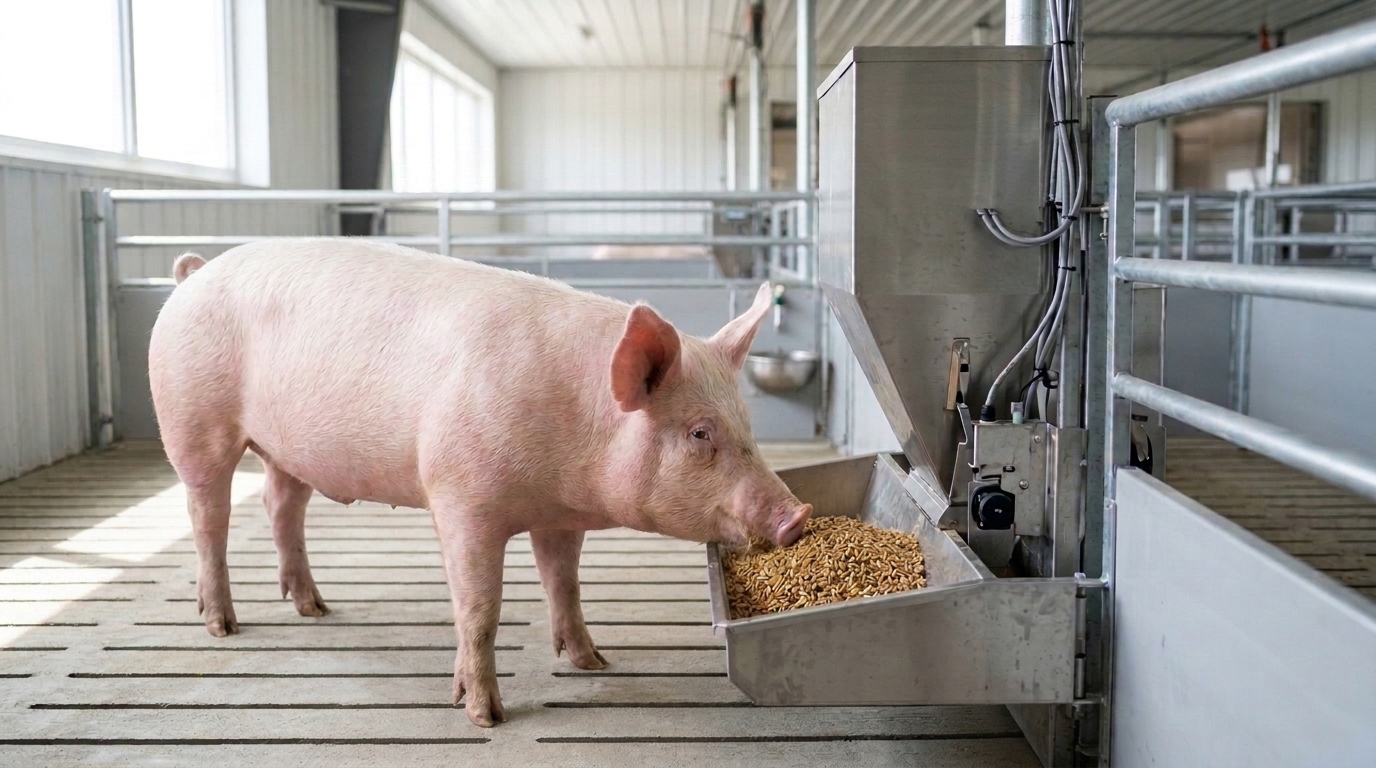
A dynamic feeding model established through a meta-analysis of historical feeding trials accurately predicts digestible energy requirements for growing-finishing pigs, enabling significant reductions in feed consumption and improvements in feed efficiency without compromising animal growth performance. In commercial swine production, traditional ad libitum feeding regimens frequently supply nutrients in substantial excess of actual biological demands, driving notable feed waste and elevating nitrogen and phosphorus excretion in animal feces and urine. Addressing these sustainability concerns, researchers synthesized experimental data from 523 dietary treatments documented across 112 peer-reviewed studies published between 2002 and 2024 to model the mathematical relationship between pig body weight and daily digestible energy intake. Subsequent empirical validation in a 42-day feeding trial demonstrated that pigs fed according to the optimized linear mixed-effects equation consumed markedly less feed per day while attaining the exact same final market body weight as control pigs permitted unrestricted access to feed.
Feed expenditures represent approximately 60 to 70 percent of total production costs in commercial swine operations, with energy and protein ingredients comprising the primary formulation expense. Conventional management strategies rely heavily on static nutritional standards, primarily the United States National Research Council guidelines published in 2012 and the Chinese Feeding Standard of Swine established in 2020. Although both references provide comprehensive syntheses of empirical research, substantial advancements in porcine genetic selection, housing technology, and management practices over recent decades have raised questions regarding whether historical static thresholds accurately capture the dynamic daily energy requirements of modern commercial crossbreds. Precision feeding strategies that deploy mathematical modeling to match nutrient provision directly to continuous changes in pig live body weight offer a viable pathway to curb unnecessary nutrient inputs, alleviate environmental burdens, and protect producer profit margins without diminishing animal productivity.
To construct a robust predictive foundation, investigators applied strict systematic screening criteria across both English and Chinese academic databases, including PubMed, Web of Science, Google Scholar, China National Knowledge Infrastructure, Wanfang Data, and the VIP Database. From an initial identification pool of 1,075 publications retrieved using targeted terms connecting swine to growth performance, the authors eliminated 474 studies lacking regional origin within China or missing dietary energy and protein records. Further quality screening discarded 166 studies that maintained fewer than three treatment gradients or fewer than three replicates per treatment, while another 128 papers were removed due to incomplete dietary formulations. A final exclusion of 195 candidate reports lacking completely randomized block designs, balanced male-to-female sex ratios, ad libitum feeding regimens, or minimum trial durations of 14 days yielded a finalized research database comprising 112 papers and 523 independent treatment groups evaluating Duroc, Landrace, Large White, and related commercial crosses.
Extracted performance parameters across the complete meta-analysis dataset were compiled into standardized analytical templates capturing baseline genetics, initial and final body weights, average daily gain, average daily feed intake, feed-to-gain ratio, dietary digestible energy content, dietary crude protein percentage, and calculated daily intakes of digestible energy and crude protein. Descriptive statistical profiling of the compiled 523 treatment cohorts revealed an average daily gain of 0.778 kilograms per day, with observed values spanning from a minimum of 0.359 to a maximum of 1.130 kilograms per day. Average daily feed intake averaged 2.281 kilograms per day, ranging between 0.968 and 3.750 kilograms per day, yielding a mean feed-to-gain ratio of 2.94 across the collective database. Dietary digestible energy averaged 13.75 megajoules per kilogram, while dietary crude protein averaged 15.58 percent, corresponding to average daily intakes of 31.27 megajoules of digestible energy and 350.25 grams of crude protein per animal.
Preliminary curve fitting revealed a distinctly nonlinear functional relationship between pig live body weight and daily digestible energy intake, prompting researchers to establish and compare three competing mathematical structures: a linear mixed-effects model, a Bayesian ridge regression model, and a machine learning random forest regression model. The linear mixed-effects model was formulated as a quadratic polynomial random slope architecture implemented in RStudio, designating study identification numbers as a random grouping factor to explicitly control for inter-study heterogeneity. Parameter estimation demonstrated superior statistical properties for the linear mixed-effects model, which attained a coefficient of determination of 0.959, alongside an Akaike information criterion of 2428.2 and a Bayesian information criterion of 2470.8. By comparison, the Bayesian ridge regression framework yielded a coefficient of determination of 0.927, whereas the random forest regression model, built using 500 decision trees, produced a mean squared error of 7.95 and an inferior coefficient of determination of 0.86.
Predictive estimates generated by each modeling technique were subsequently bench-marked against established national reference standards across four distinct body weight intervals spanning 25 to 50 kilograms, 50 to 75 kilograms, 75 to 100 kilograms, and 100 to 120 kilograms. For pigs weighing 25 to 50 kilograms, the linear mixed-effects model estimated daily digestible energy intake at 22.89 megajoules per day, deviating by only 0.74 percent from the Chinese national standard, whereas Bayesian ridge regression and random forest regression departed by 4.38 percent and 4.80 percent, respectively. Across all four successive weight phases, the linear mixed-effects model maintained average absolute deviations from the national standard of only 1.63 percent, vastly outperforming the 3.76 percent average deviation observed for Bayesian ridge regression and the 6.50 percent divergence produced by the random forest algorithm. Consequently, the linear mixed-effects quadratic polynomial model was identified as the optimal analytical formula and selected for in vivo validation.
Experimental verification was conducted during 2025 under animal ethics permit ZJU20250392 approved by the Animal Care and Use Committee of Zhejiang University. Sixteen healthy crossbred castrated male pigs (Duroc × Landrace × Large White) with an average initial body weight of approximately 85 kilograms were individually housed and randomly allocated to two equal groups of eight animals. The control cohort received unrestricted ad libitum access to feed, while the precision feeding cohort was supplied a restricted daily ration calculated dynamically from the linear mixed-effects model. Pigs in the modeled cohort were weighed every three days to update live body weight inputs, with daily feed allowances calculated by dividing model-derived energy intake targets by the dietary energy density. All pigs received identical pelleted diets providing 13.67 megajoules of digestible energy and 13.0 percent crude protein, divided into two equal daily meals delivered at 09:00 and 15:00 hours across a 42-day trial.
At the conclusion of the 42-day experimental period, pigs managed under the dynamic precision feeding regimen achieved identical final body weights and growth velocities compared to unrestricted control animals. Initial body weights averaged 85.17 kilograms in the control group and 85.00 kilograms in the precision feeding group, while final weights reached 120.25 kilograms and 120.00 kilograms, respectively, reflecting no statistically significant difference. Average daily weight gain remained statistically equivalent between treatments, recording 898.81 grams per day in control animals versus 870.83 grams per day in modeled pigs. Crucially, average daily feed intake in the precision feeding cohort exhibited an extremely significant reduction, dropping to levels yielding a probability value below 0.0001, which caused the feed-to-gain ratio to improve significantly from 3.90 in the control group down to 3.36 in the precision group. Ultrasound measurements of backfat gain and body length demonstrated no significant differences between cohorts.
Physiological evaluations revealed that restricted energy feeding positively altered specific circulating metabolic markers while preserving systemic antioxidant equilibrium. Serum biochemical profiling revealed statistically significant reductions in aspartate aminotransferase activity, which dropped from approximately 210 units per liter in control pigs to 135 units per liter in precision-fed pigs, accompanied by a significant decline in serum low-density lipoprotein cholesterol from 1.30 down to 1.05 millimoles per liter. Circulating concentrations of alanine aminotransferase, alkaline phosphatase, glucose, total cholesterol, total protein, creatine kinase, urea, and triglycerides remained statistically unaffected between feeding regimens. Serum lactate dehydrogenase, malondialdehyde, and total antioxidant capacity also showed no significant variations between groups. Measurements of digestive efficiency showed an average apparent digestibility of total organic carbon of 84.73 percent in controls compared to 86.45 percent in precision-fed animals, while fecal crude protein content exhibited a downward trend in precision pigs with a probability value of 0.0797.
High-throughput 16S ribosomal RNA amplicon sequencing of colonic digesta revealed notable structural remodeling of the intestinal microbiome in response to precision feeding, despite comparable microbial richness and alpha diversity metrics. Principal coordinate analysis based on weighted UniFrac distances established distinct separation between control and precision-fed cohorts. Taxonomic analysis at the genus level revealed that precision feeding significantly reduced the relative abundance of Clostridium sensu stricto 1, Lachnospira, and Sarcina, bacterial groups frequently correlated with gut inflammation and gastric mucosal irritation. Concurrently, precision feeding significantly increased relative abundances of putative beneficial taxa, including Bacteroidales RF16 group, Clostridium sensu stricto 6, Colidextribacter, Olsenella, and Peptococcus. The authors emphasized that their empirical validation was restricted to finishing barrows between 85 and 120 kilograms, cautioning that application beyond this weight range or across differing genetic lineages requires further independent investigation.
Subject of Research: Precision feeding model for digestible energy requirements in growing-finishing pigs
Article Title: Dynamic model of energy requirements for growing-finishing pigs from meta-analysis and its validation
Article References: Liu, J., Di, H., Tang, W., Mao, J., Ma, Y., Li, J., & Wang, H. (2026). Dynamic model of energy requirements for growing-finishing pigs from meta-analysis and its validation. Animal Nutriomics, 3, Article e29. https://doi.org/10.1017/anr.2026.10063
Image Credits: AI Generated
Keywords: swine nutrition, precision feeding, linear mixed-effects model, digestible energy, feed efficiency, growing-finishing pigs, meta-analysis, feed-to-gain ratio, serum biochemistry, gut microbiota, aspartate aminotransferase, low-density lipoprotein cholesterol, nutrient utilization, bayesian ridge regression, random forest regression, colonic microbiome, swine production
News Source: Morgan Morrow. (November 23, 2026). Dynamic Feeding Model Cuts Pig Feed Waste While Maintaining Growth Performance. Scienmag.