A new graph embedding technique called Centrality-Guided Random Walks improves overall classification accuracy while delivering notable gains among sparsely connected tail nodes, according to experimental results published in the Journal of Big Data. The findings demonstrate that integrating node centrality into walk-based embedding procedures effectively mitigates the sampling bias commonly observed in complex network datasets.
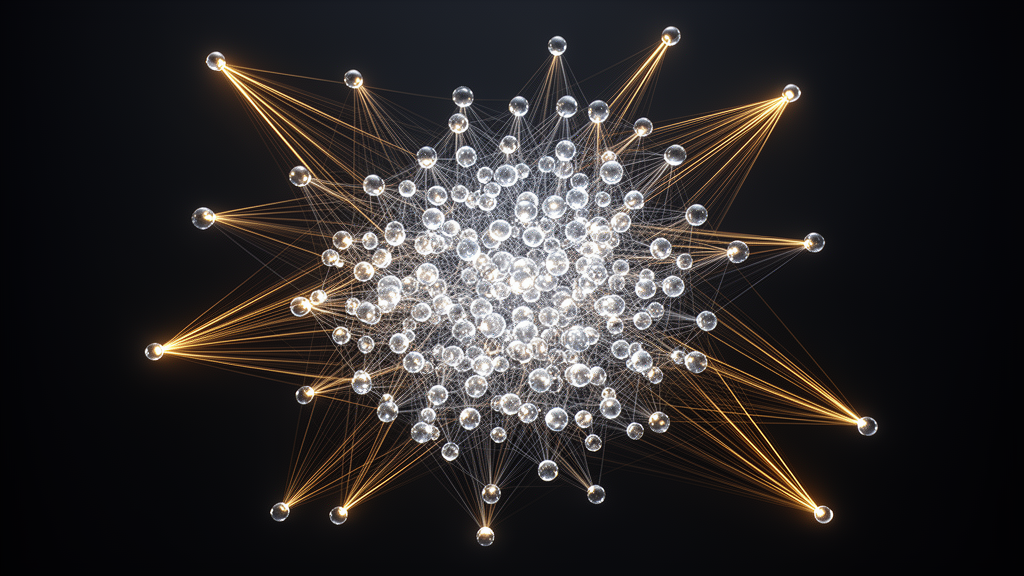
Graph-based representations provide an effective method for modeling complex real-world problems characterized by long-tailed degree distributions. In these networks, a small fraction of nodes exhibit dense connectivity, whereas the majority remain only sparsely connected.
This structural imbalance is particularly salient in random walk-based graph embedding techniques. As random walks preferentially traverse highly connected regions, sparsely connected nodes receive inadequate sampling, which directly impairs their ultimate representation quality.
To address the sampling bias induced by degree disparity, the researchers introduced Centrality-Guided Random Walks that adaptively sample nodes based on centrality-driven transition probabilities. The model integrates multiple centrality metrics to balance the exploration of both highly connected and sparsely connected nodes during the walk process.
By balancing network traversal across high-degree and low-degree regions, this adjustment produces robust embeddings for all nodes regardless of their degree. Experimental evaluations confirm that incorporating node centrality into walk-based graph embedding frameworks enhances classification performance across the entire network, with especially significant gains achieved for tail-node groups.
Subject of Research: Balanced node representation in graph embeddings
Article Title: Centrality-guided random walks for balanced node representation in graph embeddings
Article References: Ryu, Y., Shin, M., Choe, T., Man, K. L., & Kim, M. (2026). Centrality-guided random walks for balanced node representation in graph embeddings. Journal of Big Data. https://doi.org/10.1186/s40537-026-01603-5
Image Credits: AI Generated
DOI: 10.1186/s40537-026-01603-5
Keywords: graph embeddings, random walks, node representation, node centrality, centrality metrics, long-tailed distributions, degree disparity, sampling bias, transition probabilities, classification accuracy, tail nodes, densely connected nodes, sparsely connected nodes, graph-based representations, walk-based embedding, balanced exploration
News Source: Denise Maddox. (November 21, 2026). Centrality-guided random walks improve classification accuracy for graph tail nodes. Scienmag.