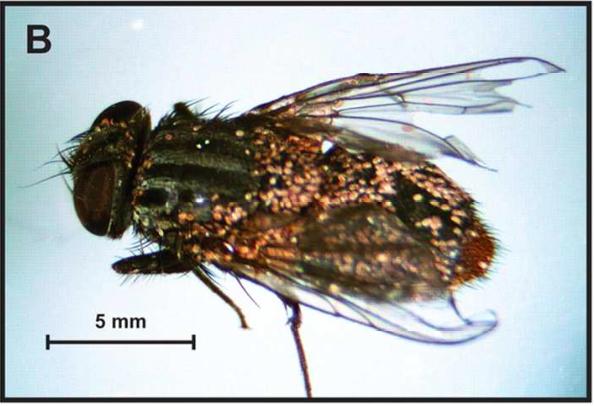
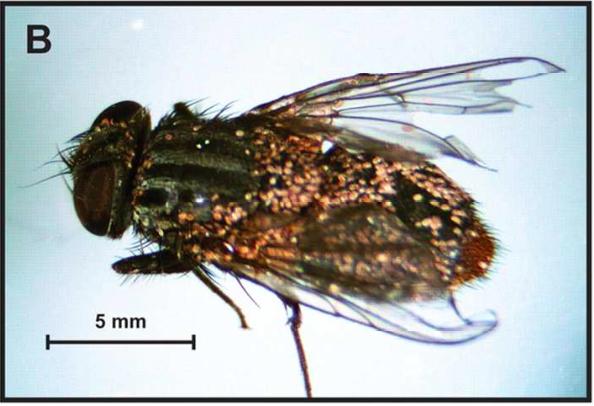
IMAGE: Carrion feeding Myianoetus muscarum mites is hitching a ride to their next meal on the fly Synthesiomyia nudiseta.
Credit: Entomological Society of America
Most forensic entomology investigations generally focus on insects such as blow flies or beetles. However, the authors of a paper published in the Journal of Medical Entomology have shown that tiny mites can reveal information as well.
Dr. Meaghan Pimsler of Texas A&M and her co-authors have described three forensic investigations in which the mite Myianoetus muscarum was found on corpses in association with a fly (Synthesiomyia nudiseta) that is commonly used by forensic entomologists to estimate time of death. Pimsler and colleagues believe that a better understanding of the succession of mite communities on cadavers could lead to more accurate estimations of the postmortem interval.
The mite Myianoetus muscarum feeds on vertebrate carrion, including human remains. However, these mites cannot fly, and instead must hitch rides on flies to get to their next meal.
Pimsler and colleagues have documented the first known phoretic association between a mite and S. nudiseta in the continental U.S., and they hope that their work will help spur researchers to pay more attention to mites and their role in decomposition.
Observing mites could improve estimates of postmortem intervals. These estimates rely on a timeline of when different species typically arrive on a corpse and how long they take to develop. Mites and their developmental stages could add more time points to this timeline, allowing for more precise estimates.
Mites may also affect the timelines and presence of other insects commonly used by forensic entomologists. They may compete with the insects for food (the corpse), thus slowing their development, or in some cases may even feed on the insects.
"The truth is that we really do not know, right now, all of the utility mites may have in forensic investigations," Pimsler said.
But perhaps someday the critical clue in a murder case will not be the fly itself, but rather the tiny, eight-legged scavenger that hitched a ride on the fly to get to the body.
###
The full article, "Association of Myianoetus muscarum (Acari: Histiostomatidae) With Synthesiomyia nudiseta (Wulp) (Diptera: Muscidae) on Human Remains," is available at http://jme.oxfordjournals.org/content/early/2016/01/04/jme.tjv203.
The Journal of Medical Entomology is published by the Entomological Society of America, the largest organization in the world serving the professional and scientific needs of entomologists and people in related disciplines. Founded in 1889, ESA today has nearly 7,000 members affiliated with educational institutions, health agencies, private industry, and government. Members are researchers, teachers, extension service personnel, administrators, marketing representatives, research technicians, consultants, students, and hobbyists. For more information, visit http://www.entsoc.org.
Media Contact
Richard Levine
[email protected]
301-731-4535
@EntsocAmerica
http://www.entsoc.org