Materials researchers have developed submicron composite particles made from polyvinylpyrrolidone and green tea extract using an electrospraying technique, demonstrating enhanced antioxidant activity compared to unencapsulated extract. The laboratory study evaluated how specific operational parameters during the electrospraying process directly influenced the physical characteristics, payload efficiency, and functional biological performance of the resulting polymer particles.
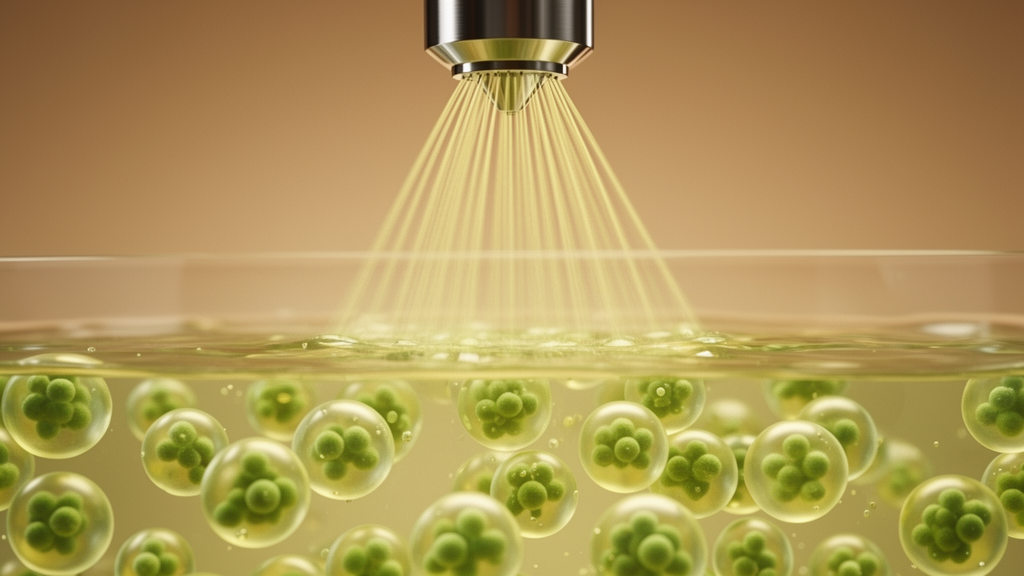
To generate the composite structures, the research team prepared a precursor solution containing green tea extract and polyvinylpyrrolidone dissolved in ethanol at a concentration of 13 percent by weight. The precursor mixture was subsequently electrosprayed under a constant electrical potential of 15 kilovolts across a fixed collection distance of 15 centimeters. During synthesis, the liquid flow rate served as a primary variable parameter, tested systematically at rates of 1, 3, and 5 microliters per minute.
Morphological evaluation using scanning electron microscopy confirmed the successful formation of spherical particle structures across the tested processing conditions. The imaging data showed that the average diameter of the resulting electrosprayed particles increased systematically from 391 nanometers up to 713 nanometers as the precursor solution flow rate was elevated from the lowest to the highest setting.
Chemical and structural characterization provided insight into how the plant extract was incorporated within the synthetic polymer carrier. Fourier transform infrared spectroscopy verified the encapsulation of the green tea extract within the polyvinylpyrrolidone matrix, showing that retention occurred through hydrogen bonding. Furthermore, analytical examinations via differential scanning calorimetry and X-ray diffraction indicated that the encapsulated extract resided in an amorphous state, a structural configuration considered desirable for bioavailability.
Functional antioxidant evaluations demonstrated measurable performance enhancements resulting from encapsulation. In a diphenylpicrylhydrazyl assay, the composite particles exhibited pronounced free radical scavenging activity, achieving an IC50 value of approximately 22 micrograms per milliliter compared to 47 micrograms per milliliter recorded for free green tea extract.
The study also revealed an inverse relationship between traditional nanoscale particle minimization and overall antioxidant payload capacity. Rather than smaller diameters conferring superior release kinetics, the larger particles produced at higher flow rates exhibited greater overall antioxidant activity. This performance corresponded with a higher extract loading content reaching approximately 47 percent.
The authors reported that higher payload capacity can overcome the conventional surface-area advantages typically attributed to smaller nanoparticles in delivering antioxidant efficacy. These laboratory findings indicate that optimizing encapsulation efficiency and drug loading can serve as a critical design priority alongside physical particle size reduction when developing polymer-based natural antioxidant delivery platforms.
The structural analysis confirmed that stabilizing green tea extract within the polyvinylpyrrolidone matrix via hydrogen bonding maintained the encapsulated extract in an amorphous form. Because this amorphous state represents a desired condition for enhanced bioavailability, the electrospray process successfully addresses an essential requirement for antioxidant delivery systems. Furthermore, systematically varying the precursor solution flow rate established the critical connection between operational parameters, extract loading content, and biological activity.
Rather than relying on mere particle size decrease, the experimental evidence demonstrates that higher flow rates yielded larger spherical particles containing approximately 47 percent extract loading. This higher payload capacity enabled the composite particles to achieve superior antioxidant activity over smaller nanoparticles, proving that optimizing encapsulation efficiency provides a highly promising platform for creating efficient natural antioxidant delivery systems.
Subject of Research: Electrosprayed polymer submicron particles for green tea extract antioxidant delivery
Article Title: Formation of electrosprayed PVP-GTE submicron particles: physicochemical characteristics and antioxidant activities
Article References: Kamaruddin, K., Hastuty, S., & Khairurrijal, K. (2026). Formation of electrosprayed PVP-GTE submicron particles: physicochemical characteristics and antioxidant activities. Journal of Materials Science: Materials in Engineering. https://doi.org/10.1186/s40712-026-00589-5
Image Credits: AI Generated
DOI: 10.1186/s40712-026-00589-5
Keywords: electrospraying, polyvinylpyrrolidone, green tea extract, submicron particles, antioxidant activity, DPPH assay, scanning electron microscopy, Fourier transform infrared spectroscopy, differential scanning calorimetry, X-ray diffraction, drug loading, encapsulation efficiency, amorphous state, hydrogen bonding, particle morphology, flow rate optimization, materials engineering
News Source: Denise Maddox. (November 21, 2026). Electrosprayed Polymer Particles Improve Green Tea Extract Antioxidant Activity. Scienmag.