• HOME
  • NEWS
  • EXPLORE
    • CAREER
      • Companies
      • Jobs
    • EVENTS
    • iGEM
      • News
      • Team
    • PHOTOS
    • VIDEO
    • WIKI
  • BLOG
  • COMMUNITY
    • FACEBOOK
    • INSTAGRAM
    • TWITTER
Friday, November 20, 2026
BIOENGINEER.ORG
No Result
View All Result
  • Login
  • HOME
  • NEWS
  • EXPLORE
    • CAREER
      • Companies
      • Jobs
        • Lecturer
        • PhD Studentship
        • Postdoc
        • Research Assistant
    • EVENTS
    • iGEM
      • News
      • Team
    • PHOTOS
    • VIDEO
    • WIKI
  • BLOG
  • COMMUNITY
    • FACEBOOK
    • INSTAGRAM
    • TWITTER
No Result
View All Result
Bioengineer.org
No Result
View All Result
Home NEWS Science News Biology

Matrix-Free Mixture Model Accelerates High-Dimensional Biomedical Clustering and Characterization

by
November 20, 2026
in Biology
Reading Time: 2 mins read
0
Matrix-Free Mixture Model Accelerates High-Dimensional Biomedical Clustering and Characterization

Matrix-Free Mixture Model Accelerates High-Dimensional Biomedical Clustering and Characterization

Share on FacebookShare on TwitterShare on LinkedinShare on RedditShare on Telegram

Computational researchers have introduced a hybrid matrix-free estimation framework for Gaussian mixture of factor analyzers, enabling faster and more flexible clustering across massive, high-dimensional biomedical datasets. Model-based clustering is widely applied to identify latent subgroups and characterize heterogeneous biological structures, but modern studies frequently generate vast sample sizes and numerous variables that challenge conventional fitting algorithms. By addressing the computational bottlenecks that typically hamper mixture models, the new framework provides an efficient method to analyze complex biomedical measurements without sacrificing statistical accuracy.

Standard mixture of factor analyzers approaches reduce dimensionality by representing high-dimensional covariance structures through a limited number of underlying latent factors. However, existing estimation procedures often become computationally impractical for massive datasets because nested expectation-maximization algorithms converge slowly. Furthermore, traditional implementations typically impose a shared number of latent factors across all clusters, restricting their capacity to capture unique, group-specific architectures. To resolve these operational constraints, the researchers developed a hybrid scheme that avoids the explicit construction or storage of large covariance matrices while allowing factor counts to vary across individual clusters.

In controlled simulation experiments, the matrix-free computational strategy achieved substantially faster algorithmic convergence than existing estimation methods, demonstrating particular efficiency advantages in high-dimensional analytical settings while preserving high clustering and parameter estimation precision. Beyond synthetic benchmarks, the investigators evaluated the methodology on three distinct biological datasets, confirming that the flexible formulation reliably isolates known sample groupings and uncovers detailed structural patterns that standard shared-factor models fail to capture.

Empirical evaluations on the Wisconsin breast cancer dataset successfully differentiated benign and malignant tumors, revealing biologically informative differences in nuclear morphology where malignant samples exhibited markedly stronger irregularity-related variation. In a lymphoma gene-expression dataset, the approach accurately identified three clinical subtypes alongside group-specific transcriptional heterogeneity. Finally, analysis of human brain single-cell RNA sequencing data distinguished neuronal and astrocytic cell populations, establishing that neuronal variation encompasses a broader set of coordinated transcriptional directions while astrocytic variation remains concentrated in a more compact latent structure.

Subject of Research: Model-based clustering and factor analysis for high-dimensional biomedical data

Article Title: A hybrid mixture approach for clustering and characterizing biomedical data

Article References: Kareem, K. A., & Dai, F. (2026). A hybrid mixture approach for clustering and characterizing biomedical data. PLOS Computational Biology, 22(11), e1014974. https://doi.org/10.1371/journal.pcbi.1014974

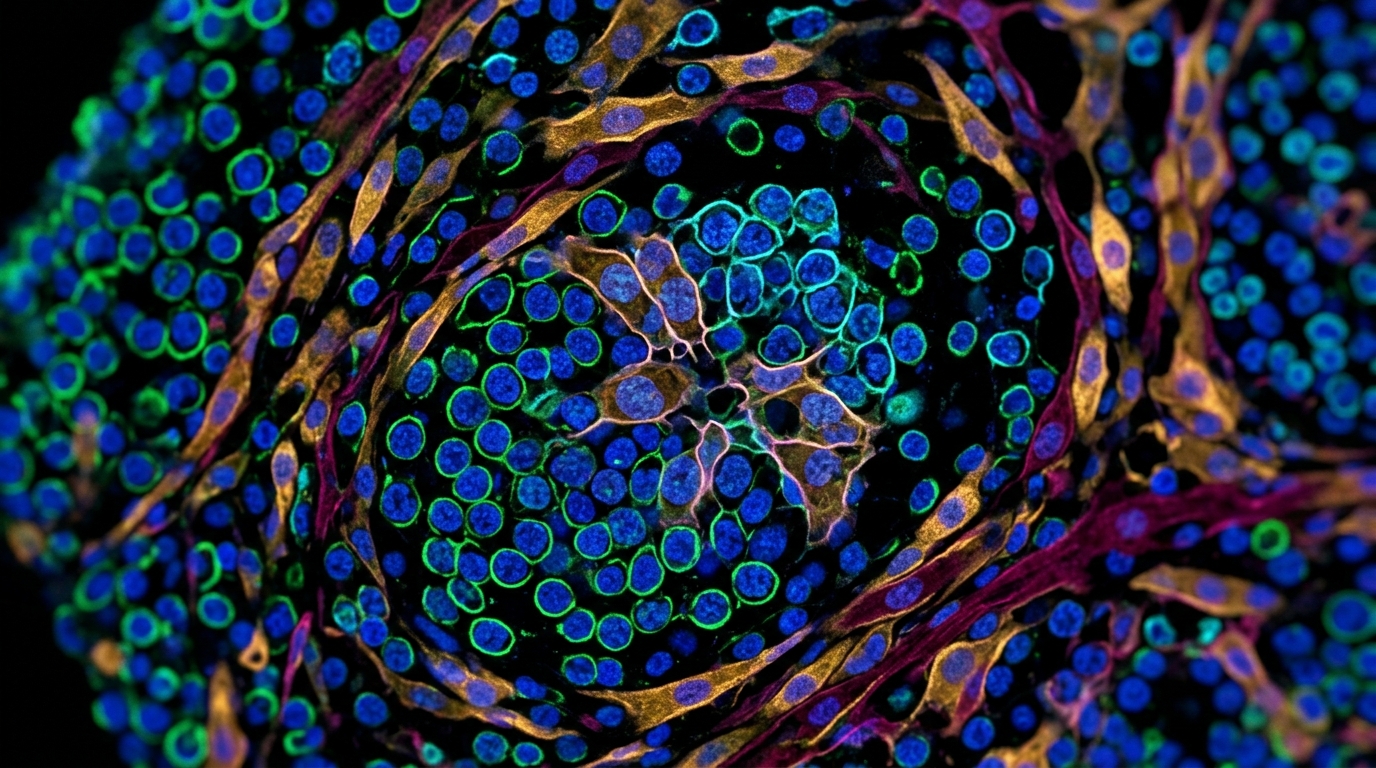
Image Credits: AI Generated

DOI: 10.1371/journal.pcbi.1014974

Keywords: model-based clustering, mixture of factor analyzers, Gaussian mixture models, matrix-free computation, high-dimensional data, latent factor models, biomedical data clustering, expectation-maximization algorithm, covariance structure, Wisconsin breast cancer dataset, nuclear morphology, lymphoma gene expression, single-cell RNA sequencing, neuronal transcriptional variation, astrocytic cell populations, computational biology, heterogeneous data structures

News Source: Juliet Wilcox. (November 20, 2026). Matrix-Free Mixture Model Accelerates High-Dimensional Biomedical Clustering and Characterization. Scienmag.


Tags: astrocytic cell populationsbiomedical data clusteringcomputational biologyCovariance Structureexpectation-maximization algorithmGaussian Mixture Modelsheterogeneous data structureshigh-dimensional datalatent factor modelslymphoma gene expressionmatrix-free computationmixture of factor analyzersmodel-based clusteringneuronal transcriptional variationnuclear morphologysingle-cell RNA sequencingWisconsin breast cancer dataset
Share12Tweet7Share2ShareShareShare1

Related Posts

Zebra Mussel Biofouling Inhibits Reproductive Shoreline Movement in Endangered European Mussels

Zebra Mussel Biofouling Inhibits Reproductive Shoreline Movement in Endangered European Mussels

November 20, 2026
Urinary Proteomics Reveals Staged Heme Stress in Neonatal Hypoxic-Ischemic Encephalopathy

Urinary Proteomics Reveals Staged Heme Stress in Neonatal Hypoxic-Ischemic Encephalopathy

November 20, 2026

Mucorales Fungi Deploy Distinct Stage-Specific Mechanisms to Evade Host Immunity

November 20, 2026

Genomic Revision Reclassifies Primorskyibacter Species and Resolves Roseobacteraceae Bacterial Placement

November 20, 2026

POPULAR NEWS

  • Biostable Insect Kinin Mimetics Deter Mosquito Blood and Sugar Feeding

    Biostable Insect Kinin Mimetics Deter Mosquito Blood and Sugar Feeding

    29 shares
    Share 12 Tweet 7
  • Phenomenology offers ethical framework for South Asian end-of-life care

    29 shares
    Share 12 Tweet 7
  • Multi-Solver Finite Element Framework Accurately Predicts Freeway Tunnel Stability

    29 shares
    Share 12 Tweet 7
  • Creep Model Simulates Sustained Deformation in South China Sea Hydrate Sediments

    29 shares
    Share 12 Tweet 7

About

We bring you the latest biotechnology news from best research centers and universities around the world. Check our website.

Follow us

Recent News

Spanish Medical Students Rate GPT-4 Virtual Patient Usable in Pilot Study

Serial Heart Ultrasound Detects Stroke Volume Drop Preceding Spinal Anesthesia Hypotension

Dental Cements Show Distinct Fluoride and Hardness Profiles Across Exposure Protocols

Subscribe to Blog via Email

Enter your email address to subscribe to this blog and receive notifications of new posts by email.

Join 88 other subscribers
  • Contact Us

Bioengineer.org © Copyright 2023 All Rights Reserved.

Welcome Back!

Login to your account below

Forgotten Password?

Retrieve your password

Please enter your username or email address to reset your password.

Log In
No Result
View All Result
  • Homepages
    • Home Page 1
    • Home Page 2
  • News
  • National
  • Business
  • Health
  • Lifestyle
  • Science

Bioengineer.org © Copyright 2023 All Rights Reserved.