• HOME
  • NEWS
  • EXPLORE
    • CAREER
      • Companies
      • Jobs
    • EVENTS
    • iGEM
      • News
      • Team
    • PHOTOS
    • VIDEO
    • WIKI
  • BLOG
  • COMMUNITY
    • FACEBOOK
    • INSTAGRAM
    • TWITTER
Friday, November 20, 2026
BIOENGINEER.ORG
No Result
View All Result
  • Login
  • HOME
  • NEWS
  • EXPLORE
    • CAREER
      • Companies
      • Jobs
        • Lecturer
        • PhD Studentship
        • Postdoc
        • Research Assistant
    • EVENTS
    • iGEM
      • News
      • Team
    • PHOTOS
    • VIDEO
    • WIKI
  • BLOG
  • COMMUNITY
    • FACEBOOK
    • INSTAGRAM
    • TWITTER
No Result
View All Result
Bioengineer.org
No Result
View All Result
Home NEWS Science News Biology

Warmer Temperatures and Explosive Residues Increase Mortality in Mealworm Larvae

by
November 20, 2026
in Biology
Reading Time: 2 mins read
0
Warmer Temperatures and Explosive Residues Increase Mortality in Mealworm Larvae

Warmer Temperatures and Explosive Residues Increase Mortality in Mealworm Larvae

Share on FacebookShare on TwitterShare on LinkedinShare on RedditShare on Telegram

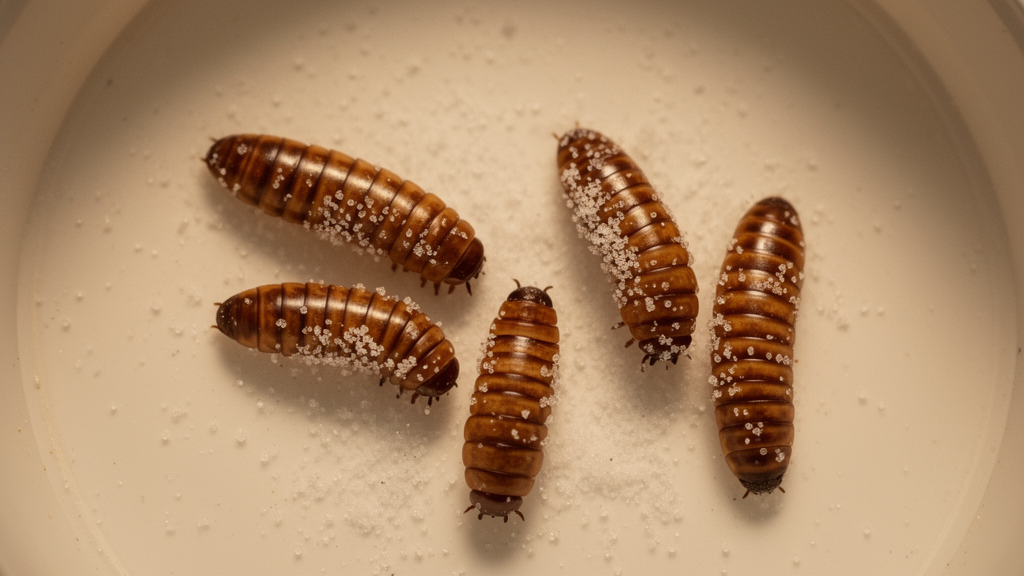
Exposure to nitroaromatic explosive residues significantly increases mortality and alters development in yellow mealworm larvae, with toxic effects amplified under warmer environmental conditions. In an ecotoxicological investigation, researchers examined how 2,4,6-trinitrotoluene along with its incomplete detonation byproducts, o-nitrotoluene and 2,4-dinitrotoluene, impact the host-parasite system composed of Tenebrio molitor larvae and their intestinal Gregarina parasites across two distinct temperature ranges.

The controlled five-day laboratory bioassay assessed six hundred larvae systematically partitioned into ten distinct experimental cohorts. Across regimes held at either 21 to 23 degrees Celsius or elevated temperatures of 26 to 28 degrees Celsius, the insects were exposed to unamended control substrates or substrate concentrations containing 30, 90, or 270 milligrams per kilogram of each chemical agent. Investigators monitored larval survival, changes in body mass, and parasite abundance to evaluate comparative physiological impacts.

The experimental observations demonstrated a consistent pattern of concentration-dependent lethality among the tested compounds, ranking in toxicity from 2,4,6-trinitrotoluene as the most lethal, followed by o-nitrotoluene, and then 2,4-dinitrotoluene. Under the maximum exposure level of 270 milligrams per kilogram in the warmer 26 to 28 degrees Celsius regime, larval mortality reached 40.0 percent for 2,4,6-trinitrotoluene, 26.7 percent for o-nitrotoluene, and 10.0 percent for 2,4-dinitrotoluene. Elevated ambient temperature intensified chemical toxicity overall while simultaneously reducing internal parasite burdens by 26.0 to 36.0 percent.

The response of the parasitic Gregarina varied notably depending on the specific contaminant present within the substrate. While exposures to 2,4,6-trinitrotoluene and 2,4-dinitrotoluene produced no measurable change in parasitic infection intensity, substrate contamination with o-nitrotoluene corresponded with an increase in parasite counts as chemical concentrations rose. In addition, all three nitroaromatic compounds stimulated premature pupation in 10.0 to 11.1 percent of larvae compared to 0.0 percent in untreated control groups, occurring regardless of the specific chemical, dose, or thermal treatment.

All larvae that underwent premature pupation achieved a 100.0 percent survival rate across treatments, whereas individuals that remained in the larval stage exhibited a lower overall survival rate of 88.2 percent. However, the authors noted that the five-day observation window limits definitive causal interpretation, as the enhanced survival of pupae could not be disentangled from the shorter duration of time spent actively feeding on contaminated substrate. These findings indicate that threshold developmental shifts and temperature fluctuations interact to shape insect tolerance toward explosive contaminants.

Subject of Research: Toxicity of nitroaromatic explosive residues on mealworm larvae and gut parasites

Article Title: Toxicity of nitroaromatic explosives for the host-parasite system Tenebrio molitor–Gregarina spp. at different temperatures

Article References: Rybalka, D., & Brygadyrenko, V. (2026). Toxicity of nitroaromatic explosives for the host-parasite system Tenebrio molitor–Gregarina spp. at different temperatures. Ecotoxicology, 35(10), Article 203. https://doi.org/10.1007/s10646-026-03190-w

Image Credits: AI Generated

DOI: 10.1007/s10646-026-03190-w

Keywords: Tenebrio molitor, Gregarina, nitroaromatic explosives, 2,4,6-trinitrotoluene, o-nitrotoluene, 2,4-dinitrotoluene, ecotoxicology, insect larvae, temperature effects, parasite invasion, larval mortality, premature pupation, soil ecotoxicity, detonation products, host-parasite system, substrate exposure

News Source: Drew Townsend. (November 20, 2026). Warmer Temperatures and Explosive Residues Increase Mortality in Mealworm Larvae. Scienmag.


Tags: 2,4,6-trinitrotoluene2,4-dinitrotoluenedetonation productsecotoxicologyGregarinahost-parasite systeminsect larvaelarval mortalitynitroaromatic explosiveso-nitrotolueneparasite invasionpremature pupationsoil ecotoxicitysubstrate exposureTemperature effectsTenebrio molitor
Share12Tweet7Share2ShareShareShare1

Related Posts

Soil Resources Associate With Leaf Trait Coordination Across Southwest China Karst Forests

Soil Resources Associate With Leaf Trait Coordination Across Southwest China Karst Forests

November 20, 2026
Rapid Review Identifies Thirty-Eight Parent-of-Origin Genetic Variants Linked to Fetal Growth

Rapid Review Identifies Thirty-Eight Parent-of-Origin Genetic Variants Linked to Fetal Growth

November 20, 2026

Breeding Failure Prompts Earlier Autumn Migration in Southern British Eurasian Curlews

November 20, 2026

Review Outlines Context-Dependent Roles of Lysosomal Membrane Protein LAPTM5 in Neurological Disorders

November 20, 2026

POPULAR NEWS

  • Pediatric Urology AI Prediction Models Lack External Validation Despite High Discrimination

    Pediatric Urology AI Prediction Models Lack External Validation Despite High Discrimination

    29 shares
    Share 12 Tweet 7
  • Ultraviolet-Ozone Fabric Treatment Boosts 3D-Printed Polymer Adhesion by Up to 239 Percent

    29 shares
    Share 12 Tweet 7
  • Rapid Review Identifies Thirty-Eight Parent-of-Origin Genetic Variants Linked to Fetal Growth

    29 shares
    Share 12 Tweet 7
  • Breeding Failure Prompts Earlier Autumn Migration in Southern British Eurasian Curlews

    29 shares
    Share 12 Tweet 7

About

We bring you the latest biotechnology news from best research centers and universities around the world. Check our website.

Follow us

Recent News

Lattice QCD Calculation Resolves Electromagnetic Pion Mass Splitting Using Photon Cutoff

Gut Microbiome Functional Modules Link to Major Depressive Disorder and Symptom Severity

Review Uncovers How Adaptive Immune Cells Direct Alzheimer’s Disease Progression Across Experimental Models

Subscribe to Blog via Email

Enter your email address to subscribe to this blog and receive notifications of new posts by email.

Join 89 other subscribers
  • Contact Us

Bioengineer.org © Copyright 2023 All Rights Reserved.

Welcome Back!

Login to your account below

Forgotten Password?

Retrieve your password

Please enter your username or email address to reset your password.

Log In
No Result
View All Result
  • Homepages
    • Home Page 1
    • Home Page 2
  • News
  • National
  • Business
  • Health
  • Lifestyle
  • Science

Bioengineer.org © Copyright 2023 All Rights Reserved.