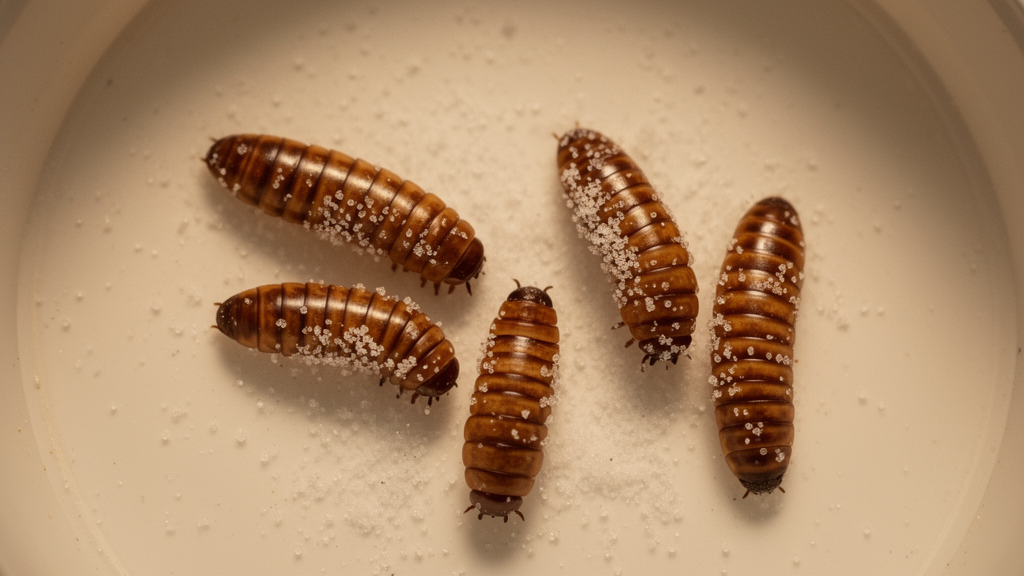
Exposure to nitroaromatic explosive residues significantly increases mortality and alters development in yellow mealworm larvae, with toxic effects amplified under warmer environmental conditions. In an ecotoxicological investigation, researchers examined how 2,4,6-trinitrotoluene along with its incomplete detonation byproducts, o-nitrotoluene and 2,4-dinitrotoluene, impact the host-parasite system composed of Tenebrio molitor larvae and their intestinal Gregarina parasites across two distinct temperature ranges.
The controlled five-day laboratory bioassay assessed six hundred larvae systematically partitioned into ten distinct experimental cohorts. Across regimes held at either 21 to 23 degrees Celsius or elevated temperatures of 26 to 28 degrees Celsius, the insects were exposed to unamended control substrates or substrate concentrations containing 30, 90, or 270 milligrams per kilogram of each chemical agent. Investigators monitored larval survival, changes in body mass, and parasite abundance to evaluate comparative physiological impacts.
The experimental observations demonstrated a consistent pattern of concentration-dependent lethality among the tested compounds, ranking in toxicity from 2,4,6-trinitrotoluene as the most lethal, followed by o-nitrotoluene, and then 2,4-dinitrotoluene. Under the maximum exposure level of 270 milligrams per kilogram in the warmer 26 to 28 degrees Celsius regime, larval mortality reached 40.0 percent for 2,4,6-trinitrotoluene, 26.7 percent for o-nitrotoluene, and 10.0 percent for 2,4-dinitrotoluene. Elevated ambient temperature intensified chemical toxicity overall while simultaneously reducing internal parasite burdens by 26.0 to 36.0 percent.
The response of the parasitic Gregarina varied notably depending on the specific contaminant present within the substrate. While exposures to 2,4,6-trinitrotoluene and 2,4-dinitrotoluene produced no measurable change in parasitic infection intensity, substrate contamination with o-nitrotoluene corresponded with an increase in parasite counts as chemical concentrations rose. In addition, all three nitroaromatic compounds stimulated premature pupation in 10.0 to 11.1 percent of larvae compared to 0.0 percent in untreated control groups, occurring regardless of the specific chemical, dose, or thermal treatment.
All larvae that underwent premature pupation achieved a 100.0 percent survival rate across treatments, whereas individuals that remained in the larval stage exhibited a lower overall survival rate of 88.2 percent. However, the authors noted that the five-day observation window limits definitive causal interpretation, as the enhanced survival of pupae could not be disentangled from the shorter duration of time spent actively feeding on contaminated substrate. These findings indicate that threshold developmental shifts and temperature fluctuations interact to shape insect tolerance toward explosive contaminants.
Subject of Research: Toxicity of nitroaromatic explosive residues on mealworm larvae and gut parasites
Article Title: Toxicity of nitroaromatic explosives for the host-parasite system Tenebrio molitor–Gregarina spp. at different temperatures
Article References: Rybalka, D., & Brygadyrenko, V. (2026). Toxicity of nitroaromatic explosives for the host-parasite system Tenebrio molitor–Gregarina spp. at different temperatures. Ecotoxicology, 35(10), Article 203. https://doi.org/10.1007/s10646-026-03190-w
Image Credits: AI Generated
DOI: 10.1007/s10646-026-03190-w
Keywords: Tenebrio molitor, Gregarina, nitroaromatic explosives, 2,4,6-trinitrotoluene, o-nitrotoluene, 2,4-dinitrotoluene, ecotoxicology, insect larvae, temperature effects, parasite invasion, larval mortality, premature pupation, soil ecotoxicity, detonation products, host-parasite system, substrate exposure
News Source: Drew Townsend. (November 20, 2026). Warmer Temperatures and Explosive Residues Increase Mortality in Mealworm Larvae. Scienmag.