• HOME
  • NEWS
  • EXPLORE
    • CAREER
      • Companies
      • Jobs
    • EVENTS
    • iGEM
      • News
      • Team
    • PHOTOS
    • VIDEO
    • WIKI
  • BLOG
  • COMMUNITY
    • FACEBOOK
    • INSTAGRAM
    • TWITTER
Thursday, November 19, 2026
BIOENGINEER.ORG
No Result
View All Result
  • Login
  • HOME
  • NEWS
  • EXPLORE
    • CAREER
      • Companies
      • Jobs
        • Lecturer
        • PhD Studentship
        • Postdoc
        • Research Assistant
    • EVENTS
    • iGEM
      • News
      • Team
    • PHOTOS
    • VIDEO
    • WIKI
  • BLOG
  • COMMUNITY
    • FACEBOOK
    • INSTAGRAM
    • TWITTER
No Result
View All Result
Bioengineer.org
No Result
View All Result
Home NEWS Science News Technology

Liquid-Metal Sensor Reaches Super-Resolution Touch Localisation Using Four Channels

by
November 19, 2026
in Technology
Reading Time: 2 mins read
0
Liquid-Metal Sensor Reaches Super-Resolution Touch Localisation Using Four Channels

Liquid-Metal Sensor Reaches Super-Resolution Touch Localisation Using Four Channels

Share on FacebookShare on TwitterShare on LinkedinShare on RedditShare on Telegram

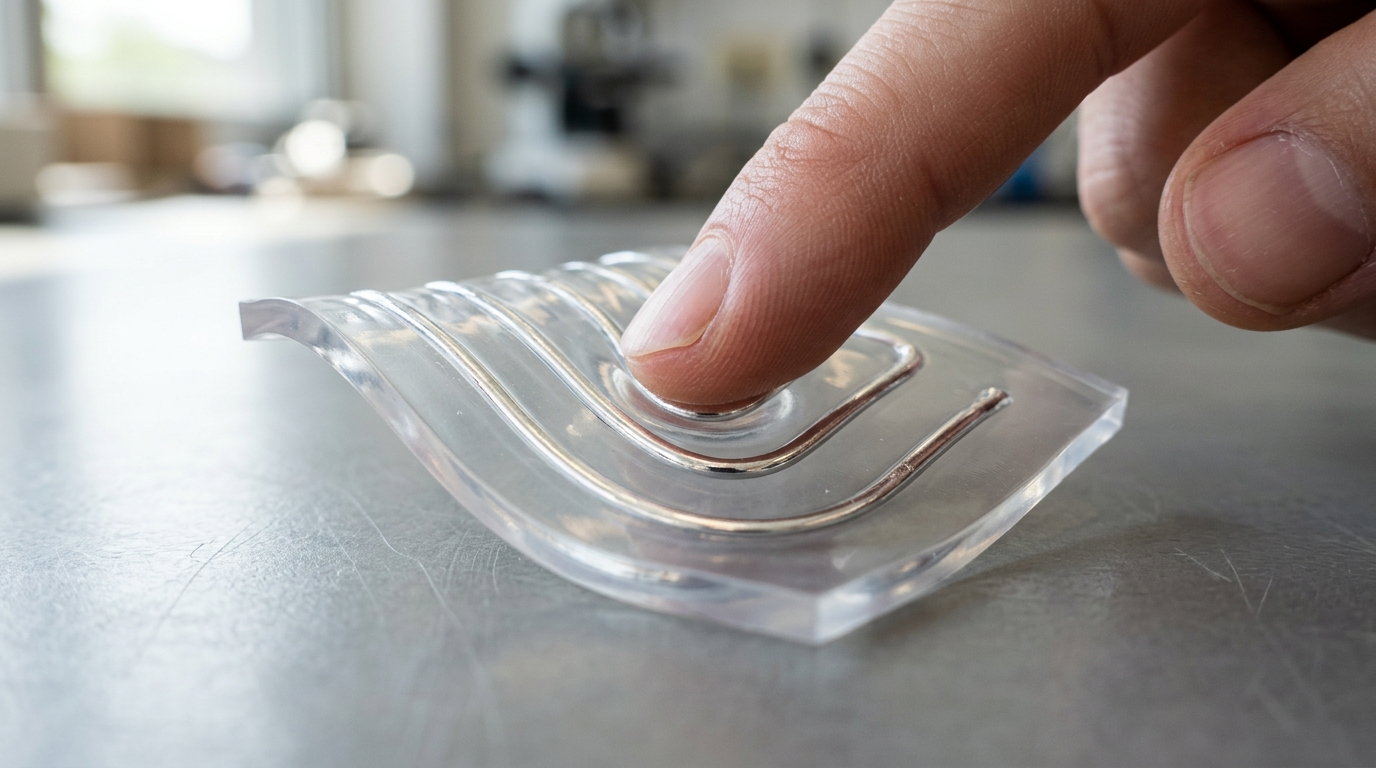
A thin liquid-metal electronic skin achieves super-resolution touch localisation and normal-force sensing using only four resistive channels, according to a study published in npj Flexible Electronics. Conventional tactile skins typically achieve fine spatial resolution by increasing sensor density, which introduces corresponding costs in wiring, readout, and structural complexity. To address these limitations, researchers encoded contact information directly into microchannel geometry, demonstrating a route to high-resolution tactile sensing with sparse readout and a compliant form factor.

To design the channel layout for spatial distinguishability, the team implemented a kernel-based fast simulator that predicts topology-dependent resistance responses without relying on repeated full-field finite-element simulations. This simulation framework enabled noise-aware optimisation of the channel layout. The selected interlocked topology balances spatial sensitivity and fingerprint separability, allowing sparse electrical measurements to capture complex spatial contact distributions.

Signal interpretation relies on a hierarchical mixture-of-experts decoder designed to jointly estimate contact position and applied normal force from the four resistive channels. Across three independently fabricated devices, the sensor demonstrated reproducible performance, achieving a mean localisation root-mean-square error of 0.230 mm. For a representative device, the system reached a localisation root-mean-square error of 0.228 mm alongside a force root-mean-square error of 0.043 N, corresponding to a super-resolution factor of 58.3.

The researchers evaluated the system across continuous and discrete human-machine interaction scenarios using dynamic demonstration platforms. Continuous contact tracking was demonstrated through force-modulated handwriting, while discrete input was tested using a wearable pressure-tiered keyboard. In keyboard evaluation trials, the device achieved a 95.38% joint key-and-mode classification accuracy, demonstrating practical utility for compact tactile interfaces.

Reproducible submillimetre localisation across independently fabricated devices confirms that geometric encoding reliably overcomes the wiring and structural constraints of conventional tactile skins. High resolution tactile perception is especially critical for dexterous manipulation and immersive human machine interaction, where traditional approaches depend on dense sensor arrays. By pairing an interlocked channel topology with a hierarchical decoder, the thin compliant device separates spatial fingerprints and normal force while requiring only sparse electrical connections. These results confirm that simulation guided geometric encoding provides an effective framework for continuous contact tracking and discrete human machine interaction.

Subject of Research: Super-resolution tactile sensing using geometric encoding in liquid-metal microchannels

Article Title: Super-resolution tactile sensing through geometric encoding in liquid-metal microchannels

Article References: Cai, S., Feng, J., Wu, T., Zheng, H., Cheng, X., Zhu, K., & Tee, B. C. K. (2026). Super-resolution tactile sensing through geometric encoding in liquid-metal microchannels. npj Flexible Electronics. https://doi.org/10.1038/s41528-026-00651-4

Image Credits: AI Generated

DOI: 10.1038/s41528-026-00651-4

Keywords: tactile sensing, electronic skin, liquid metal, microchannels, geometric encoding, super-resolution, touch localisation, force sensing, resistive sensors, mixture of experts, human-machine interaction, flexible electronics, spatial resolution, wearable sensors, haptics

News Source: Denise Maddox. (November 19, 2026). Liquid-Metal Sensor Reaches Super-Resolution Touch Localisation Using Four Channels. Scienmag.


Tags: electronic skinflexible electronicsforce sensinggeometric encodinghapticsHuman-machine interactionliquid metalmicrochannelsmixture-of-expertsresistive sensorsspatial resolutionsuper-resolutiontactile sensingtouch localisationwearable sensors
Share12Tweet7Share2ShareShareShare1

Related Posts

Acidic Solutions Accelerate Freeze-Thaw Slaking and Fragmentation in Jurassic Mudstone

Acidic Solutions Accelerate Freeze-Thaw Slaking and Fragmentation in Jurassic Mudstone

November 19, 2026
Dual-Network Decomposition Model Improves Carbon Price Prediction Intervals Across Chinese Markets

Dual-Network Decomposition Model Improves Carbon Price Prediction Intervals Across Chinese Markets

November 19, 2026

Deep Learning Architecture Boosts Attack Detection Across Medical Internet of Things Networks

November 19, 2026

Modified YOLO Architecture Boosts Aerial Small Target Detection Across Drone Benchmarks

November 19, 2026

POPULAR NEWS

  • Study Reveals Outflow of Early-Career Japanese Pharmacists From Hospitals to Pharmacies

    Study Reveals Outflow of Early-Career Japanese Pharmacists From Hospitals to Pharmacies

    29 shares
    Share 12 Tweet 7
  • Mouse and Human Studies Show GATA2 Actively Maintains Müllerian Ducts

    29 shares
    Share 12 Tweet 7
  • Study Identifies Factors Linked to Women’s Health Decision Autonomy in Zambia

    29 shares
    Share 12 Tweet 7
  • Dual-Network Decomposition Model Improves Carbon Price Prediction Intervals Across Chinese Markets

    29 shares
    Share 12 Tweet 7

About

We bring you the latest biotechnology news from best research centers and universities around the world. Check our website.

Follow us

Recent News

Trilaciclib Targets NUAK2 RNA Splicing Vulnerability in Aggressive Prostate Cancer

Choroid Plexus Transporter NCBE Emerges as Therapeutic Target for Hydrocephalus

Brain-Computer Interfaces Aid Attention After Stroke but Global Cognitive Benefits Remain Uncertain

Subscribe to Blog via Email

Enter your email address to subscribe to this blog and receive notifications of new posts by email.

Join 89 other subscribers
  • Contact Us

Bioengineer.org © Copyright 2023 All Rights Reserved.

Welcome Back!

Login to your account below

Forgotten Password?

Retrieve your password

Please enter your username or email address to reset your password.

Log In
No Result
View All Result
  • Homepages
    • Home Page 1
    • Home Page 2
  • News
  • National
  • Business
  • Health
  • Lifestyle
  • Science

Bioengineer.org © Copyright 2023 All Rights Reserved.