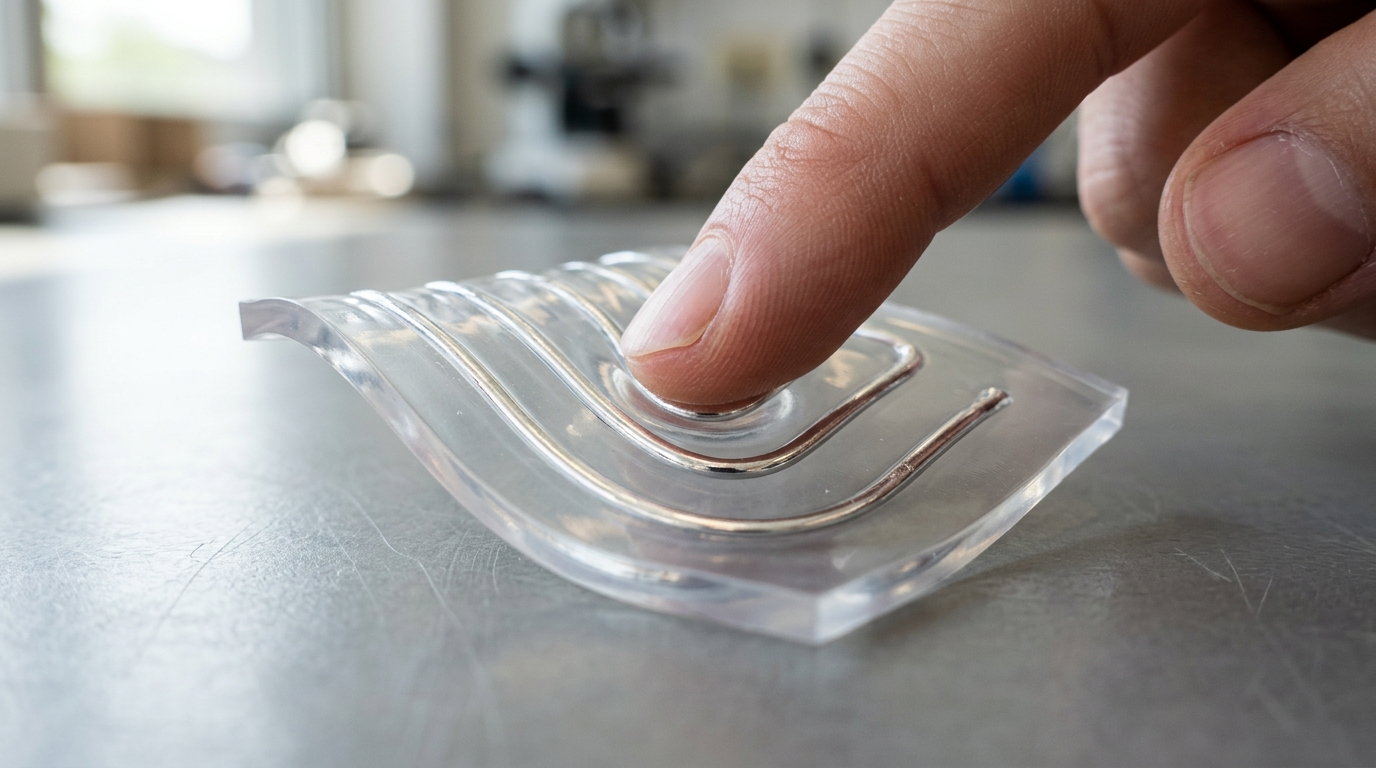
A thin liquid-metal electronic skin achieves super-resolution touch localisation and normal-force sensing using only four resistive channels, according to a study published in npj Flexible Electronics. Conventional tactile skins typically achieve fine spatial resolution by increasing sensor density, which introduces corresponding costs in wiring, readout, and structural complexity. To address these limitations, researchers encoded contact information directly into microchannel geometry, demonstrating a route to high-resolution tactile sensing with sparse readout and a compliant form factor.
To design the channel layout for spatial distinguishability, the team implemented a kernel-based fast simulator that predicts topology-dependent resistance responses without relying on repeated full-field finite-element simulations. This simulation framework enabled noise-aware optimisation of the channel layout. The selected interlocked topology balances spatial sensitivity and fingerprint separability, allowing sparse electrical measurements to capture complex spatial contact distributions.
Signal interpretation relies on a hierarchical mixture-of-experts decoder designed to jointly estimate contact position and applied normal force from the four resistive channels. Across three independently fabricated devices, the sensor demonstrated reproducible performance, achieving a mean localisation root-mean-square error of 0.230 mm. For a representative device, the system reached a localisation root-mean-square error of 0.228 mm alongside a force root-mean-square error of 0.043 N, corresponding to a super-resolution factor of 58.3.
The researchers evaluated the system across continuous and discrete human-machine interaction scenarios using dynamic demonstration platforms. Continuous contact tracking was demonstrated through force-modulated handwriting, while discrete input was tested using a wearable pressure-tiered keyboard. In keyboard evaluation trials, the device achieved a 95.38% joint key-and-mode classification accuracy, demonstrating practical utility for compact tactile interfaces.
Reproducible submillimetre localisation across independently fabricated devices confirms that geometric encoding reliably overcomes the wiring and structural constraints of conventional tactile skins. High resolution tactile perception is especially critical for dexterous manipulation and immersive human machine interaction, where traditional approaches depend on dense sensor arrays. By pairing an interlocked channel topology with a hierarchical decoder, the thin compliant device separates spatial fingerprints and normal force while requiring only sparse electrical connections. These results confirm that simulation guided geometric encoding provides an effective framework for continuous contact tracking and discrete human machine interaction.
Subject of Research: Super-resolution tactile sensing using geometric encoding in liquid-metal microchannels
Article Title: Super-resolution tactile sensing through geometric encoding in liquid-metal microchannels
Article References: Cai, S., Feng, J., Wu, T., Zheng, H., Cheng, X., Zhu, K., & Tee, B. C. K. (2026). Super-resolution tactile sensing through geometric encoding in liquid-metal microchannels. npj Flexible Electronics. https://doi.org/10.1038/s41528-026-00651-4
Image Credits: AI Generated
DOI: 10.1038/s41528-026-00651-4
Keywords: tactile sensing, electronic skin, liquid metal, microchannels, geometric encoding, super-resolution, touch localisation, force sensing, resistive sensors, mixture of experts, human-machine interaction, flexible electronics, spatial resolution, wearable sensors, haptics
News Source: Denise Maddox. (November 19, 2026). Liquid-Metal Sensor Reaches Super-Resolution Touch Localisation Using Four Channels. Scienmag.