• HOME
  • NEWS
  • EXPLORE
    • CAREER
      • Companies
      • Jobs
    • EVENTS
    • iGEM
      • News
      • Team
    • PHOTOS
    • VIDEO
    • WIKI
  • BLOG
  • COMMUNITY
    • FACEBOOK
    • INSTAGRAM
    • TWITTER
Thursday, November 19, 2026
BIOENGINEER.ORG
No Result
View All Result
  • Login
  • HOME
  • NEWS
  • EXPLORE
    • CAREER
      • Companies
      • Jobs
        • Lecturer
        • PhD Studentship
        • Postdoc
        • Research Assistant
    • EVENTS
    • iGEM
      • News
      • Team
    • PHOTOS
    • VIDEO
    • WIKI
  • BLOG
  • COMMUNITY
    • FACEBOOK
    • INSTAGRAM
    • TWITTER
No Result
View All Result
Bioengineer.org
No Result
View All Result
Home NEWS Science News Technology

Adaptive Cloud-Edge Dual-Graph Model Improves High-Speed Railway Passenger Flow Forecasting

by
November 19, 2026
in Technology
Reading Time: 2 mins read
0
Adaptive Cloud-Edge Dual-Graph Model Improves High-Speed Railway Passenger Flow Forecasting

Adaptive Cloud-Edge Dual-Graph Model Improves High-Speed Railway Passenger Flow Forecasting

Share on FacebookShare on TwitterShare on LinkedinShare on RedditShare on Telegram

A collaborative cloud-edge adaptive dual-graph model achieved improved passenger flow forecasting performance compared with baseline methods on a real-world, large-scale rail transit dataset.

Accurate passenger flow predictions support station operations, resource allocation, and service optimization across rapidly expanding high-speed railway networks. However, passenger volumes fluctuate over time, across station spatial interactions, and through regional travel dependencies.

Existing forecasting methods that rely on fixed spatial structures or centralized computing architectures face challenges in capturing dynamic passenger correlations while meeting the real-time and large-scale demands of railway service applications.

To address these constraints, the proposed framework employs a dual-graph representation that pairs physical station connectivity with an input-window-adaptive correlation graph derived from recent passenger flow observations.

A dedicated spatio-temporal learning module captures multi-scale temporal variations alongside complex spatial dependencies across the rail transit network.

The collaborative system integrates global knowledge from the cloud side with local real-time features on the edge side, maintaining a lightweight edge-side inference branch while validating the architectural components in smart railway service scenarios.

The research, conducted by Ling Liu and Majid Ghani Varzaneh, appeared in the Journal of Cloud Computing on September 11, 2026. Published as an open-access, peer-reviewed accepted article carrying a permanent DOI, the work provides early access to the findings ahead of the final Version of Record.

In their experimental evaluation, the researchers tested the architecture on a real-world, large-scale rail transit passenger flow dataset. The empirical results demonstrated that the collaborative forecasting model achieved better forecasting performance than the compared baselines. Subsequent empirical analyses further verified the specific effectiveness of each component, demonstrating the practical advantages of the cloud-edge design for real-time railway service scenarios.

Subject of Research: High-speed railway passenger flow forecasting

Article Title: Cloud-Edge collaborative adaptive dual-graph spatio-temporal passenger flow forecasting model for smart high-speed railway services

Article References: Liu, L., & Varzaneh, M. G. (2026). Cloud-Edge collaborative adaptive dual-graph spatio-temporal passenger flow forecasting model for smart high-speed railway services. Journal of Cloud Computing. https://doi.org/10.1186/s13677-026-00986-3

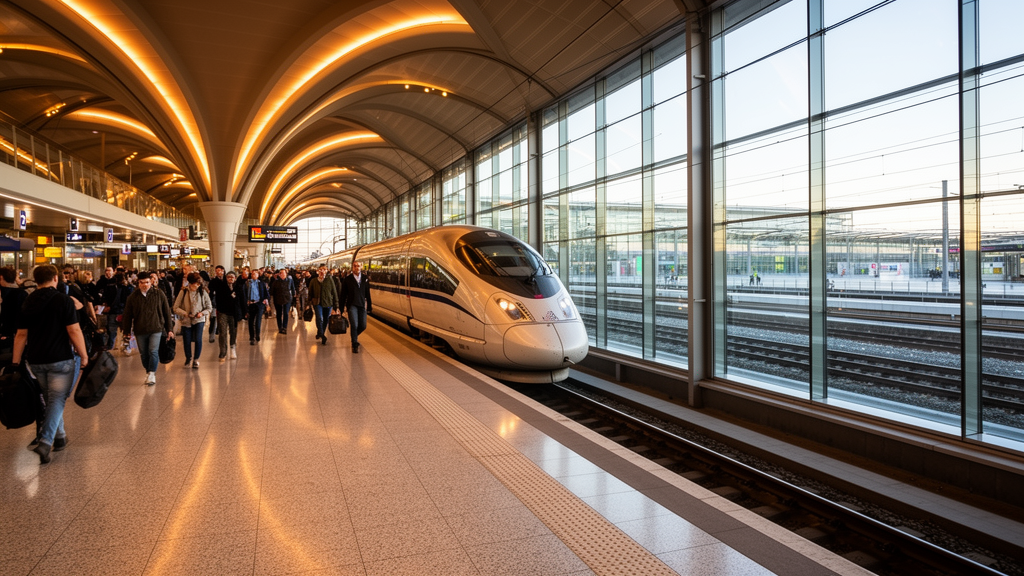
Image Credits: AI Generated

DOI: 10.1186/s13677-026-00986-3

Keywords: passenger flow forecasting, high-speed railway, cloud-edge collaboration, dual-graph model, spatio-temporal learning, rail transit, station operations, resource allocation, service optimization, physical connectivity, adaptive correlation graph, edge computing, smart railway services, temporal fluctuations, spatial dependencies, lightweight edge inference, transit network modeling

News Source: Denise Maddox. (November 19, 2026). Adaptive Cloud-Edge Dual-Graph Model Improves High-Speed Railway Passenger Flow Forecasting. Scienmag.


Tags: adaptive correlation graphcloud-edge collaborationdual-graph modelEdge Computinghigh-speed railwaylightweight edge inferencepassenger flow forecastingphysical connectivityrail transitresource allocationservice optimizationsmart railway servicesspatial dependenciesspatio-temporal learningstation operationstemporal fluctuationstransit network modeling
Share12Tweet7Share2ShareShareShare1

Related Posts

Bioinspired Composite Review Reconciles Conflicting Stiffness Reports Through Architecture

Bioinspired Composite Review Reconciles Conflicting Stiffness Reports Through Architecture

November 19, 2026
Single-Camera Video Predicts Knee Contact Forces but Lacks Clinical Accuracy

Single-Camera Video Predicts Knee Contact Forces but Lacks Clinical Accuracy

November 19, 2026

Hybrid Neural Networks Accurately Predict Blood-Based Nanofluid Flow Over a Wedge

November 19, 2026

Physicists Derive Candidate Gaugings for Continuous Categorical Symmetries in Quantum Theories

November 19, 2026

POPULAR NEWS

  • Somatic Symptom Burden in Oral Health Clinic Patients Shifted Modestly Across Pandemic

    Somatic Symptom Burden in Oral Health Clinic Patients Shifted Modestly Across Pandemic

    29 shares
    Share 12 Tweet 7
  • Multicenter ICU Study Identifies Nurse Knowledge Gaps in Pneumonia Prevention

    29 shares
    Share 12 Tweet 7
  • Study Finds One-Third of Ethiopian Neuropsychiatric Patients Exhibit Harmful Alcohol Use

    29 shares
    Share 12 Tweet 7
  • Low-Dose Epidural Analgesia Modestly Lengthens Labor Stages in Low-Risk Women

    29 shares
    Share 12 Tweet 7

About

We bring you the latest biotechnology news from best research centers and universities around the world. Check our website.

Follow us

Recent News

3D Guides for Kyphoplasty Reduced Operative Time and Fluoroscopy Radiation

3D Rat Cortical Microtissues Reveal Changing Microglia Dynamics During Tissue Maturation

New Surgical Console Linked to Shorter Vitreoretinal Workflow Time in Observational Study

Subscribe to Blog via Email

Enter your email address to subscribe to this blog and receive notifications of new posts by email.

Join 89 other subscribers
  • Contact Us

Bioengineer.org © Copyright 2023 All Rights Reserved.

Welcome Back!

Login to your account below

Forgotten Password?

Retrieve your password

Please enter your username or email address to reset your password.

Log In
No Result
View All Result
  • Homepages
    • Home Page 1
    • Home Page 2
  • News
  • National
  • Business
  • Health
  • Lifestyle
  • Science

Bioengineer.org © Copyright 2023 All Rights Reserved.