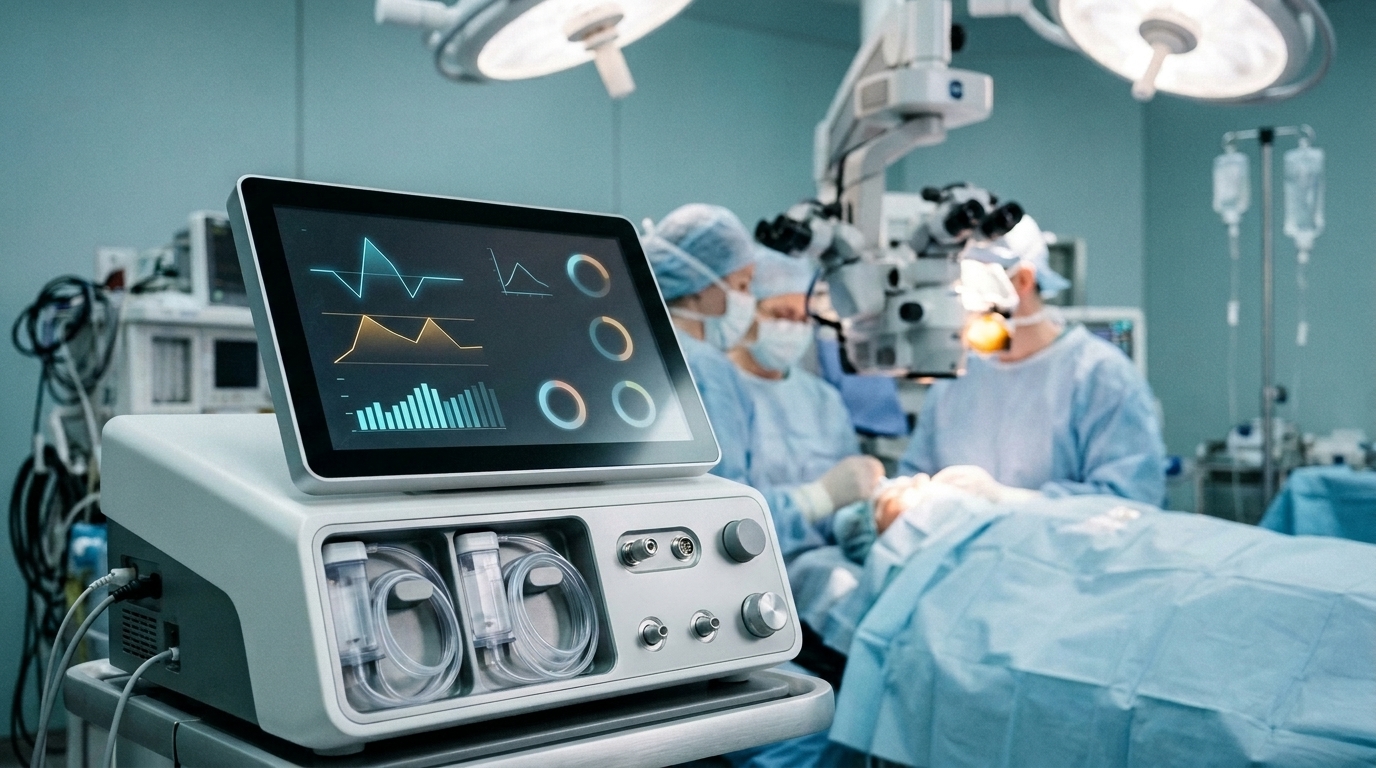
A prospective multicenter time-and-motion study evaluating surgical workflow in vitreoretinal operating rooms found that the UNITY Vitreoretinal Cataract System was associated with a statistically significant reduction in console-associated workflow duration compared with the CONSTELLATION Vision System. Operating room workflow has faced intensifying logistical constraints as an expanding elderly population drives higher surgical volumes for complex posterior segment eye diseases, while projected ophthalmology workforce shortages and restricted access to operating room blocks create scheduling bottlenecks. The trial tracked adult patients undergoing planned 25-gauge pars plana vitrectomy procedures across two surgical facilities in the United States to evaluate whether modern console engineering could measurably shorten turnover and device-mediated intraoperative steps under real-world clinical conditions.
Epidemiological patterns from Medicare Part B data show that pars plana vitrectomy-associated procedures increased from 71,039 to 95,429 services between 2000 and 2021, reflecting conditions such as diabetic retinopathy, retinal detachment, and macular disorders. Compounding this demand, a simulation model projected that the ophthalmology physician supply will decrease by approximately 12 percent while demand increases by 24 percent between 2020 and 2035, yielding a 30 percent supply-demand mismatch. Furthermore, survey metrics reported by the American Society of Retina Specialists highlighted that more than 70 percent of members experienced persistent obstacles in securing adequate operating room time.
To investigate whether technological refinements to surgical equipment could offer an operational countermeasure to these systemic constraints, investigators initiated a sequential pre-post observational trial across two distinct clinical environments: Good Samaritan Hospital and the GSH Seaver Ambulatory Surgery Center in Los Angeles, California, alongside the Lexington Surgery Center in Lexington, Kentucky. The study protocol excluded combined anterior and posterior segment procedures, including phaco-vitrectomy, as well as pregnancy at the time of surgery. Data were first collected during procedures performed with the CONSTELLATION system before transitioning to data collection with the UNITY VCS between May 2024 and July 2025.
The study specifically measured objective operational increments by deploying a dual-camera recording rig operated by an independent videographer inside the operating suite in tandem with surgical microscope video streams. Perioperative actions were recorded and manually converted to calibrated timecodes by trained videography analysts who had no role in direct patient care or surgical execution, with random audit samples formally validated by a vitreoretinal surgical fellow. The primary endpoint was defined as total console-associated vitreoretinal workflow duration, calculated as the contiguous sum of console setup time, intraoperative surgical time spanning from initial trocar insertion through final trocar removal or suture placement, and subsequent console teardown. Secondary metrics evaluated isolated component intervals, including console turnover, console setup, console teardown, vitreous removal, and endolaser photocoagulation time normalized per 500 delivered laser spots.
Equipment configurations across both arms followed standardized vitreoretinal procedural practices with their corresponding platform-specific consumables. Procedures conducted on the legacy CONSTELLATION console utilized the HYPERVIT dual-blade vitrectomy probe operating at cutting speeds up to 20,000 cuts per minute combined with a PUREPOINT single-spot endolaser delivery probe. In the experimental arm, surgeries conducted on the UNITY VCS console employed the HYPERVIT dual-blade vitrectomy probe calibrated up to 30,000 cuts per minute alongside the UNITY TetraSpot multi-spot endolaser probe, which allows selective delivery of one-, two-, or four-spot laser pattern arrays. Spot volumes were recorded directly by internal console summary telemetry, while surgeons retained complete discretionary control over laser energy delivery and pattern selection throughout each case.
Across the two clinical sites, 231 adult patients provided written informed consent, yielding a final analyzed dataset of 179 completed surgical cases, comprising 87 procedures performed on the CONSTELLATION console and 92 procedures completed with the UNITY VCS. Statistical power calculations completed prior to patient accrual determined that 86 cases per experimental group would provide at least 80 percent power to detect a 20 percent relative reduction in mean console-associated workflow duration at a two-sided significance threshold of five percent. Baseline demographic characteristics, patient ages, gender distributions, and surgical procedural subtypes were balanced across cohorts without statistically significant variance, though unadjusted minor numerical variations were recorded for silicone oil tamponade usage and procedural sub-types.
Analysis of the primary endpoint revealed that UNITY VCS was associated with a statistically significant 16 percent reduction in total console-associated surgical workflow duration relative to CONSTELLATION, recording a mean duration of 27.3 minutes versus 32.4 minutes. This corresponded to an absolute mean difference of 5.1 minutes, with a 95 percent confidence interval spanning from 0.5 to 9.7 minutes and an independent t-test significance value of p = 0.029. To confirm the validity of this finding against potential center-specific variance and surgeon-level variability, researchers executed mixed-effects models specifying study site and surgeon as random clustering effects and surgical console as a fixed effect, which fully corroborated the primary comparative outcome.
Secondary endpoints subjected to Holm step-down multiplicity adjustment demonstrated that workflow efficiencies were heavily concentrated in staff-administered perioperative procedures and device-automated delivery systems. Mean console setup duration, measured from the technician’s initial touch to the console’s digital confirmation of surgical readiness, was 33 percent shorter with UNITY VCS compared with CONSTELLATION (p < 0.001). Mean console teardown time, capturing the interval from fluidics management system cassette ejection through waste disposal and completion of cleaning cycles, was 38 percent shorter (p < 0.001). Combined console turnover was 33 percent faster overall (p < 0.001), while endolaser photocoagulation duration normalized per 500 spots showed a 36 percent reduction on the UNITY platform (p < 0.001).
In marked contrast to perioperative staff efficiencies, intraoperative surgical time intervals governed directly by the vitreoretinal surgeon showed no statistically significant differences between consoles. The duration of core vitreous removal did not differ significantly between platforms, yielding an unadjusted p-value of 0.14. Similarly, total intraoperative procedure duration from initial trocar entry to surgical closure showed no significant variance between platforms, recording a p-value of 0.15. These comparative observations demonstrate that surgical efficiency gains were entirely isolated to nursing activities, console engineering interfaces, and device-enabled instrument delivery, rather than any compression, acceleration, or alteration of direct physician operative work.
The preservation of intraoperative procedural duration carries direct implications for healthcare administration and professional reimbursement frameworks, particularly in the United States where physician compensation under the Medicare Physician Fee Schedule is indexed to intraoperative operative complexity and physician time. Because the reduction in console-associated time occurred outside the surgeon’s operative window, the observed differences represent facility workflow streamlining rather than an erosion of physician work effort. When contextualized against published operating room valuation models estimating outpatient vitreoretinal suite expenses at approximately $42 per minute, an absolute mean workflow compression of 5.1 minutes highlights theoretical economic relevance, though researchers emphasized that translating time savings into practical capacity expansion depends entirely on overarching institutional scheduling, staffing patterns, and block-allocation strategies.
The study authors identified several methodological limitations inherent to observational surgical research. The non-randomized, sequential pre-post structure reflects practical equipment deployment in real-world facilities rather than strict randomized allocation, leaving open the theoretical possibility of temporal confounding or selection bias. Furthermore, videography analysts could not be blinded to the hardware platform because console chassis designs were unavoidably visible in video feeds, though standardized objective criteria for timestamping mitigated subjective evaluation errors. While a retrospective run-in period of approximately five to ten cases was estimated per surgeon to absorb immediate platform learning curves, longer-term multicenter evaluations will be required to determine how device-driven workflow gains influence overall facility throughput, clinical staffing satisfaction, and patient-reported outcomes.
Subject of Research: Comparative workflow performance of vitreoretinal surgical consoles
Article Title: Console-Associated Surgical Workflow Performance in Vitreoretinal Surgery: A Comparative Time-and-Motion Study of UNITY VCS and CONSTELLATION Vision Systems
Article References: Busquets, M., Kitchens, J., Roe, R. H., Dhariwal, M., Persaud, E., Rychlik, J., Inoue, Y., Iyengar, R. S., Kim, A., Kang, I., Perez, R., & Rahhal, F. M. (2026). Console-Associated Surgical Workflow Performance in Vitreoretinal Surgery: A Comparative Time-and-Motion Study of UNITY VCS and CONSTELLATION Vision Systems. Ophthalmology and Therapy, 15(11), 3697-3708. https://doi.org/10.1007/s40123-026-01500-3
Image Credits: AI Generated
DOI: 10.1007/s40123-026-01500-3
Keywords: vitreoretinal surgery, ophthalmology, operating room efficiency, surgical workflow, UNITY VCS, CONSTELLATION Vision System, time-and-motion study, vitrectomy, retinal surgery, surgical instrumentation, endolaser photocoagulation, ambulatory surgery centers, console turnover, operating room turnover, health systems management, clinical engineering, surgical tech
News Source: Ophelia Keating. (November 19, 2026). New Surgical Console Linked to Shorter Vitreoretinal Workflow Time in Observational Study. Scienmag.