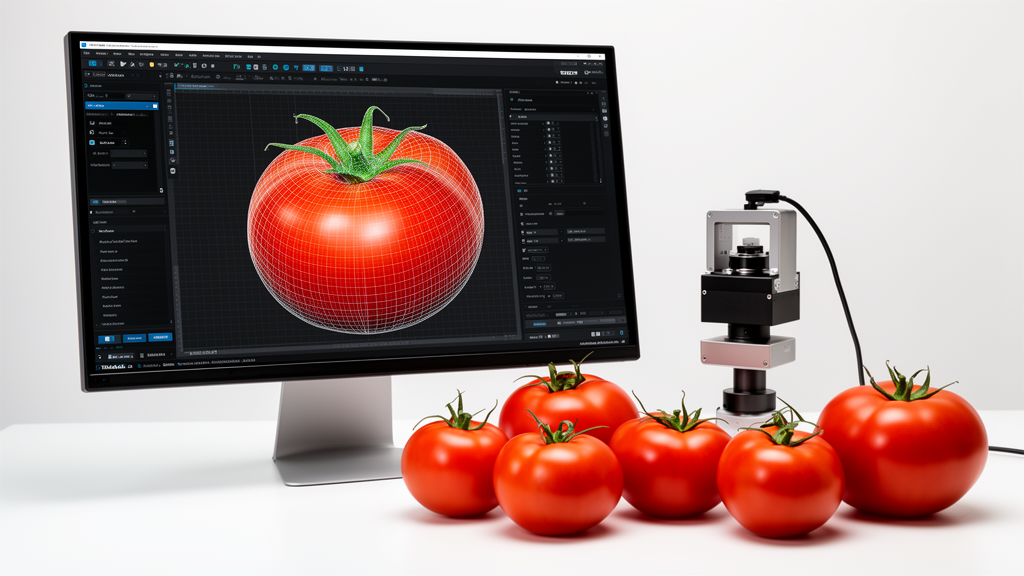
A newly developed software program named Tomato Image Metrics (TIM4desk) successfully estimates the volume, sphericity, and surface area of tomato fruits from digital images captured with conventional RGB cameras. The computational tool extracts these physical dimensions from two-dimensional digital images while operating independently of the specific image acquisition system.
The research, published in Discover Applied Sciences, addresses the growing necessity for non-destructive tools to measure physical parameters of fruits across agricultural production chains.
To calculate fruit measurements without specialized photographic setups, TIM4desk combines digital image processing techniques with geometric modelling. This computational routine was formulated to quantify physical attributes directly from two-dimensional planar images, allowing standard RGB photographic data to serve as the basis for three-dimensional dimensional estimates.
The performance of TIM4desk was evaluated across three distinct categories of test samples: idealized samples, commercially acquired tomatoes, and tomatoes collected following mechanical harvesting. The physical parameters calculated by the software were systematically compared against standard reference values obtained using conventional measurement methods.
To assess the accuracy and consistency of the software, the research team analyzed the agreement between the conventional reference values and the estimates generated by TIM4desk using linear regression and Bland–Altman analyses. Across all evaluated physical parameters, the software demonstrated excellent performance for the idealized samples, confirming the effectiveness of the geometric modelling framework under controlled laboratory conditions.
Among the individual metrics assessed by the software, volume estimation achieved the highest level of agreement with conventional reference measurements. In contrast, surface area estimation was more sensitive to surface deformations and irregularities in fruit contours, indicating that irregular outlines present greater measurement challenges.
The study also revealed that the origin of the fruit affected measurement consistency, as physical parameter estimates for commercially sourced tomatoes showed greater agreement with reference methods than those for mechanically harvested fruits.
Subject of Research: Software estimation of tomato fruit physical parameters using digital images
Article Title: Development and validation of software for estimating physical parameters of tomato fruits using digital images
Article References: Costa, A. G., de Carvalho, J. C. L., da Silveira Abreu Jorge, R., de Almeida Machado, T., Carmo, G. A., & de Mendonça, H. V. (2026). Development and validation of software for estimating physical parameters of tomato fruits using digital images. Discover Applied Sciences. https://doi.org/10.1007/s42452-026-09831-3
Image Credits: AI Generated
DOI: 10.1007/s42452-026-09831-3
Keywords: TIM4desk, tomato fruits, digital image processing, RGB cameras, geometric modelling, volume estimation, surface area estimation, sphericity, non-destructive testing, agricultural quality control, Bland–Altman analysis, linear regression, mechanical harvesting, commercial tomatoes, two-dimensional images, physical parameter estimation, Discover Applied Sciences
News Source: Denise Maddox. (November 19, 2026). TIM4desk Software Accurately Estimates Tomato Fruit Dimensions From Digital Images. Scienmag.