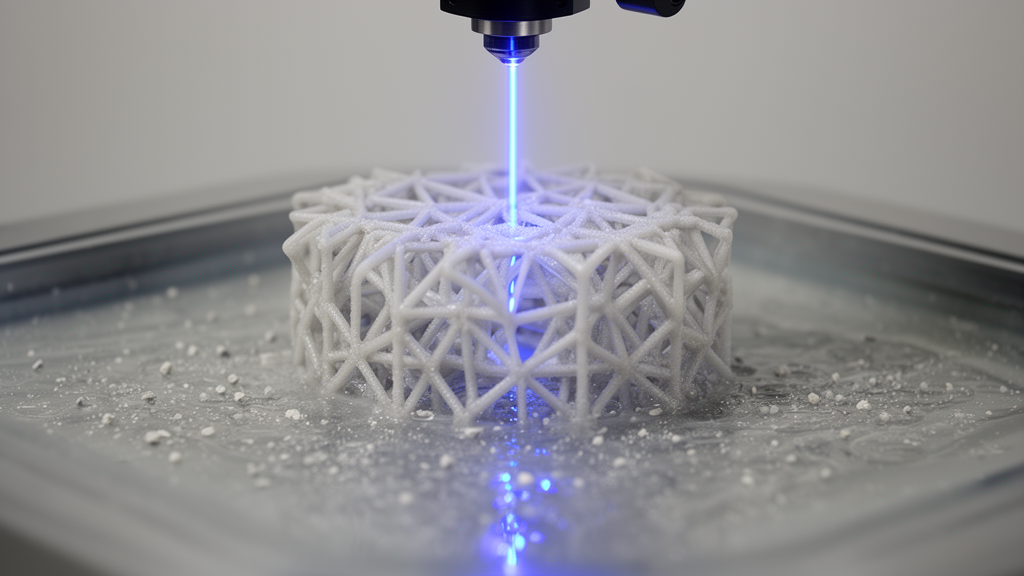
Additive manufacturing using stereolithography allows the fabrication of components exhibiting high geometric complexity and fine dimensional precision. Nevertheless, commercial ultraviolet-curable photopolymer resin formulations frequently suffer from technical constraints, including dimensional instability, post-curing shrinkage, structural warpage, and limited mechanical performance. These processing limitations routinely restrict the adoption of printed photopolymers in engineering applications that demand high structural reliability.
To address these processing challenges, researchers evaluated the incorporation of chamotte, a refractory ceramic waste generated during red ceramic production, into ultraviolet-curable photopolymer resin systems processed by stereolithography. The study investigated the feasibility of utilizing this industrial byproduct as both a sustainable dimensional stabilizer and a functional ceramic particulate reinforcement within the polymer network.
The experimental procedure tested multiple chamotte concentrations, specifically evaluating formulations containing 0 wt%, 0.5 wt%, 1 wt%, 1.5 wt%, and 2 wt% of the ceramic filler. This systematic range enabled the authors to isolate the direct influence of particle loading on the physical, mechanical, and dimensional behavior of the resulting additive manufacturing structures.
Prior to composite synthesis, the chamotte residue underwent material characterization via X-ray diffraction to identify its constituent crystalline phases alongside laser particle size analysis to quantify particle dimensions. Following stereolithography processing, the fabricated composite specimens were subjected to an extensive testing protocol to evaluate their baseline structural integrity and dimensional stability.
The characterization suite measured tensile, compressive, and flexural mechanical responses, complemented by Shore hardness testing and physical determinations of composite density and surface wettability. Furthermore, researchers evaluated geometric performance by measuring directional shrinkage, structural warpage, and dimensional deviation, while scanning electron microscopy captured the composite microstructure and particle distribution.
The experimental results demonstrated that incorporating chamotte significantly modified both the mechanical response and the dimensional stability of the printed photopolymer resin. The formulation reinforced with 1.0 wt% chamotte yielded the best overall composite performance across the evaluated metrics.
Compared to the unreinforced neat photopolymer resin, the 1.0 wt% composite exhibited reduced dimensional deviation, lower warpage, and decreased anisotropic shrinkage, leading to enhanced dimensional accuracy. Improvements were similarly documented in tensile and flexural performance, which traditionally represent the weakest mechanical responses of the pristine photopolymer matrix.
Overall, the findings indicate that low chamotte concentrations can act as sustainable dimensional stabilizers and ceramic reinforcements for stereolithography photopolymer systems. By mitigating dimensional deviation, warpage, and anisotropic shrinkage, this ceramic residue directly addresses the persistent limitations of commercial photopolymer resins. These geometric improvements contribute to developing more stable materials for additive manufacturing applications where structural reliability remains critical.
In addition, the documented improvements in tensile and flexural behavior directly address the weakest mechanical responses of the unreinforced matrix. Incorporating this refractory ceramic waste derived from red ceramic production provides a practical strategy to produce components with enhanced accuracy, higher geometric precision, and stability.
Subject of Research: Photopolymer resin reinforcement with chamotte ceramic waste for stereolithography 3D printing
Article Title: Construction and demolition waste-reinforced photopolymer resin for stereolithography (SLA) 3D printing
Article References: Gonçalves, V. P. D., de Lima, E. B., Velasco, D. C. R., Simonassi, N. T., Vieira, C. M. F., & Lopes, F. P. D. (2026). Construction and demolition waste-reinforced photopolymer resin for stereolithography (SLA) 3D printing. Journal of Materials Science: Materials in Engineering. https://doi.org/10.1186/s40712-026-00636-1
Image Credits: AI Generated
DOI: 10.1186/s40712-026-00636-1
Keywords: stereolithography, additive manufacturing, 3D printing, photopolymer resin, chamotte, ceramic waste, dimensional stability, warpage reduction, anisotropic shrinkage, tensile properties, flexural behavior, materials science, mechanical reinforcement, refractory ceramic, composite materials, polymer matrix
News Source: Denise Maddox. (November 19, 2026). Ceramic Waste Additive Enhances Stereolithography 3D Printing Resins. Scienmag.