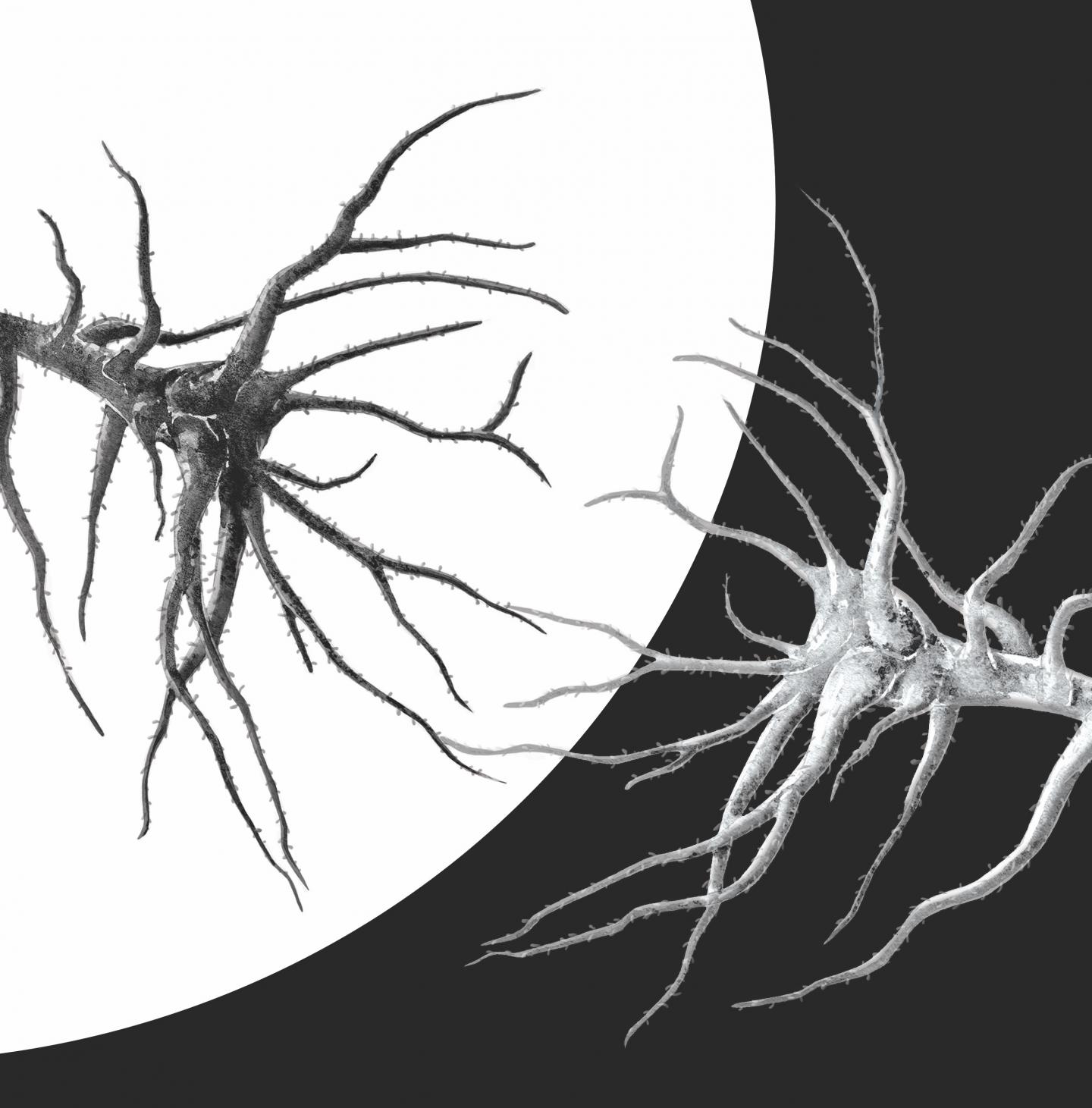
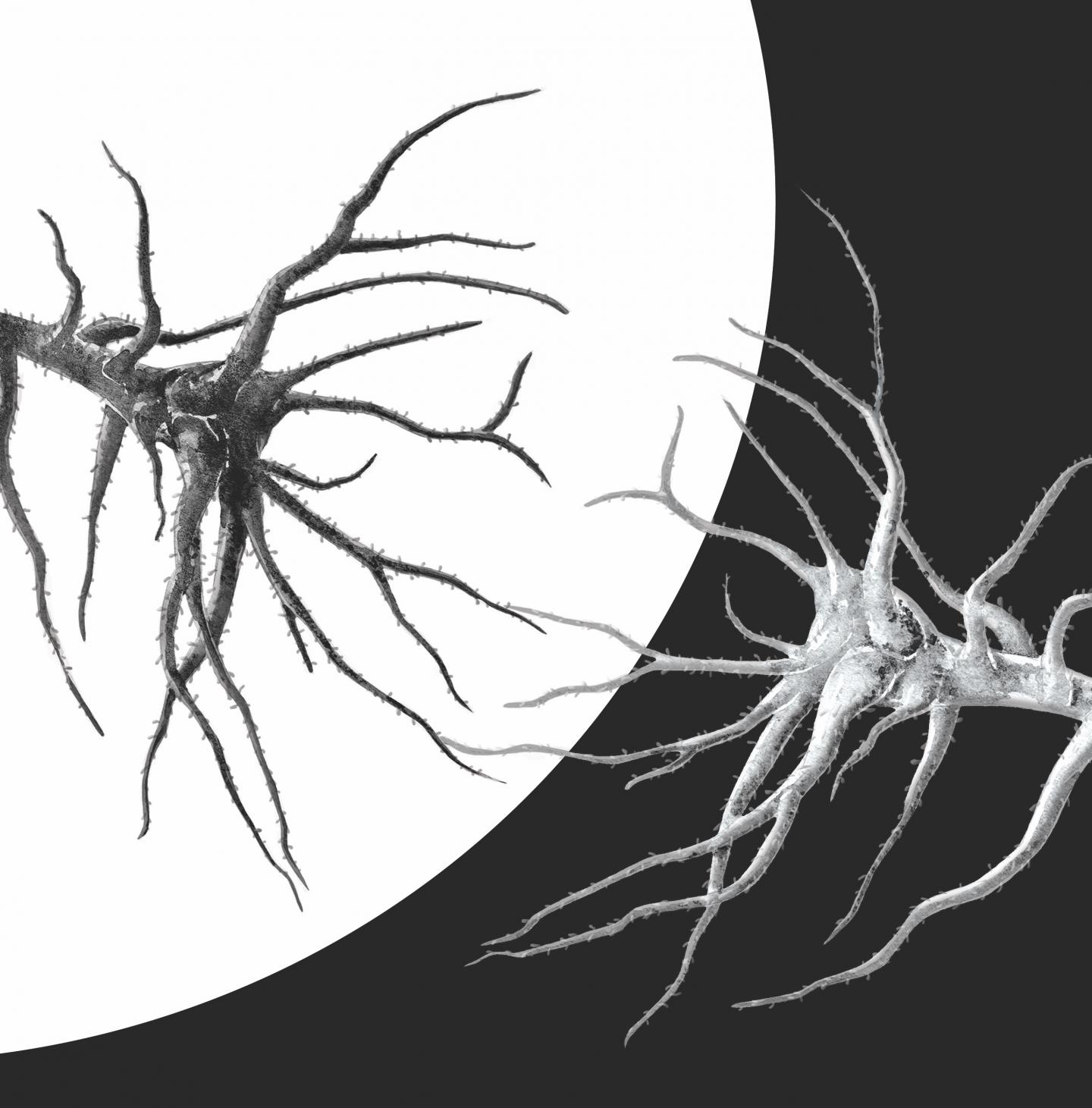
While some things may be 'as simple as black and white,' this has not been the case for the circuits in the brain that make it possible for you to distinguish black from white. The patterns of light and dark that fall on the retina provide a wealth of information about the world around us, yet scientists still don't understand how this information is encoded by neural circuits in the visual cortex–a part of the brain that plays a critical role in building the neural representations that are responsible for sight. But things just got a lot clearer with the discovery that the majority of neurons in visual cortex respond selectivity to light vs dark, and they combine this information with selectivity for other stimulus features to achieve a detailed representation of the visual scene.
Scientists have long known that neurons in the retina that provide information to higher centers in the brain respond selectively to light vs dark stimuli. 'ON' cells that respond selectively to light stimuli and 'OFF' cells that respond selectively to dark stimuli were known to form separate parallel channels relaying information to circuits in visual cortex. But here is where the picture got murky. Based on recording the responses of single cortical neurons with electrodes, it appeared that as soon as the ON and OFF channels entered the cortex, they converged onto single neurons, a convergence necessary for the emergence of a novel cortical response property: selectivity for the orientation of edges. Further stages in cortical processing were thought to lead to more and more mixing of the ON and OFF signals, so that individual neurons responded similarly to both dark and light stimuli. These results raised an obvious question: If the responses of single cortical neurons to dark and light are ambiguous, how is it that the brain allows us to perceive these differences?
Drs. Gordon Smith and David Whitney in David Fitzpatrick's lab at Max Planck Florida Institute for Neuroscience decided it was time to revisit this question. Using new imaging technologies that make it possible for the first time to visualize the activity of hundreds of neurons simultaneously in the living brain, they quantified the responses of neurons in ferret visual cortex to light and dark stimulation.
The first surprise for the team happened when they looked at cortical responses to the presentation of uniform dark or light stimuli. Although previous studies had not observed responses to uniform luminance changes, Smith et al. were not only able to visualize neurons that responded to these stimuli, they discovered patches of neurons that responded preferentially to dark vs light stimulation. Even more surprising, they found that the cortical neurons that responded selectively to the orientation of edges or to the direction of stimulus motion also responded preferentially to dark vs light stimuli. In short, the Max Planck Florida scientists discovered that information about dark and light is preserved in the responses of most neurons in visual cortex, and it is an integral part of the neural code that cortical circuits use to represent our visual world.
The next challenge for Max Planck Florida scientists is to understand the precise patterns of synaptic connections that enable cortical circuits to construct this modular representation of black and white.
###
About Max Planck Florida Institute for Neuroscience
The Max Planck Florida Institute for Neuroscience (Jupiter, Florida, USA) specializes in the development and application of novel technologies for probing the structure, function and development of neural circuits. It is the first research institute of the Max Planck Society in the United States.