Non-intrusive heuristic optimization algorithms can accurately determine the operational efficiency of three-phase induction motors subjected to unbalanced supply voltages without requiring machine shutdown or intrusive testing procedures. In an experimental investigation published in the Journal of King Saud University – Engineering Sciences, researchers Murat Göztaş and Mehmet Çunkaş demonstrated that combining positive- and negative-sequence equivalent circuit modeling with metaheuristic search techniques enables precise on-site performance tracking. Evaluating the framework on a physical 1.1-kilowatt squirrel-cage induction motor across voltage unbalance factors ranging from zero to five percent, the authors established that Particle Swarm Optimization and Harris Hawks Optimization reproduced empirical efficiency benchmarks obtained through standard IEEE 112-A dynamometer testing with full-load estimation errors remaining below one percent. This capability provides a non-disruptive alternative to traditional testing regimes, allowing industrial plant engineers to monitor electromechanical degradation continuously during normal operation.
Voltage unbalance represents a widespread power quality disturbance in commercial and industrial electrical distribution networks, arising from unbalanced single-phase load distributions, asymmetries in transformer winding impedances, capacitor bank failures, large rectifier installations, or untransposed transmission lines. When supply line voltages deviate in magnitude or phase displacement, the symmetrical voltage symmetry collapses, generating substantial negative-sequence voltage components. The resulting electromechanical consequences include severe rotor overheating, line current asymmetry, parasitic torque pulsations, elevated mechanical vibrations, and accelerated degradation of winding insulation systems. IEEE and National Electrical Manufacturers Association standards classify a voltage unbalance factor exceeding five percent as critically detrimental to motor health. However, assessing these adverse effects in operating industrial facilities remains difficult because standard efficiency testing protocols typically require physical dismounting, no-load idling tests, or locked-rotor evaluations that halt plant operations.
Conventional field-based efficiency assessment techniques frequently fail to yield dependable results when applied to operating induction machinery subjected to unbalanced terminal supplies. Simplified equivalent circuit methods, segregated loss models, and basic slip or line current techniques exhibit heightened sensitivity to instrumentation errors or rely on idealized operating assumptions that neglect electrical supply asymmetries. Although air-gap torque methods can incorporate unbalanced waveforms, their accuracy deteriorates because they treat iron core losses as well as mechanical friction and windage losses as invariant constants. Commercial diagnostic tools, such as MotorMaster Plus, ORNEL96, and MAS-100, have achieved industrial adoption but generally lack comprehensive mechanisms to compensate for negative-sequence current interactions. While previous research explored evolutionary optimization, including Genetic Algorithms, Bacterial Foraging, and Cuckoo Search, published studies predominantly examined balanced terminal conditions or restricted testing to numerical simulations without experimentally validating multiple competing optimization algorithms under identical motor hardware, identical loading schedules, and systematically controlled voltage unbalance factors.
To overcome these diagnostic constraints, the research framework relies on symmetrical component analysis to mathematically decouple three-phase unbalanced terminal voltages and line currents into decoupled positive-, negative-, and zero-sequence vectors. Utilizing Fortescue transformations, line-to-line voltage measurements and line currents acquired at the motor terminals are converted into symmetrical sequence quantities using complex transformation matrices. Phase voltage magnitudes and relative angular displacements are derived geometrically from terminal line voltages, with phase A chosen as the baseline angular reference so that modified phase and line angles are systematically aligned. Positive-sequence voltage and negative-sequence voltage vectors are then extracted alongside their respective positive-sequence and negative-sequence stator currents.
The core electromechanical model integrates the IEEE Standard 112 Method F1 and Form F2 formulation, executing simultaneous calculations across dual positive-sequence and negative-sequence equivalent circuits. Rather than attempting to estimate all machine parameters simultaneously, the optimization problem selectively isolates four unknown circuit parameters: stator leakage reactance, rotor resistance, magnetizing reactance, and core-loss resistance. These four specific variables govern the electromechanical dynamics of the motor under voltage asymmetry and vary significantly with operational load, making non-intrusive direct field measurements virtually impossible during continuous processing. Conversely, stator winding resistance is acquired through baseline cold direct-current measurements and adjusted for steady-state operating temperature using standard thermal formulas, while mechanical friction, windage, and stray-load losses are incorporated via standard empirical relationships. Restricting the heuristic optimization to four decision variables effectively curtails the dimensionality of the multidimensional search space, suppressing numerical instability, avoiding over-parameterization, and accelerating iterative convergence during parameter extraction.
Parameter identification is governed by a multi-component objective function structured to minimize normalized discrepancies between measured physical operating quantities and values predicted by the equivalent circuit equations. The objective function aggregates absolute fractional errors in the real and imaginary components of the positive-sequence stator current, the total active input power, the terminal phase impedance angle, and the rated shaft output power. To solve this minimization problem, the researchers implemented and compared three distinct nature-inspired algorithms: Particle Swarm Optimization, Harris Hawks Optimization, and the Fox Optimization Algorithm. Particle Swarm Optimization navigates the search space through velocity vectors updated by personal memory and global swarm positions. Harris Hawks Optimization balances exploratory perching with dynamic exploitation modeled after cooperative four-phase avian hunting strikes. The Fox Optimization Algorithm utilizes acoustic sound propagation delays and probabilistic jump trajectories. All three algorithms were standardized with population sizes of two hundred agents and executed across two hundred iterations over twenty independent optimization trials.
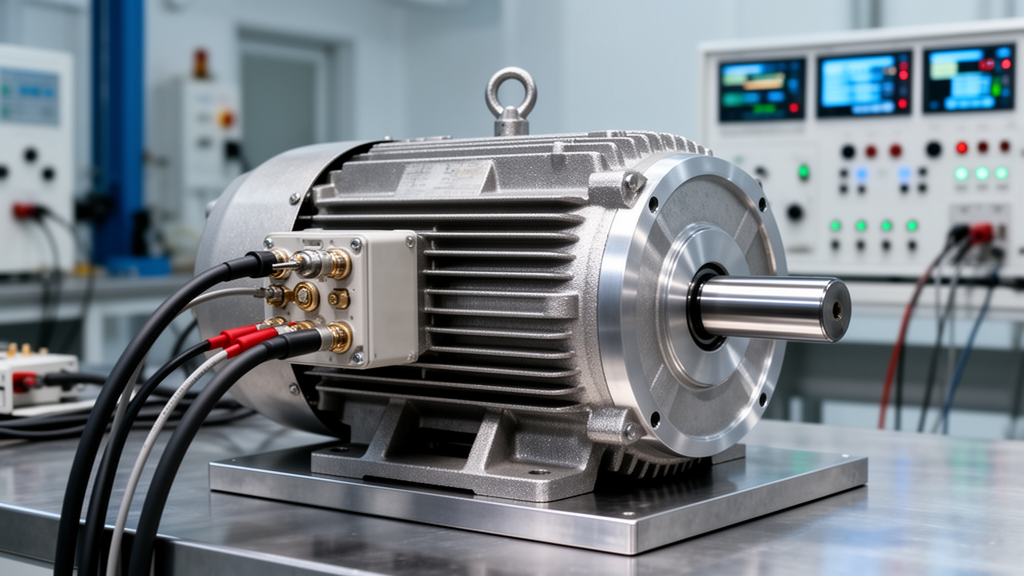
Experimental validation was conducted on a dedicated laboratory test bench centered around a three-phase, 1.1-kilowatt GAMAK induction motor mechanically coupled to an adjustable magnetic powder brake capable of generating up to twenty newton-meters of braking torque. The magnetic powder brake acts as a passive mechanical load that remains completely electrically isolated from the motor supply grid, ensuring stable mechanical loading while eliminating harmonic feedback or electrical distortions. Three independently regulated single-phase voltage supplies supplied controlled phase-voltage asymmetries to generate precise voltage unbalance factors of one, two, three, four, and five percent, alongside a balanced zero-percent reference state. For each unbalance level, the motor underwent comprehensive testing across four distinct load factors: twenty-five, fifty, seventy-five, and one hundred percent of rated continuous capacity. High-precision digital power analyzers recorded terminal phase voltages, line currents, active input power, rotational speed, and torque, streaming experimental data into MATLAB for symmetrical decomposition and algorithmic parameter estimation.
Empirical findings verified that heuristic optimization provides exceptional accuracy when tracking induction motor efficiency under voltage asymmetry, provided the motor operates at moderate or high mechanical loads. When benchmarked against direct IEEE 112-A dynamometer measurements, Particle Swarm Optimization and Harris Hawks Optimization reproduced motor efficiencies with full-load deviations remaining below one percent across all tested voltage unbalance factors from zero to five percent. At load factors of fifty percent and seventy-five percent, both algorithms maintained robust agreement with empirical reference curves. Computational analysis revealed that Particle Swarm Optimization delivered the most balanced overall performance, exhibiting rapid, consistent convergence curves and superior statistical stability across repeated trials. Harris Hawks Optimization achieved comparable terminal estimation accuracy but demanded the longest computational execution times due to its multi-stage hunting dynamics. In contrast, the Fox Optimization Algorithm exhibited substantial run-to-run variability and higher fitness plateaus, producing noticeably larger estimation errors, particularly under light-load operating conditions.
A central experimental observation was that voltage unbalance exerts its most damaging efficiency penalties when an induction motor operates under light mechanical loading. At twenty-five percent load, increasing the voltage unbalance factor from zero to five percent precipitated an efficiency decline of nearly seven percentage points under IEEE 112-A measurement. Conversely, under full rated loading, the efficiency reduction between balanced and five percent unbalanced operation contracted to less than one percentage point, as forward positive-sequence electromechanical torque overwhelmingly dominated machine behavior. This disparity underscores a significant operational vulnerability in industrial manufacturing facilities, where motors frequently run below rated capacity. Because standard plant monitoring often relies on static voltage thresholds without tracking real-time partial-load efficiencies, severe energy losses can accumulate undetected within nominally acceptable regulatory limits. Continuous non-intrusive monitoring enables plant operators to detect localized efficiency drops early, scheduling targeted maintenance or load rebalancing before prolonged negative-sequence heating damages stator insulation and causes premature motor breakdown.
Despite its diagnostic efficacy, the proposed estimation framework exhibits distinct physical boundaries that outline directions for subsequent investigation. Under twenty-five percent loading, relative estimation errors increased across all algorithms due to reduced operating power factors, elevated relative measurement noise, and the predominance of magnetizing currents relative to resistive active components. Furthermore, the underlying IEEE 112-F1 model assumes invariant iron core-loss resistance, introducing subtle modeling uncertainties when active power draw is minimal. The experimental platform also focused on purely sinusoidal voltage unbalance, whereas industrial grids frequently exhibit coexisting harmonic distortion that alters sequence impedances. Nevertheless, because the framework relies on standard IEEE Form F2 equivalent circuits that apply universally to squirrel-cage induction machinery, the authors noted that the optimization methodology scales naturally to medium- and large-capacity motors as well as modern high-efficiency classes such as IE3 and IE4, provided search boundaries are calibrated dynamically from manufacturer nameplate ratings.
Subject of Research: In-situ efficiency estimation of induction motors under unbalanced voltages
Article Title: In-situ efficiency estimation of induction motors under unbalanced voltages using heuristic optimization algorithms
Article References: GÖZTAŞ, M., & ÇUNKAŞ, M. (2026). In-situ efficiency estimation of induction motors under unbalanced voltages using heuristic optimization algorithms. Journal of King Saud University – Engineering Sciences, 38(4), Article 30. https://doi.org/10.1007/s44444-026-00106-1
Image Credits: AI Generated
DOI: 10.1007/s44444-026-00106-1
Keywords: induction motors, voltage unbalance factor, in-situ efficiency estimation, particle swarm optimization, harris hawks optimization, fox optimization algorithm, symmetrical components, negative sequence current, ieee 112-f1, ieee 112-a, equivalent circuit parameters, stator leakage reactance, magnetizing reactance, core loss resistance, rotor resistance, stray-load loss, magnetic powder brake, partial load efficiency
News Source: Denise Maddox. (November 19, 2026). Heuristic Algorithms Accurately Track Induction Motor Efficiency Under Unbalanced Voltages. Scienmag.